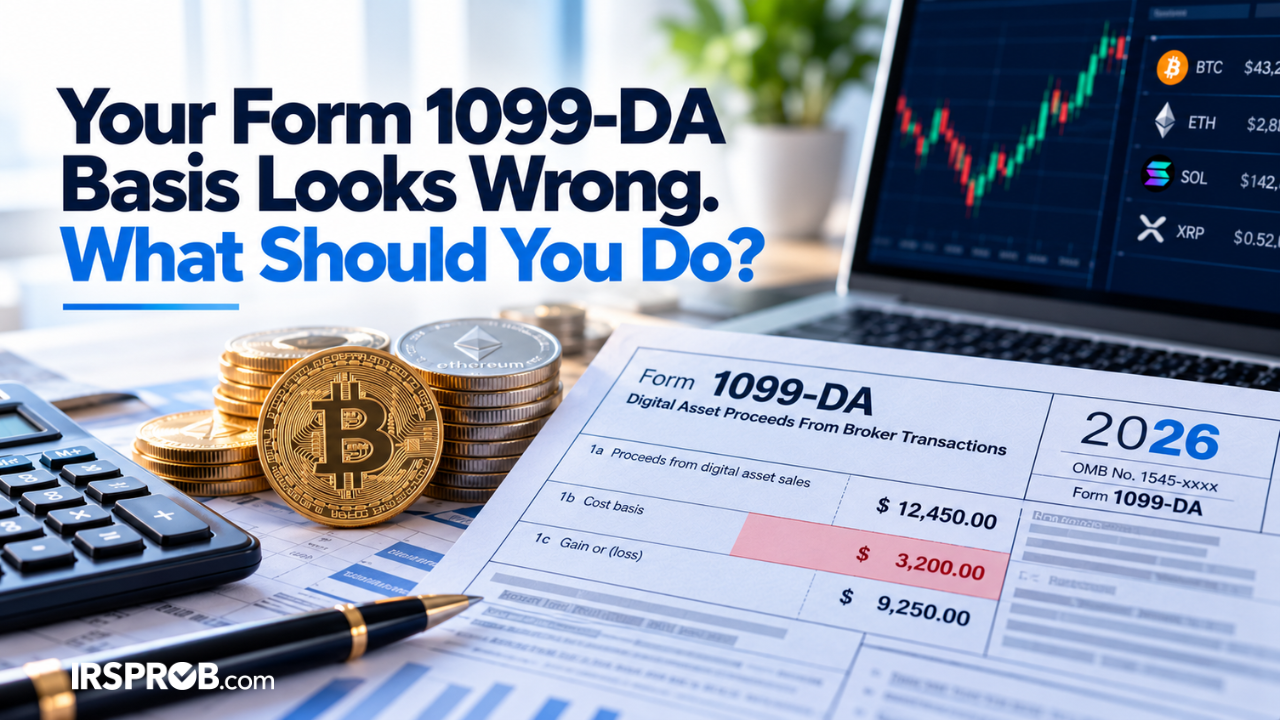
Your Form 1099-DA shows $28,000 in crypto sales and a Form 1099-DA basis of only $6,000.
That does not look right.
You bought the crypto years ago, moved it between exchanges and a private wallet, then sold it through a different broker. The broker knows how much you received from the sale, but it may not know what you originally paid.
If you use the wrong basis, your taxable gain could look much larger than it really was. But simply replacing the broker’s number without proper records may create questions when the IRS compares your return with the form.
Form 1099-DA is important, but it may not tell the whole story. Before filing, check whether the basis was reported to the IRS, compare it with your transaction history, and make sure your records support the amount you use.
Here is what to review before reporting the sale.
- What Form 1099-DA Actually Reports
- Why 2026 Digital-Asset Reporting Is Different
- What Are Covered and Noncovered Digital Assets?
- Why Your Form 1099-DA Basis May Be Missing or Incorrect
- The Wallet-by-Wallet Basis Rule Matters
- A Simple Crypto Gain Example
- Is Moving Crypto Between Your Own Wallets Taxable?
- What Records Can Help Prove Your Crypto Cost Basis?
- What Should You Do If Form 1099-DA Is Wrong?
- How to Correct Form 1099-DA Basis on Form 8949
- Could an Incorrect Form Trigger a CP2000 Notice?
- What to Do Before You File
- What If You Already Filed Your Return?
- Frequently Asked Questions
What Form 1099-DA Actually Reports
Form 1099-DA is used by brokers to report certain digital-asset dispositions to taxpayers and the IRS.
A disposition may include selling a digital asset for cash, exchanging it for another digital asset, or using it in another transaction treated as a disposition for federal tax purposes.
The form may report:
- The name or code of the digital asset
- The number of units disposed of
- The disposition date
- Gross proceeds
- Cost or other basis, when required or voluntarily reported
- Whether the gain or loss is short-term or long-term
- Federal income tax withheld
- Whether the asset is noncovered
The form reports transaction information. It does not always determine the final taxable gain or loss.
Gross Proceeds Are Not the Same as Profit
Gross proceeds generally represent the amount received from a disposition. They are not automatically your taxable profit.
Your gain or loss generally depends on the amount realized compared with your adjusted basis. Other rules and adjustments may also apply.
If you sold crypto for $28,000 after investing $18,000, the full $28,000 generally would not be your profit. The basic difference would be $10,000 before any other applicable adjustments.
That distinction matters.
The Form May or May Not Report Basis
For digital-asset sales after 2025, brokers generally must report gross proceeds. Basis reporting is also required for digital assets treated as covered securities.
A broker may voluntarily report basis for a noncovered asset, but it may not be required to do so.
It may mean the broker did not have a reporting duty or lacked the necessary acquisition history.
The IRS provides more information on its page about understanding Form 1099-DA .
Why 2026 Digital-Asset Reporting Is Different
Form 1099-DA reporting began with broker-reported gross proceeds for certain transactions occurring in 2025.
For sales after 2025, brokers generally must report gross proceeds for applicable dispositions and basis information for covered digital assets.
This may make filing easier when the broker has the complete history. It may also cause confusion when an asset came from another exchange or private wallet.
Transferred-in digital assets are generally treated as noncovered for Form 1099-DA purposes. The receiving broker may know when the assets arrived and when they were sold, but it may not have the original acquisition history needed to report your tax basis.
The new form gives the IRS more information. It does not remove your responsibility to maintain complete records.
What Are Covered and Noncovered Digital Assets?
A covered digital asset is generally one acquired after 2025 in an account for which the broker provided custodial services and held there until the broker completed the sale or other reportable disposition.
A digital asset is generally noncovered if it was acquired before 2026, transferred into the broker, or was not acquired while that broker provided custodial services.
These labels describe the broker’s basis-reporting responsibility.
“Covered” does not mean the transaction is tax-free. “Noncovered” does not mean the asset has no basis.
Even when basis is not reported to the IRS, you still must determine and report the correct gain, loss, or other tax treatment.
Review the current Form 1099-DA instructions for the tax year involved.
Why Your Form 1099-DA Basis May Be Missing or Incorrect
A missing basis does not necessarily mean anyone made a mistake.
The broker may not be required to report it. You may have acquired the asset before 2026, purchased it through another platform, or transferred it from a private wallet.
A reported amount may need additional review when:
- The asset moved between exchanges
- The asset came from a private wallet
- You bought units in several batches
- The acquisition date is incomplete
- Transaction costs were not handled correctly
- You received the asset as a gift
- You inherited the asset
- You earned it from work, mining, staking, or another activity
- The broker lacks earlier transaction information
Gift and inherited-property rules can be especially important. Basis may depend on information from the donor, the value at the date of death, and other facts. The wallet value on the day you received the asset is not automatically its tax basis.
Do not assume the form is wrong merely because the number surprises you. Compare it with reliable records first.
The Wallet-by-Wallet Basis Rule Matters
Beginning in 2025, digital-asset basis identification generally works separately within each wallet or account.
That means you should not automatically combine all units of the same cryptocurrency held across every exchange and private wallet into one universal basis pool.
If you held Bitcoin in three places, the units and basis assigned to one wallet generally cannot simply be replaced with higher-basis units held somewhere else.
Depending on the records and instructions given to the broker, the applicable units may be determined through specific identification or a default method such as first-in, first-out within that wallet or account.
This can materially change the gain or loss.
Revenue Procedure 2024-28 provided transitional relief for allocating unused basis to digital assets held as of January 1, 2025. Taxpayers who relied on that relief should keep records showing how the allocation was made.
The IRSProb article about digital-asset basis changes provides additional background.
A Simple Crypto Gain Example
Assume Form 1099-DA reports:
- Gross proceeds: $28,000
- Reported basis: $6,000
Those numbers could produce a $22,000 gain before other adjustments.
Your records show that the correct adjusted basis for the units sold from that account is $18,000. If supported, the basic gain would instead be $10,000.
That is a $12,000 difference.
The answer is not to choose whichever number produces less tax. The answer is to identify the correct units, apply the proper basis rules, and preserve the supporting records.
Is Moving Crypto Between Your Own Wallets Taxable?
Moving a digital asset from one wallet or account you own to another wallet or account you own generally is not a taxable disposition by itself.
No new owner has received the asset, and you generally have not exchanged it for cash, property, or services.
Still, examine the complete transaction. Digital assets used or withheld to pay network or transaction fees may create a separate disposition. Bridges, token conversions, and wrapped assets can also involve more than a simple transfer.
The tax treatment of fees may depend on whether the fee relates to acquiring, selling, exchanging, or transferring the asset. There is no single rule that safely covers every fee.
Do not let tax software treat transfers between accounts you own as income, purchases, sales, or duplicate transactions.
What Records Can Help Prove Your Crypto Cost Basis?
Useful records may include:
- Exchange transaction histories
- Purchase confirmations
- Wallet addresses and transaction IDs
- Bank or credit-card statements
- Transaction-fee records
- Prior tax returns
- Earlier information returns
- Records connecting transfers between your accounts
- Gift documents and donor information
- Estate or inheritance records
- Broker correspondence
- Digital-asset tax reports
Software reports are useful only when the source information is complete. If a wallet or exchange account was omitted, the result may be wrong.
Keep the underlying records. You should be able to trace the final calculation back to actual purchases, transfers, and dispositions.
What Should You Do If Form 1099-DA Is Wrong?
First, identify the exact issue.
Is the asset wrong? Are the units incorrect? Is the sale date wrong? Does the basis omit part of the acquisition history? Was a transfer incorrectly reported as a disposition?
Then contact the broker. Explain the specific problem and provide records supporting your position. Ask whether it will issue a corrected Form 1099-DA.
Keep copies of:
- The original form
- Your correction request
- Documents provided to the broker
- The broker’s response
- Any corrected form
- Your final basis calculation
Do not delay filing indefinitely while waiting for a broker that has stopped responding. You still must file an accurate and timely return based on the information reasonably available.
How to Correct Form 1099-DA Basis on Form 8949
Form 8949 is generally used to report capital-asset dispositions and reconcile broker information with the amounts reported on the return.
If Form 1099-DA says basis was reported to the IRS and that amount is wrong, current Form 8949 instructions generally require you to:
- Enter the broker-reported basis in column (e).
- Enter adjustment code B in column (f).
- Enter the supported correction in column (g).
It helps explain why the amount on your return differs from the information return.
If basis was not reported to the IRS, the method is different. You generally enter the correct supported basis in column (e), subject to the instructions applying to that return.
Always review the Form 8949 instructions for the tax year being filed. Reporting may also depend on the holding period, transaction costs, and whether other adjustments apply.
Could an Incorrect Form Trigger a CP2000 Notice?
The IRS may compare Form 1099-DA with the digital-asset transactions reported on your return.
If proceeds are missing or the amounts do not match, the IRS may ask questions or propose an adjustment. One possible result is a CP2000 notice.
A CP2000 is a proposed adjustment, not a final tax bill. The IRS may have identified a real mismatch without having your complete basis history.
If that happens, respond by the printed deadline. Provide a clear reconciliation and organized supporting documents.
Our guide to CP2000 information-return mismatches explains that process.
What to Do Before You File
Before completing your return:
- Gather every Form 1099-DA.
- Download records from every exchange and broker.
- Identify the wallets used during the year.
- Match transfers between accounts you owned.
- Separate transfers from taxable dispositions.
- Check whether basis was reported to the IRS.
- Apply the wallet-by-wallet identification rules.
- Verify acquisition dates and holding periods.
- Review fees and other adjustments.
- Save the records supporting the calculation.
Do not wait for an IRS notice before rebuilding years of transaction history.
Does your Form 1099-DA not match your crypto records?
Start by confirming whether basis was reported to the IRS, then rebuild the transaction history before changing the broker’s number.
Review Digital-Asset Basis ChangesWhat If You Already Filed Your Return?
A corrected Form 1099-DA does not automatically mean you must amend.
Compare the corrected form with the return you filed. If the return already reported the proper proceeds, basis, gain, and loss, an amendment may not change the tax result.
If the filed return is wrong, Form 1040-X may be necessary.
If the IRS already sent a notice, follow the notice instructions instead of automatically filing an amended return as your response. The correct step depends on what changed and where the return stands in the IRS process.
Frequently Asked Questions
Does Form 1099-DA mean I owe tax?
Not automatically. The result depends on proceeds, basis, holding period, losses, and other facts.
Is the full amount of gross proceeds taxable?
Generally, no. Gross proceeds are not automatically taxable profit.
Why is my basis blank?
The broker may not have been required to report it, or the asset may be noncovered. You still need to determine the proper basis.
Can I use a basis different from the broker’s amount?
You must report the transaction correctly. If broker-reported basis is wrong, Form 8949 provides a method for making a supported adjustment.
What if I lost my purchase records?
Gather exchange downloads, wallet histories, bank records, emails, and earlier returns. Reconstruction may be possible, but do not invent a basis.
What to Do Next
If the form matches your records, keep the documents and report the transaction properly.
If basis is missing, reconstruct it from reliable records.
If the basis appears wrong, contact the broker, document the disagreement, and determine how the supported correction should be reported.
The goal is not to copy the form blindly or replace its numbers casually. The goal is to file a return that accurately explains the transaction.
The Bottom Line
Form 1099-DA gives the IRS more information about digital-asset sales, but it may not contain your entire transaction history.
Review the proceeds, basis, covered status, wallet location, and acquisition information before filing. If something is wrong, address it clearly and keep the records supporting your calculation.
What matters most is not whether a number came from a broker. It is whether the number is correct.