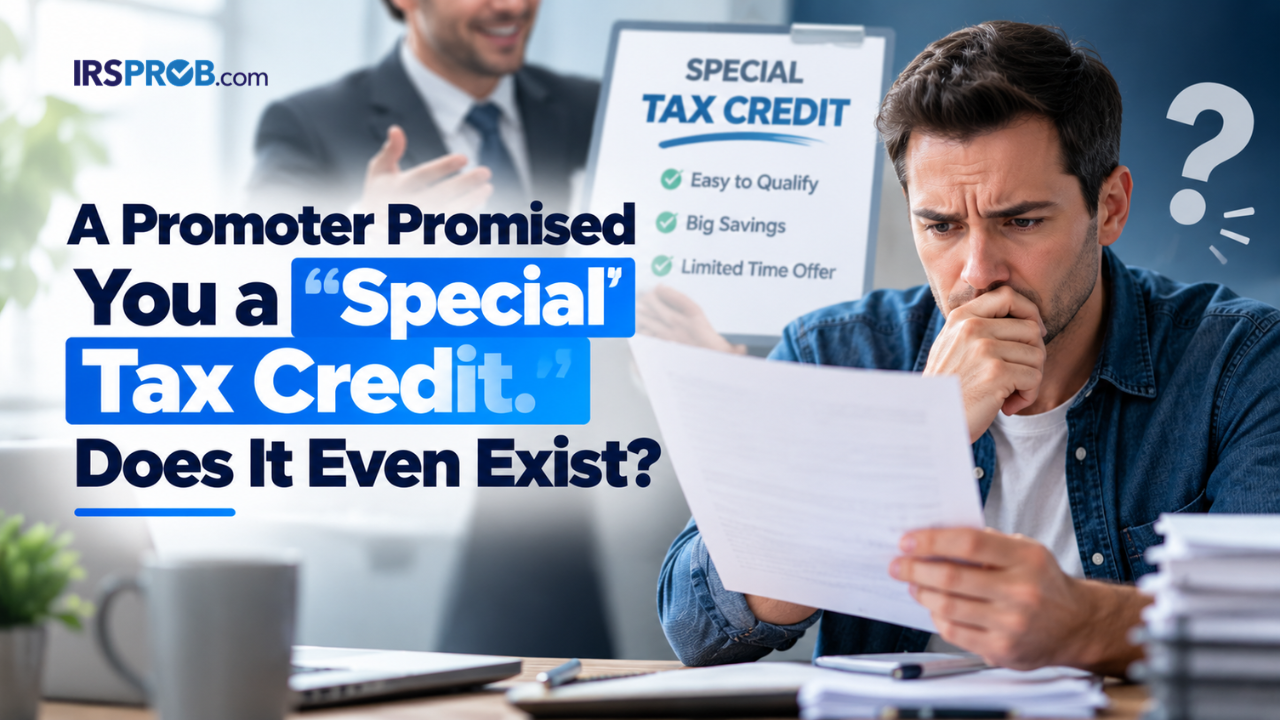
A promoter calls with good news. Your business may qualify for a “special tax credit” worth tens of thousands of dollars.
They say the credit is completely legal. They claim most accountants do not know about it. They have helped other business owners receive large refunds, and they will prepare the paperwork for a percentage of whatever you collect.
The offer sounds professional. There is a website, a contract, and a refund estimate.
Then you ask a simple question:
“What is the exact name of the credit?”
The answer becomes vague.
Some promoted tax credits are made up. Others are real credits stretched far beyond their actual rules. Either way, the taxpayer may be left with the repayment, interest, penalties, and IRS notices long after the promoter has collected a fee.
Before signing a return or amended return, slow down. A legitimate credit should have a legal basis, clear eligibility rules, supporting records, and a calculation someone can explain.
- The Offer Sounds Professional
- A Tax Credit Can Be Fake or Simply Claimed Incorrectly
- Five Questions to Ask Before Signing Anything
- Warning Signs of a Fake Tax Credit Promoter
- Real Credits That Promoters May Misrepresent
- Receiving a Refund Does Not Prove the Claim Was Approved
- You Are Still Responsible for Your Return
- What to Check Before Filing
- What if the Questionable Claim Was Already Filed?
- Should You Amend or Withdraw the Claim?
- How to Report a Questionable Promoter
- What to Do Next
- Frequently Asked Questions
The Offer Sounds Professional
Questionable tax promotions do not always look questionable at first.
The salesperson may use real tax terms and quote sections of the Internal Revenue Code. The company may have a polished website, customer testimonials, and documents filled with legal language.
The promoter may also tell you:
- Your regular accountant missed the credit.
- Almost every business qualifies.
- The IRS created a limited-time opportunity.
- Other clients have already received refunds.
- The company will defend the claim if it is audited.
- You do not pay unless you receive money.
Those statements can make the offer feel safe. They do not prove that you qualify.
If the promoter calculates a large refund after asking only a few general questions, that is a reason to pause.
A Tax Credit Can Be Fake or Simply Claimed Incorrectly
There are two different problems to watch for.
The first is a supposed credit that does not exist. A promoter may give an ordinary deduction, expired provision, or made-up concept an official-sounding marketing name.
The second problem is more common. The credit is real, but the taxpayer does not meet its eligibility rules.
A real IRS form does not make an unsupported claim valid. Neither does a real tax-code section. The taxpayer’s facts still have to fit the law.
This distinction matters because a salesperson may truthfully say, “This credit is in the tax code,” while leaving out the narrow rules that prevent you from claiming it.
Five Questions to Ask Before Signing Anything
Do not begin with the promised refund. Begin with the rule.
1. What Is the Credit’s Exact Legal Name?
Ask for the official name, not the company’s marketing name.
“Business recovery credit,” “self-employment refund,” and “special payroll benefit” may be sales labels rather than names used by the IRS.
2. What Law Authorizes the Credit?
Ask for the specific law or other controlling authority that creates the credit, along with current IRS guidance explaining how it applies.
IRS forms, instructions, and publications can help explain the rules, but the promoter should also be able to identify the legal basis for the credit.
A social media video or the promoter’s own article is not enough.
3. Which Years and Taxpayers Qualify?
Some credits apply only to certain years. Others are limited to particular industries, expenses, employees, or events.
A historical credit may have been legitimate but may no longer be available. The time for filing a refund claim may also have expired.
4. What Records Support Your Eligibility?
Ask what documents prove each part of the claim.
The answer may involve payroll records, government orders, gross receipts, fuel-use logs, leave records, invoices, employment records, or other evidence.
If the promoter does not request meaningful records, ask how eligibility was determined.
5. How Was the Refund Calculated?
Request the calculation in writing.
You should be able to see which return will be changed, which lines will be affected, which forms will be filed, and how the refund was calculated.
“Trust our tax team” is not a calculation.
Warning Signs of a Fake Tax Credit Promoter
No single warning sign proves that a company is dishonest. Several warning signs together should cause you to slow down.
The Fee Is Based on Your Refund
A promoter may charge 15%, 20%, or more of the expected refund.
A percentage fee gives the promoter a financial reason to maximize the claim. Ask what work is being performed, when the fee becomes due, and what happens if the IRS later denies the credit.
Everyone Supposedly Qualifies
Tax credits normally have conditions. Be careful if the salesperson says that every employer, contractor, business owner, or self-employed person qualifies.
You Are Pressured to File Immediately
Real deadlines exist, but they should be explained clearly. Ask for the official deadline and confirm it independently.
Do not sign because someone says the opportunity will disappear tonight.
The Promoter Does Not Request Enough Records
A short questionnaire may help begin a review. It should not replace the records needed to support the claim.
The Return Preparer Will Not Sign
If a person is paid to prepare or has primary responsibility for preparing your return or refund claim, the signing tax-return preparer generally must sign it, include a valid preparer tax identification number, and give you a completed copy.
A person who only markets or promotes an arrangement may not necessarily be the signing return preparer. Ask who will actually prepare and sign the filing.
An “Audit Guarantee” Is Used to Close the Sale
Ask what the guarantee covers.
It may offer only limited help gathering documents. It may not cover additional tax, penalties, interest, legal representation, or the cost of correcting other returns.
Real Credits That Promoters May Misrepresent
Some heavily promoted credits are real. The problem is how they are presented.
Employee Retention Credit
The Employee Retention Credit was available to certain eligible employers that paid qualified wages during specific pandemic-era periods.
Not every employer qualified. Eligibility depended on facts such as a qualifying government-order suspension, the required decline in gross receipts, or recovery-startup-business rules for applicable periods.
The IRS continues to provide Employee Retention Credit guidance , including an eligibility checklist and options for resolving some incorrect claims.
A promoter’s statement that COVID-19 affected every business is not a complete eligibility analysis.
Fuel Tax Credit
The Fuel Tax Credit is also real, but it generally applies to qualifying nontaxable uses of fuel, including certain off-highway business and farming uses.
Most taxpayers do not qualify merely because they bought gasoline for an ordinary car or truck. The IRS explains the actual Fuel Tax Credit rules .
Sick-and-Family-Leave Credits
Certain sick-and-family-leave credits were available during limited pandemic-era periods. Promoters have sometimes marketed them as a broad “self-employment tax credit.”
Self-employment alone did not establish eligibility. The dates, qualifying reason, income, filing deadline, and supporting records all matter.
IRSProb has a separate guide to promotions involving a supposed self-employment tax credit .
Receiving a Refund Does Not Prove the Claim Was Approved
A taxpayer may assume the claim is safe because the IRS issued the refund.
That conclusion can be risky.
The IRS may process a return and issue money before fully examining the supporting facts. A claim can later be reviewed, reduced, or denied.
If the credit is disallowed, the taxpayer may have to repay some or all of the refund. Interest may apply. Penalties may also apply depending on what was reported, the surrounding facts, and whether relief is available.
This does not mean every large refund will be audited. It means receiving the payment is not proof that the claim was correct.
You Are Still Responsible for Your Return
Your signature matters.
Taxpayers generally remain responsible for the accuracy of returns filed in their names, even when a promoter or paid preparer did the work.
The promoter may face separate preparer penalties, professional discipline, an injunction, or other consequences. Those consequences do not automatically erase the taxpayer’s balance.
A contract saying the promoter will “take full responsibility” may create rights between you and the promoter. It does not require the IRS to collect from the promoter instead of you.
Before signing, read the complete return. Do not sign a blank form or allow someone to file without giving you a copy.
What to Check Before Filing
Use this review process before submitting anything:
- Get the official name of the credit.
- Request its legal basis and current IRS guidance.
- Ask which tax years qualify.
- Obtain the complete calculation.
- Review the proposed original or amended return.
- Identify the forms and schedules being changed.
- Confirm the preparer’s identity and credentials.
- Read the fee agreement and audit-assistance terms.
- Collect records supporting every requirement.
- Ask an independent tax professional to review the claim.
The independent reviewer should not be paid based on the proposed refund.
You can also compare the promotion with the current IRS tax-scam warnings .
What if the Questionable Claim Was Already Filed?
First, collect the complete file.
That should include the agreement, original return, amended return, worksheets, payroll filings, supporting records, emails, advertisements, invoices, text messages, and proof of the promoter’s fee.
Then determine the claim’s current stage.
The Claim Is Still Pending
Do not assume another filing will fix the problem.
Some Employee Retention Credit claims may qualify for the IRS withdrawal process . That process has specific requirements and does not apply to every tax credit or refund claim.
For other claims, the correct step may involve an amended return, written correspondence, or another procedure.
You Received the Refund
Keep the money available if possible while the claim is reviewed.
If the claim is unsupported, correcting it may require more than returning a check. The correct process depends on the return, credit, tax year, and whether the IRS has contacted you.
The IRS Sent a Notice
Read the notice carefully. Identify the tax year, credit, response deadline, and requested documents.
Do not ignore the notice. Do not automatically file another amended return unless that is the correct response.
IRSProb explains what to check when an IRS notice arrives .
Should You Amend or Withdraw the Claim?
There is no universal correction process for every questionable credit.
The appropriate action may depend on:
- Whether the claim is pending
- Whether the refund was issued
- Whether the check was deposited
- Which form was filed
- Whether employment or income-tax returns were affected
- Whether the IRS has started an examination
- Whether a special withdrawal process applies
Correcting a claim promptly may help, but it does not automatically remove interest or penalties.
Do not make a second filing until someone has reviewed the first one and identified the proper procedure.
How to Report a Questionable Promoter
The IRS currently uses Form 14242 to receive information about suspected abusive tax promotions and preparers who promote abusive arrangements.
Tax-return preparer misconduct may involve a different complaint process. IRSProb explains how to report possible tax-preparer misconduct .
Reporting the promoter does not correct your tax account. You may still need to amend a return, respond to a notice, withdraw an eligible ERC claim, or address a resulting balance.
What to Do Next
If you are unsure about a promoted tax credit:
- Stop and request everything in writing.
- Do not sign a blank or incomplete return.
- Get copies of anything already filed.
- Do not spend a questionable refund.
- Verify the credit through official guidance.
- Obtain an independent professional review.
- Respond to IRS notices by the stated deadline.
- Correct an unsupported claim through the proper process.
The goal is not to assume every unfamiliar credit is fake. The goal is to understand exactly what is being claimed before your name goes on the return.
Unsure whether a promoted tax credit is legitimate?
Get the legal basis, eligibility rules, supporting records, and complete calculation before signing or filing anything.
Review a Common Tax Credit ScamFrequently Asked Questions
Is every little-known tax credit fake?
No. The tax law contains legitimate credits that many taxpayers do not know about. A valid credit should still have an identifiable legal basis, eligibility rules, forms, and supporting records.
Does receiving a refund mean the IRS approved my claim?
Not necessarily. The IRS may review the claim later and request records or disallow the credit.
Am I responsible if the promoter prepared the return?
Generally, taxpayers remain responsible for returns filed in their names. The promoter may also face consequences, but that does not automatically remove the taxpayer’s liability.
Can a promoter charge a percentage of the refund?
Fee rules depend on the service and professional involved. A refund-based fee can create an incentive to inflate a claim and should be reviewed carefully.
What if the promoter refuses to give me a copy?
A paid signing preparer generally must provide a completed copy of the return. Gather your communications and consider obtaining tax transcripts and reporting possible misconduct.
Should I amend the return immediately?
Not without reviewing what was filed. An amended return may be appropriate, but another procedure may apply if the claim is pending or under examination.
Can Reliance on a Promoter Remove IRS Penalties?
Reasonable-cause relief may be available in some cases, but reliance is not automatic protection. The taxpayer’s efforts, the adviser’s qualifications, the information provided, and the reasonableness of the advice can matter.
Reliance may be harder to treat as reasonable when the adviser lacked appropriate tax expertise, had a financial conflict of interest, or was paid based on the size of the tax benefit.
Final Takeaway
A legitimate credit should have a real name, a clear legal basis, specific eligibility rules, supporting records, and a calculation you can understand.
If the promoter cannot provide those things, pause before signing.
The refund may be large, but the return will carry your name.