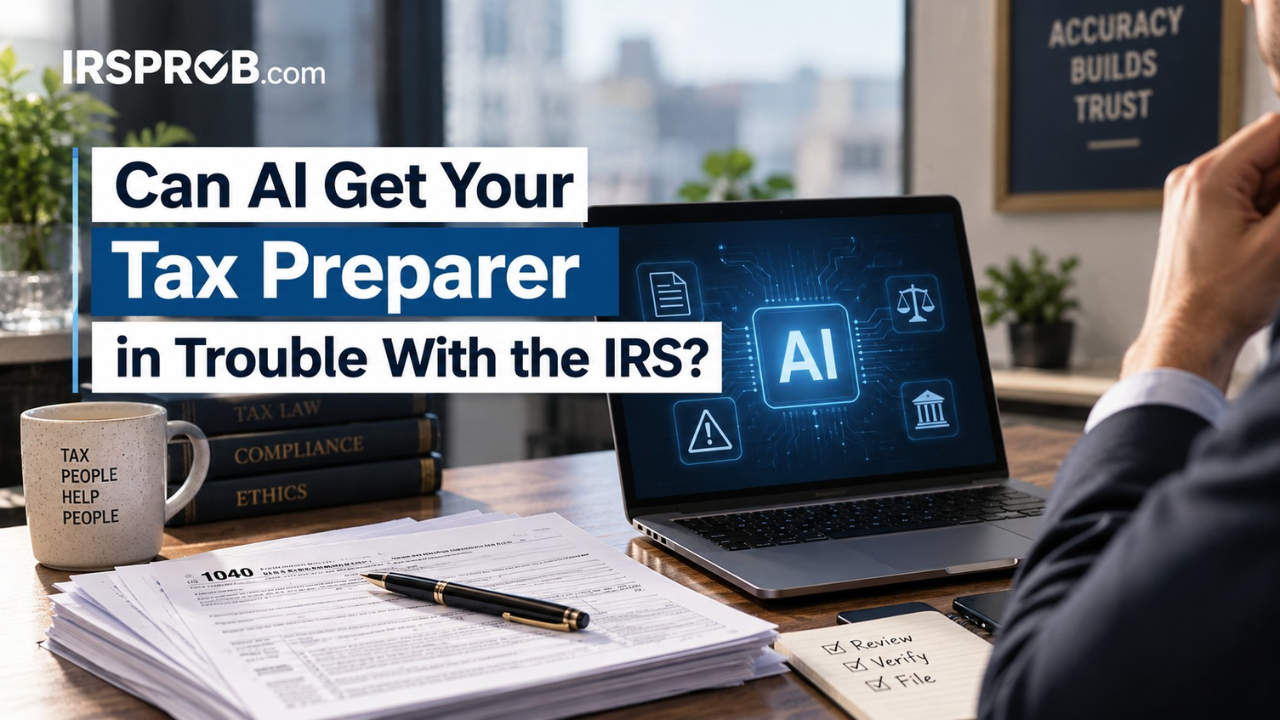
AI tax preparer risks are becoming more important as tax professionals use tools like ChatGPT and other generative AI systems for research, drafting, and tax-related work.
What happens when a tax professional submits court cases that appear to have been invented by AI?
A 2026 Tax Court case gives us a real warning.
In Clinco v. Commissioner, an attorney cited several authorities to support an argument against the IRS. Three did not exist as cited or did not support what the attorney claimed.
The Tax Court said they appeared to be the kind of hallucinated authorities produced by a large language model. But the court did not establish for certain that the attorney actually used generative AI.
The bigger lesson is simple: tax professionals are still responsible for checking the information they submit, no matter where it came from.
- What Happened in the Clinco Case?
- 5 AI Tax Preparer Risks and Lessons
- Lesson 1: AI Can Make Things Up
- Can Tax Professionals Use AI?
- Lesson 2: Professionals Still Have to Check
- Lesson 3: Circular 230 Still Matters
- Can the IRS Discipline a Professional?
- Lesson 4: Their Mistake Can Become Your Problem
- What If Bad AI Research Caused an IRS Problem?
- Lesson 5: Protecting Taxpayer Information
- Questions to Ask Your Tax Professional
- Should Tax Professionals Stop Using AI?
- Frequently Asked Questions
- Final Thoughts
What Happened in the Clinco Tax Court Case?
Clinco v. Commissioner, T.C. Memo. 2026-16, was filed on February 9, 2026.
The taxpayer operated MedCafe Westwood, a restaurant and bar near UCLA. The IRS challenged several items on his 2015 tax return.
One dispute involved the validity of an IRS notice of deficiency.
The taxpayer's attorney argued that the notice was invalid because it lacked a traditional handwritten signature. To support that argument, counsel cited four cases.
Three became a problem.
The Tax Court found that the authorities either did not exist as cited or did not support the argument.
Judge Mark Holmes said they appeared to be hallucinated authorities generated by a large language model.
The IRS pointed out the questionable citations. Even after that, one of them, "Cacchillo," appeared again in the reply brief's table of authorities.
The court described submitting fictitious caselaw as unacceptable and potentially sanctionable conduct.
But the Tax Court did not impose sanctions in its February 9 opinion.
This was also a court-conduct issue, not an IRS Office of Professional Responsibility disciplinary case.
The Tax Court said the citations appeared consistent with AI hallucinations. It did not establish that the attorney actually used generative AI.
AI Tax Preparer Risks: 5 Lessons From the Clinco Case
These AI tax preparer risks do not mean tax professionals should avoid artificial intelligence.
The concern is whether AI-generated research, calculations, citations, or advice are properly reviewed before they reach a taxpayer, the IRS, or a court.
Lesson 1: AI Can Make Things Up and Still Sound Convincing
An AI hallucination happens when an AI system produces information that sounds believable but is wrong or made up.
In tax work, that could mean:
- A court case that does not exist
- A fake citation
- The wrong Internal Revenue Code section
- An outdated IRS rule
- A bad calculation
- A real case described incorrectly
A fake citation can look realistic. Unless someone checks the actual source, it may not immediately look fake.
That is why AI should be treated as a starting point, not the final authority.
If a tax position depends on a case, open the actual case. If it depends on an IRS rule, check the IRS guidance. If it depends on a statute, read the statute.
A polished AI answer can still be wrong. Important tax positions should be checked against original authorities.
Can Tax Professionals Use ChatGPT or Other AI Tools?
Yes.
Using AI is not automatically improper.
Tax professionals can use it to organize documents, prepare drafts, summarize information, or start research.
The IRS Office of Professional Responsibility has warned practitioners that using AI does not replace their duties of competence and due diligence.
The IRS also provides guidance on AI in tax practice through Office of Professional Responsibility educational materials.
For an AI tax preparer or other tax professional, the basic standard remains the same: the work needs to be checked before it is relied on or submitted.
AI can help with the work.
It cannot take responsibility for the work.
Lesson 2: Tax Professionals Still Have to Check the Answer
If a tax professional uses AI to draft something, the professional is still responsible for reviewing it.
That can include:
- A tax return
- A response to an IRS notice
- Written tax advice
- An IRS protest
- A calculation
- A research memo
- A court filing
If AI gives a case citation, someone should verify the case.
If it gives a calculation, someone should check the numbers.
If it describes a tax rule, someone should confirm that the rule is current and actually applies to the taxpayer's facts.
"The AI said so" is not much help when the IRS, a client, or a judge asks where the answer came from.
Lesson 3: Circular 230 Still Matters When AI Is Used
Many professionals who represent taxpayers before the IRS are governed by Circular 230.
That generally includes attorneys, CPAs, enrolled agents, and certain other representatives practicing before the IRS.
Circular 230 already contains rules that matter when AI is used.
Due diligence: Practitioners must take reasonable care when preparing or submitting documents and making representations to clients and the IRS.
Competence: A practitioner needs the knowledge, skill, preparation, and thoroughness to handle the matter properly.
Written advice: Tax advice needs a reasonable factual and legal basis.
Supervision: Certain firm leaders must take reasonable steps to maintain procedures designed to keep practitioners in compliance.
Circular 230 does not specifically require every tax firm to have an AI policy, but clear review and data-handling rules can be a sensible safeguard.
Other return-preparer rules, professional licensing standards, court rules, and preparer penalties may also apply even when a particular activity falls outside Circular 230.
The IRS discusses additional professional responsibilities when using AI.
Can the IRS Discipline a Tax Professional for Bad AI Use?
Potentially, depending on the person and what happened.
The IRS Office of Professional Responsibility handles possible Circular 230 violations.
For professionals subject to those rules, sanctions can include censure, suspension, or disbarment from practice before the IRS.
But an AI mistake does not automatically mean someone will be disciplined.
The circumstances matter.
- Did the professional verify the authority?
- Did they correct the problem after learning about it?
- Did they knowingly or recklessly submit information they could not support?
And again, Clinco itself was not an IRS disciplinary proceeding.
The Tax Court did not impose sanctions in its February 9 opinion.
Lesson 4: Your Tax Professional's Mistake Can Still Become Your IRS Problem
Suppose an AI tax preparer or another tax professional uses an AI tool to research a deduction.
The AI gives the wrong answer. The preparer does not check it and puts the deduction on your return.
Months later, the IRS questions it.
Your preparer may have made the mistake, but the IRS notice may still come to you.
Now you may be dealing with:
- Additional tax
- Interest
- Possible penalties
- IRS correspondence
- An amended return
- More professional fees
- Delays in resolving your account
The same thing can happen during an IRS dispute.
If your representative relies on a fake court case or incorrect tax rule, it can weaken an otherwise legitimate argument.
Your tax professional may be responsible for the bad work. But you may still have to deal with the problem it creates.
If an AI-assisted mistake leads to an IRS audit letter, do not ignore the response deadline while determining what went wrong.
If additional tax is assessed, IRS penalties and interest may also become part of the issue.
What If You Think Bad AI Research Caused Your IRS Problem?
Start with the documents.
Get a complete copy of the return, letter, protest, court filing, or other document involved.
Ask the professional what authority supports the position.
If the IRS has already sent you a notice, pay close attention to the deadline.
Do not let a disagreement with your preparer cause you to miss the response date.
If the issue is serious, consider having another qualified professional review the work.
If the problem involves suspected fraud or misconduct by a paid tax return preparer, the IRS has a complaint process that includes Form 14157, Return Preparer Complaint.
You can review the IRS process to report tax preparer misconduct.
Form 14157 is for return-preparer complaints. It is not a general system for reporting every type of professional misconduct.
An honest mistake also does not automatically mean misconduct occurred.
If a notice has already arrived, investigating what your preparer did does not automatically extend the response deadline shown on the notice.
Lesson 5: Your Tax Information Needs More Than Basic Security
AI creates another issue that has nothing to do with made-up court cases.
Tax professionals handle sensitive information such as:
- Social Security numbers
- Tax returns
- W-2s and 1099s
- Bank information
- Business records
- Dependent information
- IRS notices
A preparer should not casually copy that information into an AI system just because the tool makes the work faster.
Security is only one part of the issue.
Paid return preparers may also be subject to federal restrictions under IRC §7216 and related regulations governing the use and disclosure of taxpayer return information.
Depending on what the preparer is doing with the information, taxpayer consent or another permitted exception may be required.
The IRS provides additional information about taxpayer information disclosure rules.
The IRS Office of Professional Responsibility has also warned practitioners about putting client information into public or open AI systems.
So the question is not only whether the tool is secure, but whether the preparer is allowed to use your information that way.
Tax professionals need to consider confidentiality, information-security requirements, §7216 restrictions, consent rules, and how the AI provider uses or retains submitted information.
Should You Ask Your Tax Professional Whether They Use AI?
You can, but a "yes" answer is not automatically a red flag.
The better questions are about how AI is being used:
- How do you check AI-generated answers?
- Do you verify important positions using original sources?
- Is any of my tax information entered into an AI system?
- If so, how is that use allowed and protected?
- Does a person review AI-assisted work before it is filed?
A good professional should be able to explain an important tax position without hiding behind the technology.
If you ask why a tax rule applies, "because the AI said so" should not be the answer.
Does Clinco Mean Tax Professionals Should Stop Using AI?
No.
AI can be useful in tax practice.
It can help organize information, prepare drafts, work through large documents, and point professionals toward issues that deserve closer research.
The better lesson from Clinco is simple:
A tax professional still needs to understand the facts, check original authorities, review calculations, protect client information, and use professional judgment.
Technology can help with the work.
It cannot take responsibility for it.
Did a tax preparer's mistake create an IRS problem?
Start by understanding exactly what was filed, what the IRS is questioning, and which response deadline applies to your account.
Review the IRS Audit Letter GuideFrequently Asked Questions About AI Tax Preparers
Can an AI tax preparer or tax professional use ChatGPT?
Yes. AI itself is not prohibited. Professionals still need to follow the tax, professional-responsibility, confidentiality, and security rules that apply to their work.
Did the attorney in Clinco definitely use AI?
No. The Tax Court said three questionable authorities appeared to be hallucinations generated by a large language model, but the record did not establish that counsel actually used generative AI.
Can AI invent Tax Court cases?
Yes. Generative AI can produce convincing cases or citations that do not actually exist.
Who is responsible if AI gives my tax professional the wrong answer?
The professional remains responsible for reviewing and verifying the work they provide or submit.
Was the attorney in Clinco sanctioned?
The Tax Court did not impose sanctions in its February 9, 2026 opinion. It did, however, strongly criticize the questionable citations.
Is it safe for my preparer to upload my tax return into an AI tool?
Not automatically. Security is only part of the issue. Paid return preparers may also face federal restrictions on using or disclosing taxpayer information under IRC §7216 and related regulations.
What should I do if bad AI advice caused an IRS problem?
Get copies of the documents involved, determine what the IRS is questioning, keep track of response deadlines, and consider having another qualified professional review the issue.
Final Thoughts
AI is becoming part of tax practice.
The bigger question is whether the person using it understands its limits.
Clinco shows what can happen when questionable legal authorities make their way into a real tax case without being properly checked.
It does not prove that AI caused the problem.
But it reinforces a basic rule that applies whether research comes from AI, a search engine, a database, or somewhere else:
Check the source before you rely on it.
Whether someone describes themselves as an AI tax preparer or simply uses AI behind the scenes, the professional still needs to verify the work, protect taxpayer information, and take responsibility for the final answer.