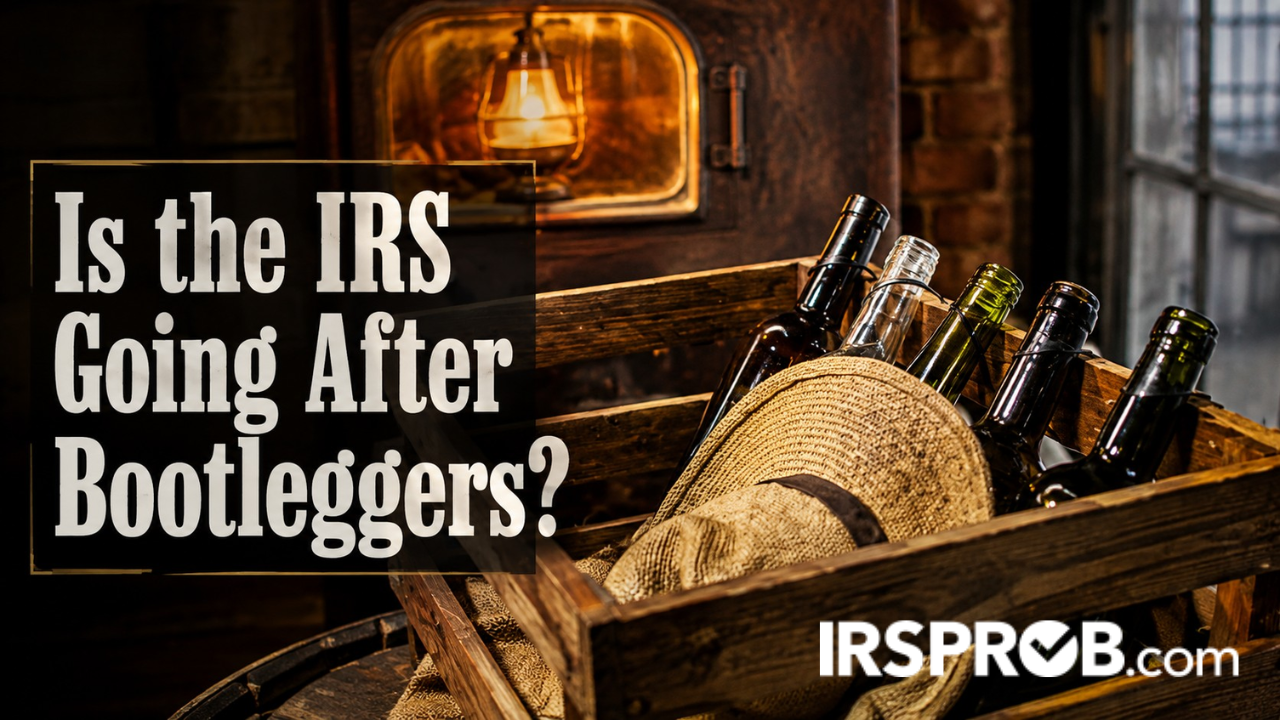
Bootlegging may sound like something from the Prohibition era, but illegal liquor can still create serious federal tax problems.
So, is the IRS going after bootleggers?
Not exactly.
TTB directly enforces many federal alcohol-production and excise-tax laws. IRS Criminal Investigation may become involved when illegal liquor activity also involves unpaid taxes, hidden income, false returns, or possible tax evasion.
And yes, money earned from illegal activity can still be taxable.
Here is when bootlegging can become a federal tax problem, which agencies may get involved, and how serious the consequences can be.
- Is the IRS Going After Bootleggers in 2026?
- What Does "Bootlegger" Mean Today?
- Who Enforces Illegal Distilling Laws?
- When Bootlegging Becomes a Federal Tax Problem
- Is Illegal Liquor Income Taxable?
- Why Taxes Matter in Bootlegging Laws
- Federal Penalties for Illegal Distilling
- Can the Government Seize Property?
- Home Distilling vs. Bootlegging
- McNutt, Ream, and the Supreme Court
- How IRS Investigations Can Begin
- What If Someone Has Unreported Income?
- Frequently Asked Questions
- Final Thoughts
Is the IRS Going After Bootleggers in 2026?
As of September 2, 2026, I found no IRS announcement of a new nationwide enforcement campaign specifically targeting "bootleggers."
That does not mean illegal liquor activity is being ignored.
TTB is directly involved in enforcing federal laws that regulate alcohol production and protect alcohol excise-tax revenue.
TTB's Trade Investigations Division investigates suspected alcohol tax evasion. Its Tax Audit Division examines federal excise-tax compliance and can support civil or criminal cases.
You can review more about TTB alcohol enforcement.
IRS Criminal Investigation has a different role. IRS-CI investigates possible criminal violations of the Internal Revenue Code and related financial crimes.
So an illegal liquor operation could involve several agencies depending on what happened.
If the facts show unpaid taxes, hidden taxable income, false returns, or a possible attempt to evade tax, the case can move beyond alcohol regulation and into criminal tax territory.
TTB directly administers and enforces many federal alcohol-production and excise-tax laws. IRS-CI can become involved when the facts also raise possible criminal violations of federal tax law.
What Does "Bootlegger" Mean Today?
"Bootlegger" is an informal term.
Most people associate it with someone secretly making, transporting, or selling liquor outside the law.
For this article, we are using the term generally to describe illegal production or sale of distilled spirits.
That does not mean everyone interested in home distilling is a bootlegger.
Someone making spirits for personal use and someone operating an illegal liquor business for profit are different situations.
Both can raise federal alcohol-law questions, but the tax issues can become much more serious when money, hidden sales, and unpaid taxes enter the picture.
Who Actually Enforces Illegal Distilling Laws?
TTB Handles the Federal Alcohol and Excise-Tax Side
TTB is responsible for enforcing federal laws involving alcohol production, importation, wholesale businesses, permits, and related excise taxes.
Its investigators can also look into suspected alcohol tax evasion.
TTB's publicly available home-distilling guidance lists several federal offenses involving illegal spirits.
These include:
- Possessing an unregistered still
- Operating as a distiller without proper registration
- Unlawfully producing distilled spirits
- Receiving or processing spirits while knowing federal excise tax has not been paid
- Removing or hiding untaxed distilled spirits
That guidance also discusses tax evasion, criminal penalties, and forfeiture.
See TTB's information about federal penalties for illegal distilling.
IRS Criminal Investigation Has a Different Role
IRS-CI investigates possible criminal violations of federal tax law.
That means the IRS does not need to be the agency that originally discovers an illegal liquor operation.
A TTB investigation, another law-enforcement case, a tip, or information found during an IRS examination could uncover a separate tax problem.
For example, investigators may discover that cash sales were never reported on federal tax returns.
That creates an issue separate from whether the alcohol itself was legally produced.
When Can Bootlegging Become a Federal Tax Problem?
There are several ways.
1. When Federal Excise Tax Goes Unpaid
Distilled spirits are subject to federal excise tax.
The general statutory rate is $13.50 per proof gallon, although qualifying distilled-spirits operations and qualifying imports can be eligible for reduced statutory rates.
Federal law generally treats the tax as attaching when distilled spirits come into existence.
That helps explain why tax collection has played such a large role in federal distilling laws.
The government has historically wanted spirits produced through a system where production can be tracked and the required taxes can be collected.
When spirits are produced outside that system, unpaid federal excise tax can become part of the case.
You can review the statute governing the federal excise tax on distilled spirits.
2. When Liquor Sales Are Hidden From the IRS
Suppose someone illegally sells homemade liquor for cash.
Does the fact that the sale itself was illegal mean the money is tax-free?
No.
Federal tax rules generally require income from illegal activities to be reported.
Getting paid in cash does not make the income disappear for tax purposes either.
That creates two separate questions.
Was the liquor legally produced and sold?
And was the income properly reported?
A person can have problems with both.
3. When Someone Willfully Tries to Avoid Tax
Owing tax is not automatically tax evasion.
Taxpayers make mistakes. Returns can contain errors. People can misunderstand tax rules.
Criminal tax evasion is more serious.
Federal law addresses willful attempts to evade or defeat taxes imposed by the Internal Revenue Code, including taxes involving distilled spirits.
So the risk becomes greater when the facts suggest someone deliberately hid activity, income, assets, or transactions in an effort to avoid paying tax.
For more background, see IRSProb's guide to tax fraud and the federal tax evasion law.
Criminal tax cases generally involve evidence of willfulness or intentional conduct. A mistake or unpaid balance does not automatically establish criminal tax evasion.
Is Income From Illegal Liquor Sales Still Taxable?
Yes.
This is one of the clearest ways an illegal liquor operation can turn into an IRS issue.
Income does not become tax-free simply because the activity that produced it was illegal.
For example, suppose someone sells homemade liquor for cash throughout the year.
The alcohol-law violations are one issue.
The money earned from those sales is another.
If taxable income is intentionally left off a federal tax return, the person may face additional tax, penalties, interest, and potentially criminal concerns depending on the facts.
IRS Publication 17 confirms that illegal income is still taxable.
The legality of the underlying activity and the federal income-tax treatment of money earned from that activity are separate issues.
Why Are Taxes Such a Big Part of Bootlegging Laws?
The connection goes back a long way.
The federal home-distilling ban dates to 1868 and came during a period when Congress was concerned about widespread evasion of federal taxes on distilled spirits.
In other words, the government was not regulating stills only because alcohol was being produced.
It was also worried about collecting the tax.
That same history became important again in two major 2026 court cases.
In McNutt, the Fifth Circuit ruled against two important federal home-distilling restrictions.
In Ream, the Sixth Circuit reached the opposite result and upheld the restriction. The Sixth Circuit concluded that restricting home distilling was sufficiently connected to protecting federal excise-tax collection.
So even today, federal courts are debating how far the government can go when regulating distilling in order to protect tax revenue.
There is also a historical IRS connection.
Before today's federal agencies were organized the way they are now, alcohol-tax investigators within the old Bureau of Internal Revenue and later the IRS directly pursued illegal liquor operations and moonshiners.
The agencies changed.
The tax issue did not.
What Federal Penalties Can Apply to Illegal Distilling?
Federal penalties can be serious.
Certain offenses under 26 U.S.C. § 5601 can be felonies punishable by:
- Up to five years in prison
- A fine of up to $10,000
- Or both
- For each covered offense
These are maximum statutory penalties. They do not mean every person charged with an offense automatically receives the maximum punishment.
Other laws can apply depending on what happened.
For example, engaging in the business of a distiller with intent to defraud the United States of tax can carry criminal penalties.
A willful attempt to evade federal tax can also lead to charges under the federal tax-evasion statute.
The facts matter.
If an unpaid tax issue arises, understanding IRS penalties and interest can also help separate ordinary civil tax charges from more serious criminal allegations.
Can the Government Seize a Still or Other Property?
In some cases, yes.
Federal law provides for seizure and forfeiture of certain property connected with illegal distilling.
Depending on the violation, that can include:
- Untaxed distilled spirits
- Unregistered stills
- Distilling equipment
- Certain property located at an unlawful distillery
- Vehicles, vessels, aircraft, or other property used in certain violations
That does not mean the government automatically gets everything someone owns because illegal distilling is suspected.
Forfeiture depends on the specific law and facts involved.
Is Making Whiskey at Home the Same as Bootlegging?
No.
Someone who wants to make whiskey at home for personal use is not automatically a bootlegger.
But home distilling does raise its own federal legal issues.
TTB's publicly available home-distilling guidance continues to state that individuals may not produce beverage spirits at home outside a qualified distilled spirits plant.
There is an important caution, however.
That TTB webpage was last updated in March 2025, before the 2026 McNutt and Ream decisions.
Those cases reached opposite conclusions about important federal home-distilling restrictions, so the court split also needs to be considered when discussing the current legal picture.
That does not mean every home distiller is a bootlegger.
It also does not mean all federal and state distilling rules disappeared because of one court ruling.
TTB's public guidance continues to prohibit home production of beverage spirits, while two federal appeals courts have reached conflicting conclusions about important parts of the federal home-distilling framework.
What Do McNutt and Ream Have to Do With Bootlegging?
The cases are mainly about home distilling, not someone running a secret commercial liquor business.
But they matter because taxes are at the heart of the disagreement.
The Fifth Circuit held in McNutt that the challenged federal home-distilling restrictions went too far under Congress's taxing authority.
The Sixth Circuit disagreed in Ream. It concluded that restricting home distilling was a reasonable way to protect federal excise-tax collection.
Now the dispute may eventually reach the Supreme Court.
John Ream has asked the Supreme Court to review the Sixth Circuit ruling in Ream v. Department of the Treasury, No. 26-93.
You can review the Ream Supreme Court petition.
The federal government has separately asked the Court to review the Fifth Circuit ruling in Department of Justice v. McNutt, No. 26-204.
You can also review the McNutt Supreme Court petition.
Ream submitted his reply on September 1, 2026. In the McNutt case, the response to the government's petition is currently due September 17.
As of September 2, 2026, the Supreme Court has not agreed to hear either case.
For now, the circuit split remains.
Petitions are pending in both Ream and McNutt, but as of September 2, 2026, the Court has not agreed to hear either case.
Does the IRS Have to Find the Problem First?
No.
IRS criminal cases can begin in different ways.
Information can come from inside the IRS, members of the public, U.S. Attorney's Offices, or investigations conducted by other law-enforcement agencies.
That matters with illegal liquor.
A case could begin as an alcohol investigation and later uncover unreported income or possible tax evasion.
A federal alcohol investigation does not have to start with the IRS to eventually create an IRS problem.
When IRS-CI completes a criminal investigation and recommends prosecution, the case can be referred to the Department of Justice.
The IRS explains more about the IRS criminal investigation process.
What If Someone Has Unreported Income From Illegal Liquor Sales?
This is not a good situation for a one-size-fits-all solution.
Someone dealing with unreported income connected to potentially illegal activity may have both tax and criminal-law concerns.
Do not ignore an IRS, TTB, or other government notice.
Do not destroy, hide, or alter records.
And do not assume that simply filing an amended tax return will automatically resolve everything.
An ordinary reporting mistake is very different from a situation in which investigators may be looking at possible intentional criminal conduct.
When there is a real concern about illegal income, unpaid excise taxes, or a government investigation, speaking with a qualified tax attorney may be appropriate before deciding what to do next.
Received an IRS notice connected to unreported income?
A notice or examination involving potentially unreported income should be reviewed carefully, especially when the underlying activity may also raise criminal or regulatory issues.
Review the IRS Audit Letter GuideFrequently Asked Questions
Is the IRS going after bootleggers in 2026?
As of September 2, 2026, I found no IRS announcement of a new nationwide campaign specifically targeting bootleggers. Illegal liquor activity can still lead to federal tax enforcement when it involves unpaid taxes, unreported income, or possible tax crimes.
Does the IRS investigate illegal liquor sales?
IRS-CI can investigate potential criminal tax violations connected with illegal income or unpaid taxes. TTB and other agencies may handle the alcohol-law side of the case.
Is money from bootlegging taxable?
Yes. Income from illegal activities can still be taxable under federal law.
Who investigates illegal moonshine, the IRS or TTB?
TTB directly enforces many federal alcohol-production and excise-tax laws and investigates suspected alcohol tax evasion. IRS-CI may become involved when the conduct also raises potential criminal violations of federal tax law.
Can unpaid alcohol taxes become tax evasion?
Potentially. But simply owing tax is not automatically criminal tax evasion. Tax evasion generally requires a willful attempt to evade or defeat tax.
What are the penalties for illegal distilling?
Certain federal offenses can carry up to five years in prison, a fine of up to $10,000, or both for each covered offense. Other penalties may apply depending on the violation.
Can the government seize an illegal still?
Federal law allows seizure and forfeiture of certain stills, spirits, equipment, and other property connected with qualifying violations.
Is a home distiller automatically a bootlegger?
No. Home distilling and operating an illegal liquor business are not the same thing.
Is making whiskey at home legal in 2026?
TTB's publicly available guidance continues to state that federal law prohibits home production of beverage spirits outside a qualified distilled spirits plant. That guidance predates the conflicting 2026 McNutt and Ream decisions, so the current court split also needs to be considered.
Final Thoughts
So, is the IRS going after bootleggers?
Not in the simple way the title might suggest.
TTB plays a direct role in enforcing federal alcohol-production and excise-tax laws. IRS Criminal Investigation may become involved when the same conduct raises possible criminal tax violations.
Illegal liquor can therefore create several problems at once.
There may be alcohol-law violations, unpaid excise taxes, unreported sales income, or even possible tax-evasion issues.
Bootlegging may sound old-fashioned.
The tax consequences are not.