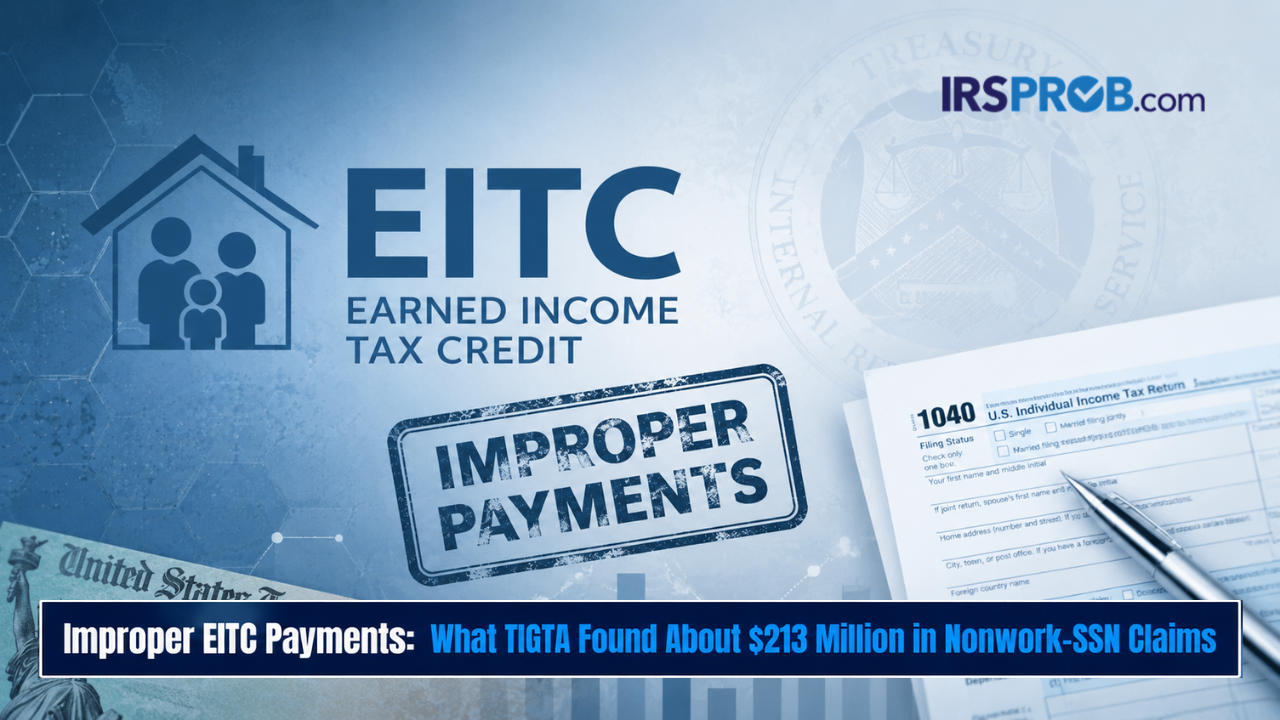
TIGTA identified about 67,000 tax returns for tax years 2023 and 2024 that claimed the Earned Income Tax Credit while involving a nonwork Social Security number.
Those returns claimed nearly $219 million in EITC, and nearly $213 million was paid.
But that does not mean TIGTA determined that every dollar of the $213 million was improper.
In fact, that uncertainty is one of the main problems TIGTA found.
The IRS does not always have enough reliable information to know why a nonwork SSN was issued or whether a person's work or citizenship status later changed.
That makes it harder for the IRS to stop improper EITC payments without also denying the credit to people who may legally qualify.
Here are seven key findings taxpayers should understand.
- 7 Key TIGTA Findings
- Fact 1: Nearly $213 Million Was Paid
- Fact 2: Nonwork SSNs and EITC Eligibility
- Fact 3: IRS and SSA Data Gap
- Fact 4: Outdated Status Information
- Fact 5: IRS Math Error Authority
- Fact 6: Manual IRS Reviews
- What the 90% Figure Really Means
- Fact 7: The Broader EITC Problem
- What This Means for Taxpayers
- 2026 Proposed Credit Rules
- What If the IRS Questions Your EITC?
- Could Better IRS and SSA Data Help?
- Frequently Asked Questions
- Final Thoughts
Improper EITC Payments: 7 Key TIGTA Findings for 2026
Fact 1: Nearly $213 Million Was Paid on Returns Involving Nonwork SSNs
TIGTA reviewed the IRS's ability to identify EITC claims involving nonwork Social Security numbers.
For tax years 2023 and 2024, TIGTA found about 67,000 returns that claimed the EITC while involving a nonwork SSN.
Those returns claimed nearly $219 million in credits.
Nearly $213 million was paid.
That number is significant, but it needs to be explained carefully.
TIGTA did not determine that the entire $213 million should have been denied.
The report says the IRS does not have enough reliable information to determine whether every nonwork SSN in that group was actually ineligible.
So this is not the same as saying taxpayers improperly received $213 million that the IRS already knew they did not qualify for.
You can review the full TIGTA report on EITC claims involving nonwork SSNs.
TIGTA found that nearly $213 million was paid on the identified returns. It did not determine that every dollar in that group was an improper payment.
Fact 2: A Nonwork SSN Does Not Automatically Make Someone Ineligible
A nonwork Social Security number is generally issued to certain noncitizens who are not authorized to work in the United States but need an SSN for another reason.
That reason matters when it comes to the EITC.
Current IRS rules say an SSN is not valid for EITC purposes if it was issued solely to receive a federally funded benefit and does not authorize the person to work.
But not every nonwork SSN falls into that category.
TIGTA gives an example of a person who received a nonwork SSN for a state or locally funded program. In that situation, the SSN may still meet this part of the EITC requirement.
That is why simply seeing a nonwork SSN does not give the IRS enough information to automatically deny the credit.
Taxpayers can review current EITC eligibility requirements and IRS Publication 596.
Fact 3: The IRS Does Not Receive All the Information SSA Has
This is one of the biggest issues TIGTA identified.
The Social Security Administration records why a person requested a nonwork SSN.
But TIGTA found that this information is not included in the regular SSA database shared with the IRS.
The IRS may know that a person has a nonwork SSN but still not know why it was issued.
Without that detail, the IRS cannot easily separate ineligible claims from claims that may be valid.
The SSA provides additional information about different Social Security card types.
Fact 4: The IRS May Be Looking at Old Information
A person's situation can change after an SSN is issued.
Someone could originally receive a nonwork SSN and later:
- Become authorized to work
- Become a U.S. citizen
- Have another change that affects EITC eligibility
But the information available to the IRS may still show the person's earlier status.
That creates another problem with automatic denials.
If the IRS uses old information, it could deny the EITC to someone who now qualifies.
If the underlying government data is incomplete or outdated, an automated denial system could incorrectly deny a valid EITC claim.
Why the IRS Could Not Stop Improper EITC Payments Automatically
Fact 5: The IRS Has a Tool to Correct Some Claims, but It Needs Reliable Data
The IRS has something called math error authority.
Despite the name, it is not limited to simple math mistakes.
In certain situations, this authority allows the IRS to correct specific problems while processing a tax return without first going through the normal deficiency process.
TIGTA said the IRS could consider using math error authority to automatically deny EITC claims involving ineligible nonwork SSNs if reliable information were available.
The key word is reliable.
If IRS records still show someone's old status after that person became authorized to work, an automatic system could deny a valid credit.
The IRS needs reliable information before it can safely use that tool.
You can review the federal law governing IRS math error authority.
Fact 6: The IRS Still Relies on Manual Reviews
Because the IRS cannot automatically identify every ineligible claim, it uses a risk-based review process.
One program involved is the Automated Questionable Credit program, or AQC.
For processing years 2023 and 2024, more than 12,600 returns met the IRS's risk criteria.
The AQC program reviewed about 40% of them and issued approximately 5,100 letters.
Nearly 90% of the selected returns that were reviewed were found ineligible for the EITC.
Those reviews protected nearly $11 million in revenue.
That shows the reviews can identify real problems.
But manual reviews take time and IRS staff, so the agency cannot review every return its systems identify.
Does the 90% Figure Mean Most Nonwork SSN Claims Are Wrong?
No.
The nearly 90% figure applies only to the higher-risk returns that the IRS selected and reviewed.
Those returns were not randomly selected from every EITC claim involving a nonwork SSN.
It would therefore be misleading to say that nearly 90% of all taxpayers with nonwork SSNs claimed the EITC incorrectly.
The IRS reviewed a risk-selected group. The result is not a general error rate for every EITC return involving a nonwork Social Security number.
Fact 7: The Nonwork-SSN Issue Is Part of a Much Bigger EITC Compliance Problem
Separately, the overall EITC has a much larger improper-payment problem.
For fiscal year 2025, the IRS estimated that about $21.1 billion of $64.7 billion in total EITC payments were improper.
That is about 33%.
TIGTA also reported that EITC improper-payment rates remained above 20% from fiscal years 2006 through 2025.
But an improper payment does not automatically mean fraud.
EITC errors can happen for different reasons.
Eligibility depends on several factors, including income, filing status, qualifying children, residency, relationships, and Social Security numbers.
Some of that information can be difficult for the IRS to verify when a return is first processed.
What Does This Mean for Taxpayers Claiming the EITC?
TIGTA's report does not by itself change the basic EITC rules.
Taxpayers still need to meet the current eligibility requirements.
Your Social Security number must qualify for EITC purposes.
If you file a joint return, your spouse must also meet the applicable SSN requirement. Qualifying children used for the credit have SSN requirements too.
If your work, immigration, or citizenship status changed, check whether your information with the Social Security Administration is current.
You should also keep documents that support the rest of your EITC claim.
That could include records showing your income, relationship to a qualifying child, where the child lived, and other information needed to prove eligibility.
2026 Update: Treasury and IRS Proposed New Refundable-Credit Rules
On August 19, 2026, Treasury and the IRS proposed new regulations affecting the refunded portion of the EITC and several other refundable tax credits.
Under the proposal, the refunded portion would generally be available only when certain U.S. citizen, U.S. national, or qualified-alien requirements are met.
These regulations are proposed, not final.
They do not yet replace the current EITC rules discussed above.
The IRS says the rules would apply to tax years ending on or after the date final regulations are published.
You can review the proposed refundable tax credit rules.
They do not yet replace the current EITC eligibility rules. Taxpayers should continue to check current IRS guidance when determining eligibility.
What If the IRS Questions Your EITC?
Receiving an IRS letter about the EITC does not automatically mean you will lose the credit.
Start by reading the notice carefully.
Look at exactly what the IRS is asking you to prove and pay attention to the response deadline.
Depending on the issue, you may need records showing:
- Your income
- Filing status
- Relationship to a qualifying child
- Where the child lived
- A valid Social Security number
- Other facts supporting your eligibility
Focus on the specific issue raised in the notice rather than sending unrelated documents.
If your Social Security information is outdated because your status changed, you may also need to update your records with SSA.
The IRS provides specific IRS EITC audit guidance for taxpayers who receive a letter or examination notice.
You can also review IRSProb's guide to an IRS audit notice or learn what to do when you receive an IRS notice.
If you are not sure how to respond or disagree with the IRS's decision, consider speaking with a qualified tax professional.
Did the IRS question your EITC or send you a notice?
Start with the exact issue and deadline shown on the notice. Gather records that directly address what the IRS is asking you to prove.
Review the IRS Notice GuideCould Better IRS and SSA Data Sharing Help?
That is one of the clearest points in TIGTA's report.
The IRS already receives information from SSA.
The problem is that the information does not always include the details needed to make an accurate EITC decision.
Better and more current information could help the IRS identify ineligible claims before refunds are paid.
At the same time, the data needs to be accurate.
More automation does not help if outdated information causes eligible taxpayers to lose credits they are allowed to claim.
TIGTA did not make formal recommendations in this report.
Instead, the report documented limits in the IRS's current data and review processes.
Frequently Asked Questions About EITC Claims Involving Nonwork SSNs
What did TIGTA find about EITC claims involving nonwork SSNs?
TIGTA identified about 67,000 returns for tax years 2023 and 2024 that claimed nearly $219 million in EITC while involving a nonwork SSN. Nearly $213 million was paid.
TIGTA did not establish that every dollar paid was improper because the IRS does not have enough reliable information to determine eligibility across the entire group.
What is a nonwork Social Security number?
It is generally an SSN issued to a noncitizen who is not authorized to work but needs an SSN for another qualifying reason.
Can someone with a nonwork SSN qualify for the EITC?
Possibly.
An SSN issued solely to receive a federally funded benefit and that does not authorize work is not valid for EITC purposes.
But other nonwork SSNs may be treated differently, and a person's status can also change after the number was issued.
Why can't the IRS automatically stop all of these claims?
The IRS does not always know why a nonwork SSN was issued, and some status information may be outdated.
Automatically denying claims based on incomplete information could also deny the EITC to taxpayers who qualify.
What is the Automated Questionable Credit program?
The AQC program uses risk information to identify certain questionable credit claims for review.
IRS employees then review selected returns and may contact taxpayers for supporting information.
Does the nearly 90% figure apply to all nonwork SSN claims?
No.
It applies to the higher-risk returns the IRS selected and reviewed. It should not be applied to every taxpayer or return involving a nonwork SSN.
Was the entire $213 million fraudulent?
No.
TIGTA did not say that.
The report found nearly $213 million was paid on the approximately 67,000 returns it identified, while also explaining that the IRS lacked enough information to determine eligibility across the entire group.
What should I do if the IRS questions my EITC?
Read the notice carefully, respond by the deadline, and provide documents that address the specific eligibility issue the IRS is questioning.
If the issue is difficult to resolve, consider getting professional tax help.
Final Thoughts
TIGTA found a real problem with the IRS's ability to identify questionable EITC claims involving nonwork Social Security numbers.
But the report also shows why there is no simple fix.
The IRS does not always have enough current information to determine which claims should be denied and which taxpayers actually qualify.
Better data could help the IRS stop improper payments earlier without incorrectly denying the credit to eligible taxpayers.
For taxpayers, the basic advice remains simple.
Make sure your information is current, understand the EITC rules, keep records supporting your claim, and respond promptly if the IRS contacts you.