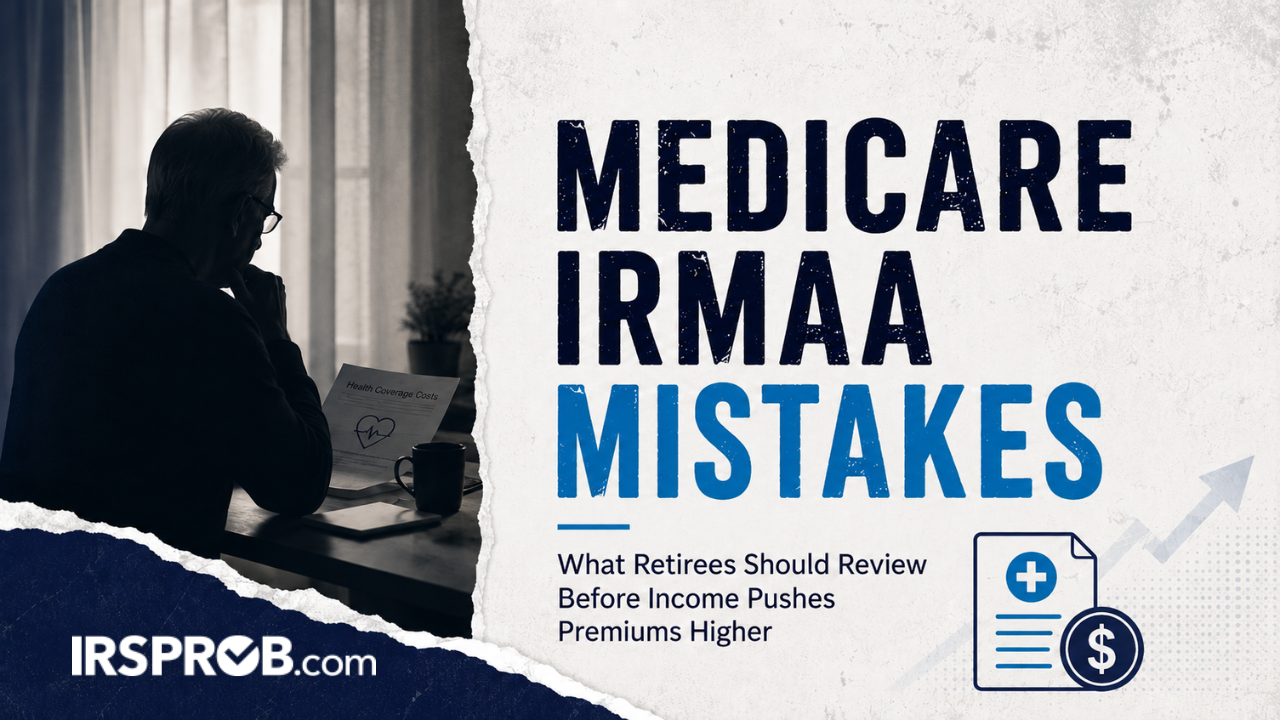
Many retirees expect a higher-income year to affect their taxes.
What they do not always expect is a higher Medicare premium later.
That is where Medicare IRMAA mistakes can get expensive.
A large IRA withdrawal, Roth conversion, required minimum distribution, capital gain, or filing-status change may look manageable on the tax return. But the same decision can affect what you pay for Medicare Part B and Part D.
The goal is not to avoid every income move. It is to understand the full cost before you make it.
- What Medicare IRMAA Is
- Why Medicare IRMAA Mistakes Can Surprise Retirees
- The Medicare Two-Year Lookback
- Mistake 1: Taking a Large IRA Withdrawal Without Checking IRMAA
- Mistake 2: Treating Roth Conversions Like a Tax-Only Decision
- Mistake 3: Forgetting That RMDs Can Push Income Higher
- Mistake 4: Selling Investments Without Looking at the Full Year
- Mistake 5: Overlooking a Filing-Status Change After a Spouse Dies
- Mistake 6: Assuming Only Current Income Matters
- When a Life-Changing Event May Help
- What Retirees Should Review Before Making a Big Income Move
- What to Do If You Receive an IRMAA Notice
- When Retirees Should Get Professional Help
- FAQs About Medicare IRMAA Mistakes
- What to Do Next
What Medicare IRMAA Is
IRMAA stands for Income-Related Monthly Adjustment Amount.
It is an additional amount some higher-income Medicare beneficiaries pay for Part B and Part D.
The calculation is based on modified adjusted gross income and filing status. For IRMAA, modified adjusted gross income generally means adjusted gross income plus tax-exempt interest.
Not every retiree pays IRMAA. It generally applies when the income Social Security uses is above the threshold for your filing status.
IRMAA is not an IRS tax bill. The IRS provides tax return information to Social Security, which uses it to decide whether an adjustment applies.
You can review Social Security’s Medicare premium and IRMAA guidance for more information.
CMS publishes new premium and IRMAA information each year. The thresholds can change, so use the table for the correct year. See the CMS Medicare premium information for 2026 for current figures.
The IRS provides tax return information, but Social Security generally makes the Medicare premium adjustment decision.
Why Medicare IRMAA Mistakes Can Surprise Retirees
Most retirees know that a large withdrawal or investment gain may increase income taxes.
The Medicare side is easier to miss.
You can file an accurate tax return and still face higher Medicare costs later. That does not mean the decision was wrong. It may mean it was reviewed only as a tax issue.
A large income event may affect taxes, taxable Social Security benefits, Medicare costs, and future cash flow.
The mistake is usually not the income move itself. It is failing to check the Medicare effect.
The Medicare Two-Year Lookback
Social Security generally uses the most recent federal tax return information available from the IRS.
In many cases, that means income from two years earlier.
For example, SSA says 2026 income-related adjustment amounts generally use information from a 2024 federal tax return, assuming that is the most recent return available.
That delay is why an IRMAA notice can feel like it came out of nowhere.
You may be retired now, but Social Security may be looking at a year when you were working, sold an investment, completed a Roth conversion, or took a larger distribution.
When you receive a notice, check the tax year listed before assuming Social Security is using your current income.
An IRMAA notice may be based on a prior-year tax return, not what your income looks like today.
Mistake 1: Taking a Large IRA Withdrawal Without Checking IRMAA
A withdrawal from a traditional IRA may increase taxable income.
The money may be needed for home repairs, medical bills, debt, family support, or living expenses. Sometimes it simply has to come out.
The question is whether the full impact was reviewed first.
Before taking a large distribution, check how much may be taxable, whether withholding is enough, and whether it could affect your tax bracket, taxable Social Security benefits, or future Medicare premiums.
Also consider whether part of the withdrawal could wait until another year.
IRSProb’s guide to retirement tax planning covers other issues retirees may want to consider.
Mistake 2: Treating Roth Conversions Like a Tax-Only Decision
Roth conversions can be useful planning tools.
A conversion may reduce the amount left in a traditional retirement account, help manage future required minimum distributions, or create another source of retirement money.
But the taxable part generally increases income in the year of the conversion. That increase may affect Medicare premiums later.
This does not mean Roth conversions are bad. It means IRMAA should be included in the math.
Before converting, review your tax brackets, how you will pay the tax, future RMD exposure, IRMAA thresholds, and whether the conversion can be spread across several years.
It may still be worthwhile. The important part is knowing the cost first.
Mistake 3: Forgetting That RMDs Can Push Income Higher
Required minimum distributions can raise taxable income even when you do not need the money for living expenses.
An RMD may be added to pension income, Social Security benefits, interest, dividends, gains, and other withdrawals.
One source may not create an IRMAA issue. The combined total may.
That is where people get caught.
Do not wait until the final weeks of the year to review your required distribution and projected income. Some planning choices may be gone by then.
People managing inherited accounts may also want to review the inherited IRA 10-year rule before choosing a withdrawal schedule.
Mistake 4: Selling Investments Without Looking at the Full Year
A profitable investment sale can affect more than capital gains tax.
The gain may also increase the income used for a future IRMAA decision.
That does not mean you should keep an investment that no longer fits your needs. Taxes and Medicare premiums should not control every investment decision, but they should be part of the conversation.
Before selling, review the expected gain, available losses, other sales, the effect on adjusted gross income, and whether the sale can be completed in stages.
A one-time gain may not affect Medicare premiums forever. It can still create a higher cost for a later premium year.
Mistake 5: Overlooking a Filing-Status Change After a Spouse Dies
The death of a spouse changes more than household income.
It may also change the surviving spouse’s filing status, which can affect the income threshold used for IRMAA.
A surviving spouse may have close to the same income but face a different result after moving from a joint return to another filing status.
Retirement and investment income may continue even though the household has changed.
This is sometimes called the widow’s penalty. Similar income may lead to a different tax and Medicare result after filing status changes.
A surviving spouse is already dealing with enough. Medicare and tax surprises should not be added because no one reviewed the new filing status.
IRSProb’s article about the widow’s penalty tax explains other issues a surviving spouse may need to consider.
Mistake 6: Assuming Only Current Income Matters
A retiree may receive an IRMAA notice and think, “My income is lower now. Why did my Medicare premium go up?”
That is a reasonable question.
The answer is often the two-year lookback.
Social Security may be using a return from a year when you were working, received a bonus, sold property, completed a Roth conversion, or had another unusual income event.
Lower income today may help in some situations. But Social Security generally needs a qualifying reason, updated income information, and supporting documents before changing an IRMAA amount.
Simply having less income now does not always mean the adjustment will change.
When a Life-Changing Event May Help
Social Security allows beneficiaries to request a lower IRMAA amount after certain life-changing events that reduce household income.
Examples may include marriage, divorce or annulment, death of a spouse, stopping or reducing work, losing income-producing property because of a disaster or another event outside your control, losing or receiving less pension income, and certain employer settlement payments.
The request is commonly made using Form SSA-44.
Social Security may ask for proof of the event and updated income.
Not every reduction qualifies. A voluntary Roth conversion, large IRA withdrawal, or profitable investment sale usually does not qualify by itself.
Review the SSA rules before assuming a lower IRMAA request will work. Social Security also explains how to request a lower IRMAA amount.
Do not panic when you receive a notice. Start with the facts.
A lower income year may help in some cases, but Social Security generally needs a qualifying life-changing event and documentation.
What Retirees Should Review Before Making a Big Income Move
Before making a large retirement income decision, look at the full year.
Review IRA withdrawals, RMDs, Roth conversions, capital gains and losses, pension income, business or rental income, taxable Social Security benefits, filing status, tax-exempt interest, and Medicare Part B and Part D costs.
Also ask whether the income increase is temporary, whether the timing can change, and whether the tax projection includes Medicare premiums.
A projection that stops with federal income tax may not show the full cost.
Medicare planning becomes especially important when projected income is close to an IRMAA threshold.
Sometimes a small change in timing can matter. Sometimes it will not. The point is to check before acting.
What to Do If You Receive an IRMAA Notice
Read the notice carefully before assuming it is right or wrong.
Check the tax year Social Security used, the income amount, the filing status, whether the income matches your federal return, whether you filed an amended return, and whether a qualifying life-changing event occurred.
Also review any appeal information or deadline shown on the notice.
Keep the notice, the return used, and records supporting any life-changing event or updated income.
If the notice is based on an amended return or information that does not match your records, you may need to contact Social Security and provide documentation.
Medicare.gov explains that an initial IRMAA determination notice includes Social Security’s decision and information about appeal rights.
The notice may be correct. It still deserves a careful review.
When Retirees Should Get Professional Help
It may be time to get help when your income is close to an IRMAA threshold, you are planning a large IRA withdrawal or Roth conversion, RMDs are increasing taxable income, you plan to sell investments or business assets, your spouse recently died, your filing status is changing, or the income on a notice does not match your return.
Help may also make sense when household income has fallen after retirement or you are assisting a parent with the paperwork.
The best time to review the issue is usually before making the income move. Once the year is over, some choices may no longer be available.
Need help reviewing a tax issue or retirement income decision?
IRSProb.com helps taxpayers review tax notices, tax balances, and IRS problems when the next step is not clear.
Visit IRSProb.com or call 214-214-3000.
Request a Free Tax ConsultationFAQs About Medicare IRMAA Mistakes
What is Medicare IRMAA?
IRMAA is an income-related adjustment that some higher-income Medicare beneficiaries pay in addition to their Part B and Part D costs.
Does every retiree pay IRMAA?
No. It generally applies only when the income Social Security uses is above the threshold for the beneficiary’s filing status.
Is IRMAA based on current income?
Not always. Social Security generally uses the most recent federal tax return information available from the IRS, often from two years before the premium year.
Can a Roth conversion trigger IRMAA?
It may. The taxable portion generally increases income for that year, which may affect Medicare premiums later.
Can Social Security lower an IRMAA amount?
Possibly. Certain qualifying life-changing events may support a request, usually with documentation.
Is an IRMAA increase permanent?
Not necessarily. Social Security generally uses updated tax return information for later premium years. A one-time income increase may not affect premiums indefinitely.
Should retirees avoid IRA withdrawals because of IRMAA?
Not automatically. A withdrawal may be necessary or appropriate. Review the tax and Medicare impact before taking a large distribution.