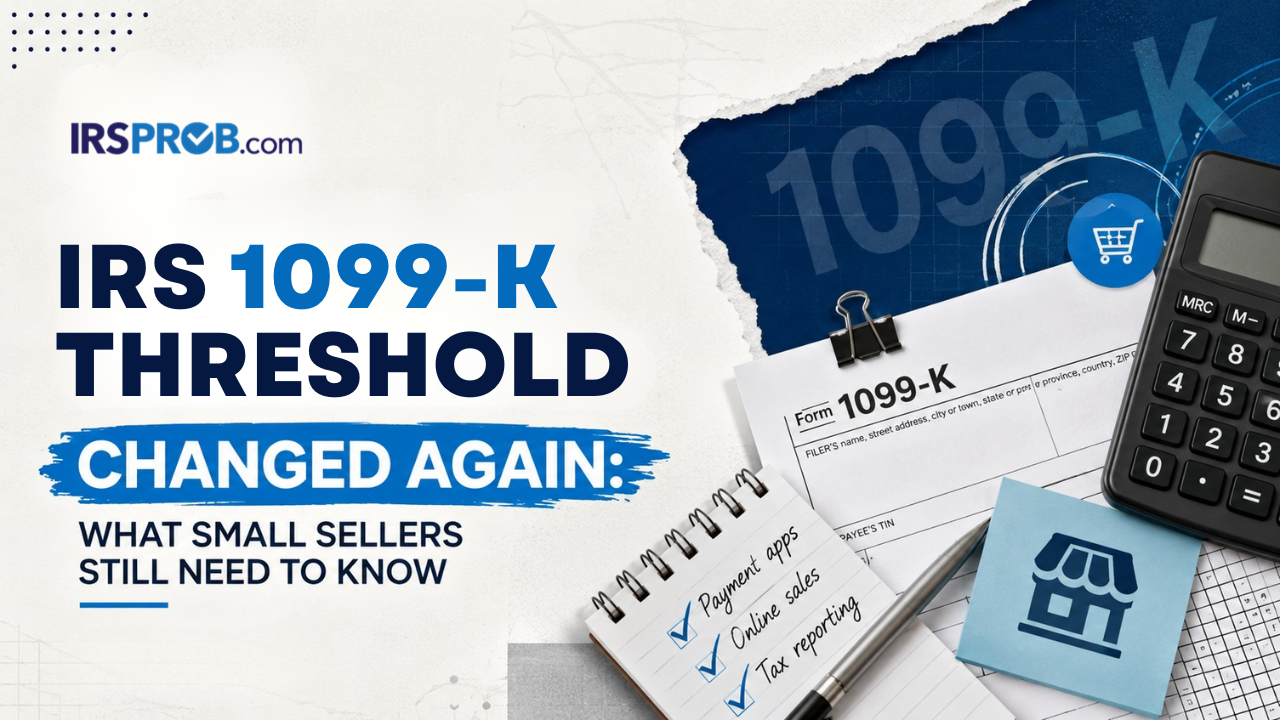
Small sellers have had a lot to keep up with when it comes to Form 1099-K.
For a while, many people expected a much lower reporting threshold. Then the IRS used transition relief. Then the rule changed again.
For federal reporting, third-party settlement organizations, which can include many payment apps and online marketplaces, generally return to the older rule. Form 1099-K is generally required when payments for goods or services are more than $20,000 and there are more than 200 transactions.
That may feel like a relief if you sell only a little online.
But it does not mean the income disappears.
Form 1099-K is a reporting form. It does not decide whether your income is taxable.
If you sell goods or services, your records still matter. A missing 1099-K does not automatically mean there is nothing to report. Receiving one also does not mean the full amount is taxable profit.
That is the part small sellers need to understand before filing.
- What the 1099-K Threshold 2026 Change Means
- Why a Missing 1099-K Does Not Mean the Income Is Tax-Free
- Why the 1099-K Amount Is Not Always Taxable Profit
- What Small Sellers Should Track Before Filing
- Personal Payments Are Different From Business Payments
- Selling Personal Items Can Be Different
- What To Do If You Receive Form 1099-K
- What To Do If the 1099-K Looks Wrong
- What If You Do Not Receive a 1099-K?
- Why State Rules May Still Matter
- When Small Sellers Should Get Help
- FAQs About the 1099-K Threshold 2026
What the 1099-K Threshold 2026 Change Means
The 1099-K threshold 2026 change matters because many sellers were preparing for a lower reporting threshold.
Now, for federal reporting by third-party settlement organizations, the general rule is back to more than $20,000 in payments for goods or services and more than 200 transactions.
This can apply to many payment apps and online marketplaces, depending on how the payments are processed.
That may include platforms like PayPal, Venmo, Cash App, Stripe, Etsy, eBay, Poshmark, Facebook Marketplace, and similar services.
The key word is reporting.
The threshold affects when a platform generally has to send Form 1099-K to you and the IRS.
It does not decide whether the money itself is taxable.
There is another important point. Payment card transactions can be different from payment app or marketplace reporting. The $20,000 and 200-transaction threshold should not be treated as the rule for every possible Form 1099-K.
You may also receive Form 1099-K from a payment card processor because payment card transactions do not follow the same de minimis threshold.
A platform may also send Form 1099-K below the federal threshold because of platform policy, state reporting rules, backup withholding, or the way the payment was processed.
So do not assume a form is impossible just because you were under the federal threshold.
And do not assume no form means no income.
You can review the IRS guidance on the Form 1099-K threshold change for more detail.
It does not decide whether your sales income is taxable, and it does not replace your records.
Why a Missing 1099-K Does Not Mean the Income Is Tax-Free
This is where many small sellers get into trouble.
Form 1099-K does not create the tax rule. It only reports certain payments.
If you sell goods or services, taxable income may still need to be reported even if no Form 1099-K arrives.
That can include income from online sales, side work, freelance services, gig work, resale activity, or small business payments.
The form may not show up.
The income still might.
That is why Form 1099-K should not be your bookkeeping system.
If you know you received payments for goods or services, review your records. Look at what came in, what it was for, and what expenses or adjustments apply.
The IRS may receive information from forms, records, and other reporting sources. More importantly, your tax return should be based on your facts, not just on whether a platform mailed a form.
Why the 1099-K Amount Is Not Always Taxable Profit
Receiving Form 1099-K can create the opposite problem.
Some taxpayers see the number on the form and assume the whole amount is taxable profit.
That is not always right.
Form 1099-K generally reports gross payments. Gross payments are not the same as net profit.
The form may not subtract things like:
- Platform fees
- Refunds
- Returns
- Chargebacks
- Shipping costs
- Cost of goods sold
- Supplies
- Business expenses
- The original cost of a personal item sold
That difference matters.
A seller may have $15,000 in gross payments, but the actual profit could be much lower after fees, refunds, product costs, and other expenses.
A casual seller may sell a used personal item for less than they originally paid. That is different from buying inventory to resell for profit.
Form 1099-K can be a starting point.
It is not always the final taxable number.
This is why clean records matter. They help show what the form does and does not explain.
The IRS has more guidance on understanding your Form 1099-K.
Fees, refunds, returns, chargebacks, cost of goods sold, basis, and business expenses may all affect the final tax answer.
What Small Sellers Should Track Before Filing
Good records do not have to be fancy.
They just need to be clear enough to show what happened.
If you sell through payment apps or online marketplaces, gather your records before filing. Do not wait until a tax form arrives.
Useful records may include:
- Form 1099-K forms received
- Platform sales reports
- Payment app statements
- Bank deposits
- Invoices
- Receipts
- Refunds
- Returns
- Chargebacks
- Platform fees
- Shipping costs
- Cost of goods sold
- Supplies
- Mileage or business expenses, if they apply
- Personal item purchase records
- Records showing gifts, reimbursements, or personal transfers
The goal is to separate gross payments from taxable income.
For a business seller, that usually means tracking income and expenses.
For a casual seller, it may mean showing whether a personal item was sold at a gain or a loss.
For someone who uses the same payment app for personal and business activity, it may mean separating customer payments from gifts, reimbursements, or personal transfers.
The cleaner your records are, the easier it is to explain the numbers.
Personal Payments Are Different From Business Payments
Not every payment app transfer is business income.
Money from a friend to split dinner, a roommate reimbursing rent, or a family member sending a birthday gift is different from a customer paying for goods or services.
Still, records matter.
Payment apps may let users label transactions as personal or business. Use those labels carefully when you can.
It is also smart to avoid mixing personal and business payments in the same account.
When everything runs through one place, it becomes harder to explain what was taxable, what was personal, and what may have been reported by mistake.
If personal payments appear on a Form 1099-K, do not ignore the form.
Review it, document the issue, and take steps to address it.
Selling Personal Items Can Be Different
Many small sellers are not running a full business.
Some are simply clearing out old clothes, furniture, tools, electronics, collectibles, or household items.
That can be confusing when a payment app or marketplace is involved.
Selling personal items at a loss is generally different from selling inventory or business property.
For example, if you bought a couch years ago for more than you later sold it for, that is not the same as buying products to resell for profit.
But if you sell a personal item for more than your original cost, there may be taxable gain.
Form 1099-K may not show that difference.
It may only show the gross payment. It does not know what you originally paid, whether the item was personal, or whether you sold it at a loss.
That is why receipts, screenshots, invoices, purchase records, or other proof can matter.
The form reports the payment.
Your records explain the story behind it.
What To Do If You Receive Form 1099-K
If Form 1099-K arrives, do not set it aside without reviewing it.
Start with the basics.
Check your name, taxpayer identification number, platform or issuer, gross payment amount, and account details.
Then compare the form to your own records.
Look at your sales reports, payment app statements, bank deposits, refunds, fees, chargebacks, and returns.
Ask a few practical questions:
- Was this for goods or services?
- Were personal payments included?
- Does the amount match the platform report?
- Were refunds or chargebacks included in the gross number?
- Were fees taken out somewhere else?
If you run a business, use the form along with your books and records to report the correct income.
If you sold personal items, review whether the sales created a gain or loss.
If the number looks too high, do not panic. Gross payment reporting can look higher than profit because it may not subtract expenses or adjustments.
Treat the 1099-K like a document to review, not a final answer.
The IRS also explains what to do with Form 1099-K if you receive one.
What To Do If the 1099-K Looks Wrong
A wrong Form 1099-K should not be ignored.
If the form includes incorrect information, start with the issuer or payment platform.
Look for the filer information on the form. Contact the platform and ask for a corrected Form 1099-K if needed.
Keep records of your communications.
Save emails, support chats, case numbers, corrected forms, and screenshots.
If the form involves backup withholding or payment card transactions, the reporting rules may be different from the TPSO threshold.
If the platform will not correct the form before you need to file, do not assume you should wait forever. You may need to file using the best available information and explain the correct tax treatment based on your records.
That is a good time to get help.
A wrong information return can create IRS matching problems later, especially if the IRS receives a form that does not match what appears on your return.
The answer is not to ignore it.
The answer is to document it.
Ask the issuer for a correction, keep proof of your communications, and file based on the best available records.
What If You Do Not Receive a 1099-K?
If no Form 1099-K arrives, you may still need to report taxable income.
Use your own records.
Review platform reports, payment app deposits, invoices, bank statements, and receipts.
Do not wait for a form if you already know you received income from goods or services.
This matters for smaller sellers who are below the federal reporting threshold but still had taxable profit.
No form does not mean no facts.
And the absence of a form is not a bookkeeping system.
If you sell regularly, keep records during the year. It is much easier than trying to rebuild everything during tax season.
Why State Rules May Still Matter
The federal threshold is not always the whole story.
Some states may have lower Form 1099-K reporting thresholds.
That means you could receive Form 1099-K even if you did not exceed the federal $20,000 and 200-transaction threshold.
This can surprise sellers who only look at the federal rule.
IRSProb.com focuses on federal IRS issues, but state rules can still affect what forms you receive and what records you need.
If you are unsure, review your state rules or ask a qualified tax professional.
When Small Sellers Should Get Help
Some 1099-K situations are simple.
Others are not.
It may be time to ask for help if:
- You received Forms 1099-K from multiple platforms
- The form amount is much higher than your actual profit
- Personal and business payments are mixed together
- The form includes personal payments
- You sold personal items and are unsure about gain or loss
- You have missing records
- Business expenses are unclear
- You are unsure whether the activity is a business or hobby
- The 1099-K appears to be wrong
- You received an IRS notice
- State reporting rules are involved
A tax professional cannot make the form disappear.
But they can help you review what the form means and how the income should be reported.
That matters if the IRS later asks questions.
The IRS will look at the form, the return, and the records. If those do not line up, the taxpayer may need to explain the difference.
IRSProb.com helps taxpayers review IRS notices, tax reporting problems, penalty issues, and situations where tax forms do not match the return. If Form 1099-K led to an IRS issue, the next step is to understand what was reported, what was actually taxable, and what records support the return.
For related guidance, see IRSProb.com resources on social media tax advice and IRS penalties and interest.
Need help with a 1099-K, IRS notice, or reporting problem?
IRSProb.com can help review tax reporting issues, IRS notices, penalty concerns, and situations where tax forms do not match the return.
Visit IRSProb.com or call 214-214-3000.
Request a Free Tax ConsultationFAQs About the 1099-K Threshold 2026
What is the 1099-K threshold for 2026?
For federal reporting by third-party settlement organizations, Form 1099-K is generally required only when gross payments for goods or services exceed $20,000 and the number of transactions exceeds 200.
Payment card transactions can be different, and a form may still be issued below the TPSO threshold in some situations.
If I do not get a 1099-K, do I still report the income?
Yes, if the income is taxable.
The reporting threshold affects whether a platform generally has to send the form. It does not decide whether income must be reported.
Is the full 1099-K amount taxable?
Not always.
Form 1099-K generally reports gross payments. Taxable profit may depend on refunds, fees, chargebacks, cost of goods sold, basis, expenses, and the facts.
Are personal payments from friends and family taxable?
Personal gifts and reimbursements are generally different from payments for goods or services.
But records matter if a payment app or platform reports something incorrectly.
What should I do if my 1099-K is wrong?
Review it against your records.
Contact the issuer or payment platform. Ask for a corrected form if needed. Keep copies of communications and supporting documents.
Do not ignore the form.
Can I ignore small sales if no form arrives?
No.
If the income is taxable, it may still need to be reported even when no Form 1099-K arrives.
Why did I receive a 1099-K if I was below the federal threshold?
A platform may still send Form 1099-K below the federal threshold in some cases.
State reporting rules may be lower, payment card transactions may be reported without the TPSO threshold, or backup withholding may trigger reporting.
Review the form and compare it with your records before filing.