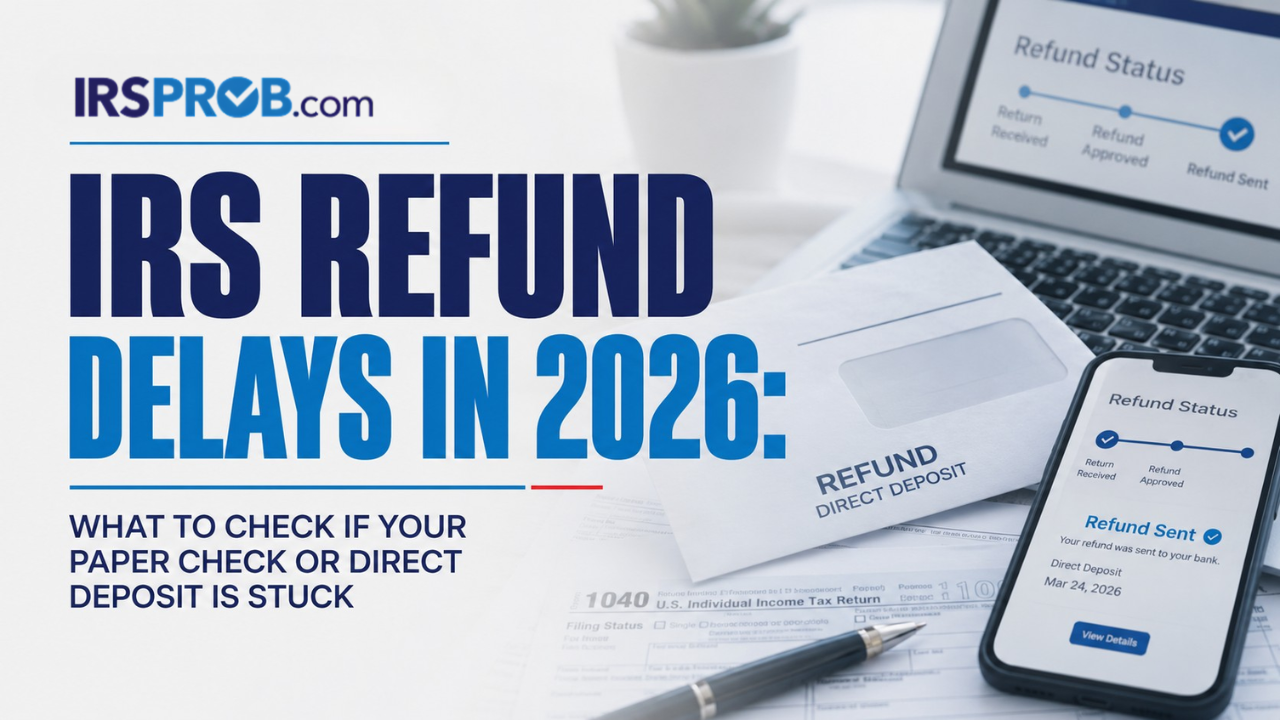
If your IRS refund delay 2026 issue is still unresolved, do not assume the refund is lost.
The delay may involve direct deposit, paper check delivery, a CP53E notice, return review, identity verification, a refund offset, or another IRS processing issue.
Those are not all the same problem.
Start with the basics. Check Where’s My Refund. Read any IRS notice carefully. Then figure out whether the delay is about how the refund is being sent, or whether the IRS is still reviewing the return.
Also, be careful with scams.
Do not give banking information through random texts, emails, phone calls, or suspicious links.
A delayed refund is frustrating. But the first step is not guessing.
The first step is finding out why it is stuck.
- Why IRS Refund Delay 2026 Questions Are Getting Attention
- Start With Where’s My Refund
- Check Whether You Received a CP53E Notice
- Do Not Give Bank Information Through Random Calls, Texts, or Emails
- If Direct Deposit Was Rejected
- If You Expected a Paper Check
- If the IRS Is Reviewing Your Return
- If Identity Verification Is Involved
- If Your Refund Was Offset
- What To Review Before You Call the IRS
- When To Get Help With a Delayed Refund
- FAQs About IRS Refund Delays in 2026
Why IRS Refund Delay 2026 Questions Are Getting Attention
Refund delays are getting more attention in 2026 because refund delivery has changed for some taxpayers.
Some delays are tied to direct deposit.
Some involve paper check delivery.
Others involve IRS review, identity verification, refund offsets, or other processing issues.
That is why one taxpayer’s refund delay may look very different from another taxpayer’s delay.
If your refund did not arrive, the IRS may not have lost it. The issue may be how the IRS is trying to send it. Or the return may need more review before the refund can be released.
That difference matters.
The next step depends on the reason for the delay.
A direct deposit problem, paper check issue, return review, identity verification request, or refund offset can each require a different next step.
Start With Where’s My Refund
Before you call the IRS, check the official refund status.
Use Where’s My Refund on IRS.gov or the IRS2Go app.
You will usually need your Social Security number or ITIN, filing status, tax year, and exact refund amount from the return.
Do not rely only on your bank account activity.
Your refund status may show whether the refund was received, approved, sent, delayed, or affected by another issue.
That gives you a starting point.
Also compare the refund status with any IRS notice you received. If the IRS mailed a notice, it may explain what is holding up the refund and what you need to do next.
Check Whether You Received a CP53E Notice
A CP53E notice is a real IRS notice.
It may be sent when your refund is affected by missing, invalid, or rejected bank information.
In plain English, the IRS may need you to add or update direct deposit information before it can send the refund electronically.
If you receive a CP53E notice, read it closely.
The notice generally gives you 30 days from the date of the CP53E notice to update or add bank information through IRS Online Account, or to explain why banking information cannot be provided.
This is important.
You generally cannot fix this by calling the IRS and giving your bank information over the phone. IRS employees cannot update bank account information for you by phone under the CP53E process.
The IRS also says taxpayers only get one opportunity to add or update bank information through IRS Online Account under this process.
CP53E is only one possible refund delay issue. You should still check Where’s My Refund and review any other IRS notices you receive.
If you receive this notice, use IRS Online Account and the official notice instructions. Do not try to update bank information by phone.
Do Not Give Bank Information Through Random Calls, Texts, or Emails
Refund delays create an easy opening for scams.
If someone texts, emails, or calls saying they need your bank information to release your refund, slow down.
Do not click random links.
Do not give your routing number, bank account number, Social Security number, or IRS login information to someone who contacts you out of nowhere.
For CP53E, the IRS says it will contact taxpayers by U.S. mail, not by phone or text, to request banking information.
Use IRS.gov, IRS Online Account, or the official instructions in the notice.
If a notice includes a link or QR code, confirm the page is secure and that the URL includes .gov before entering information.
You can also review the Taxpayer Advocate Service warning about whether a CP53E notice is a scam.
Scammers know people get anxious when refunds are delayed. They use that pressure to make taxpayers act fast.
Do not let urgency make the decision for you.
If Direct Deposit Was Rejected
Direct deposit can fail for simple reasons.
- The routing number may be wrong.
- The account number may be wrong.
- The bank account may be closed.
- The name on the account may not match.
- The bank may reject the deposit.
If direct deposit was rejected, or if banking information is missing or invalid, the refund may be delayed until you follow IRS instructions or until the IRS issues a paper check under the CP53E process.
If you receive a CP53E notice, follow the instructions carefully.
Do not assume the refund will automatically go to another account.
Do not assume a paper check is mailed right away.
Check the notice. Check your refund status. Then follow the official next step.
If You Expected a Paper Check
Some taxpayers still expect a paper check.
In 2026, that may cause more confusion.
The IRS is moving toward electronic payments for federal disbursements, including tax refunds, with limited exceptions.
That does not mean paper checks are impossible.
It does mean you should not assume a paper check will be mailed immediately just because direct deposit did not work.
If you receive a CP53E notice and take no action, the IRS says it will issue a paper check after six weeks, assuming there are no other issues with the return.
For more context, review the IRS modernizing payments Q&A and the Taxpayer Advocate Service update on direct deposit changes for 2026.
So if you expected a paper check, check your refund status and read any IRS notice carefully.
The delay may be about delivery, not the return itself.
If the IRS Is Reviewing Your Return
Not every refund delay is about a bank account.
Sometimes the IRS is reviewing the return before releasing the refund.
That review may involve income, withholding, credits, deductions, possible errors, missing information, or identity information.
That does not automatically mean you did anything wrong.
It means the IRS may need more time or more information before the refund can be released.
If the IRS sends a notice, read what it asks for before responding.
Do not send random documents without understanding the issue.
If the notice is confusing, get help before sending a response.
If Identity Verification Is Involved
Identity verification can also delay a refund.
The IRS may need to confirm that the return was really filed by you before it releases the money.
If you receive an identity verification notice, follow the official IRS instructions.
Do not use links from random texts or emails.
Do not call a phone number unless you can confirm it came from the IRS notice or IRS.gov.
Identity verification can take longer than a regular refund delay, especially if possible identity theft is involved.
Keep copies of notices, dates, and anything you submit.
If Your Refund Was Offset
Sometimes a refund is not lost.
It was applied to another debt.
A refund may be reduced or applied to past-due federal tax, certain other federal debts, state income tax debt, child support, or other qualifying obligations depending on the facts.
If that happens, you should usually receive a notice explaining the offset.
If the refund was reduced through a debt offset, the Bureau of the Fiscal Service may provide the offset notice. The IRS may not have all the offset details.
If the offset notice comes from the Bureau of the Fiscal Service, follow the instructions on that notice.
Do not assume the offset is wrong.
Do not assume it is right either.
Start by finding out what debt the refund was applied to.
You can review IRS information about reduced refunds.
If you needed the refund because of financial hardship, there may be additional issues to review, especially if old federal tax debt is involved.
IRSProb.com also has more on offset bypass refund issues.
If another debt reduced the refund, review the offset notice before assuming the IRS simply lost the payment.
What To Review Before You Call the IRS
Before calling the IRS, get organized.
It can save time and help you ask better questions.
Gather:
- A copy of the filed return
- The filing date
- The expected refund amount
- The Where’s My Refund result
- IRS Online Account notifications
- Any CP53E notice
- Any other IRS notice
- The bank account used for direct deposit
- Your current mailing address
- Any refund offset notice
- Any identity verification notice
- Information about old IRS balances or missing returns
Then ask one simple question:
What kind of delay is this?
Is it direct deposit?
Paper check delivery?
Return review?
Identity verification?
Refund offset?
A missing notice?
Once you know the category, the next step is easier to understand.
When To Get Help With a Delayed Refund
Some refund delays are simple.
Others are not.
You may want help if the refund is delayed, the CP53E notice is confusing, direct deposit was rejected, identity verification is involved, the refund may have been offset, or the IRS notice is missing or unclear.
Help may also make sense if the return has been under review for a long time, the delay is causing financial hardship, or old IRS balances and missing returns may be affecting the refund.
Professional help does not guarantee a faster refund.
But it may help you identify the issue and decide what to do next.
IRSProb.com helps taxpayers review IRS notices, refund problems, offset issues, tax balances, and IRS account concerns.
You can also review IRSProb.com resources on IRS refund delays, fast refund promises, social media tax advice, and IRS penalties and interest.
If your refund is stuck, the first goal is simple.
Find out why.
Then decide the next step.
Need help with an IRS refund delay in 2026?
IRSProb.com can help review IRS notices, refund problems, offset issues, tax balances, and IRS account concerns before you take the next step.
Visit IRSProb.com or call 214-214-3000.
Request a Free Tax ConsultationFAQs About IRS Refund Delays in 2026
Why is my IRS refund delayed in 2026?
Your refund may be delayed because of direct deposit issues, paper check delivery, return review, identity verification, refund offset, missing information, or another IRS processing issue.
Start by checking Where’s My Refund and reviewing any IRS notice.
What is a CP53E notice?
A CP53E notice is an IRS notice related to refund delivery.
It may mean your bank information is missing, invalid, or rejected. The notice may ask you to add or update direct deposit information through IRS Online Account, or explain why banking information cannot be provided.
Can I update my bank information by calling the IRS?
No, not for the CP53E process.
IRS employees cannot update your bank account information by phone. If CP53E applies, use IRS Online Account and follow the official instructions in the notice.
Will the IRS automatically send a paper check if direct deposit fails?
Not always right away.
If you receive a CP53E notice and take no action, the IRS says it will issue a paper check after six weeks, assuming there are no other issues with the return.
You should still check your refund status and read the notice carefully.
Could my refund have been used to pay another debt?
Yes.
A refund may be reduced or applied to certain debts, depending on the facts.
Review any offset notice before assuming the refund is lost.
If the offset notice comes from the Bureau of the Fiscal Service, follow the instructions on that notice.
What should I do if I think the notice is a scam?
Do not click suspicious links or give banking information through texts, emails, phone calls, or random websites.
Verify the notice through IRS.gov, IRS Online Account, or the official instructions in the notice.
For CP53E, the IRS says it will contact taxpayers by U.S. mail, not by phone or text, to request banking information.