Owing the IRS is stressful enough.
It is even harder when you know you cannot afford a monthly payment without falling behind on rent, groceries, utilities, medicine, insurance, or other basic costs.
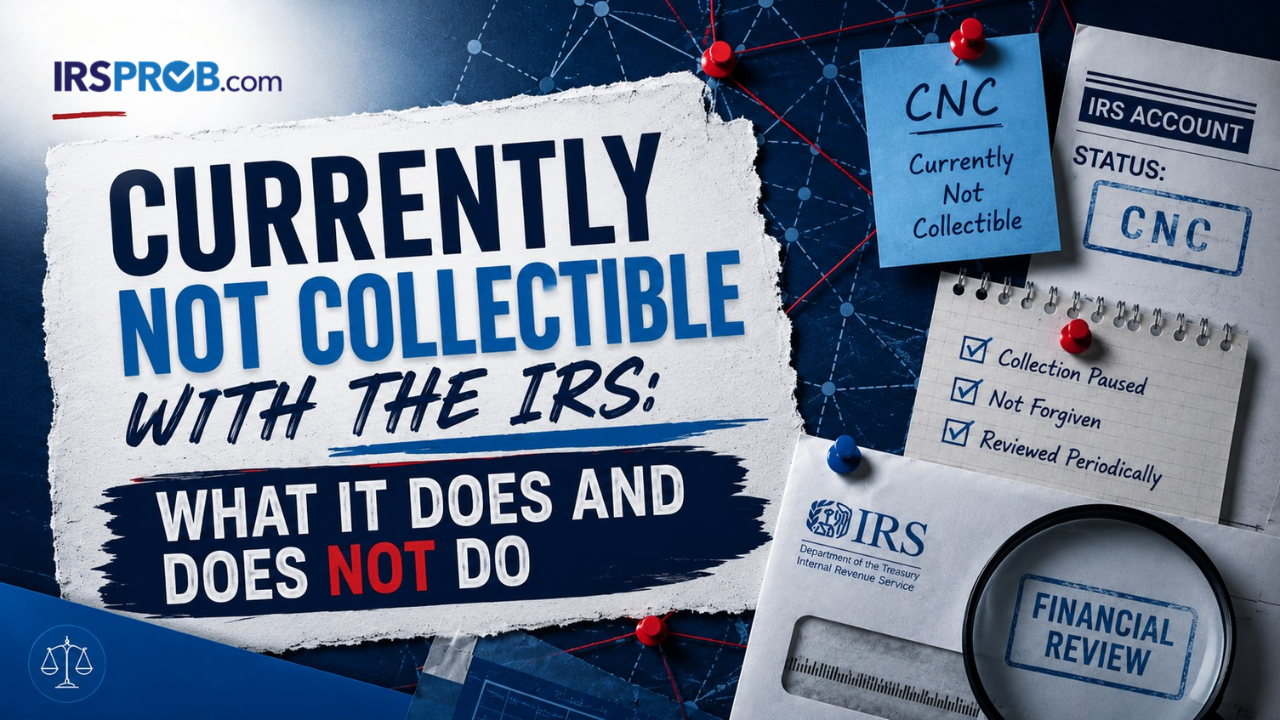
That is where Currently Not Collectible, often called CNC, may come up.
Currently Not Collectible IRS status may give you some breathing room when the IRS agrees you cannot pay because of financial hardship.
But it is important to understand what CNC really means.
It is not tax forgiveness.
It does not make the debt disappear. Penalties and interest may continue. The IRS may periodically review your financial condition later to determine whether you can make payments. If you are due a future federal tax refund, the IRS can apply it to the unpaid tax debt while the account is in CNC status.
That does not mean CNC is useless.
For the right taxpayer, it can be a practical option when a payment plan is not realistic. You just need to know what it does, what it does not do, and what the IRS may ask for before they agree.
- What Currently Not Collectible IRS Status Means
- Who May Need To Review CNC
- What the IRS May Review Before Granting CNC
- What CNC May Do
- What CNC Does Not Do
- Penalties and Interest Can Still Continue
- Future Refunds May Still Be Applied to the Debt
- The IRS May Still File a Tax Lien
- CNC Is Temporary, Not Permanent
- CNC vs. an IRS Payment Plan
- CNC vs. Offer in Compromise
- When To Get Help Before Asking for CNC
- FAQs About Currently Not Collectible IRS Status
What Currently Not Collectible IRS Status Means
Currently Not Collectible means the IRS has determined that you cannot afford to pay your tax debt right now.
That last part matters.
CNC is based on your current financial situation. It is usually considered when paying the IRS would keep you from covering basic living expenses.
That may include housing, food, utilities, transportation, medicine, insurance, and other necessary costs.
If the IRS agrees, it may place your account in Currently Not Collectible status and temporarily suspend most collection activities.
That can take pressure off for a while.
But it does not erase the debt.
You still owe the balance. Penalties and interest may continue. The IRS may also review your account again later if your income or financial situation changes.
Think of CNC as a pause.
Not a settlement.
Not forgiveness.
Not a promise that the IRS will never look at the account again.
You can review the IRS explanation of how it may temporarily delay the collection process.
Currently Not Collectible status may temporarily suspend most collection activity, but the tax debt is still owed.
Who May Need To Review CNC
CNC may be worth reviewing if paying the IRS would keep you from meeting basic living expenses.
That could include someone living paycheck to paycheck, a retired taxpayer on fixed income, someone dealing with medical costs, someone recovering from job loss, or someone trying to keep the household stable with limited income.
It may also come up when an IRS payment plan is too much.
A payment plan only helps if the payment is realistic. If the payment causes you to miss rent, skip medication, fall behind on utilities, or default on other necessary bills, it may not be the right fit.
CNC may also be worth reviewing if collection notices are coming in, but there is no real ability to pay.
Still, CNC is not automatic.
The IRS has to agree that you cannot currently pay. They usually look at income, expenses, assets, and records before making that decision.
CNC does not have one fixed income limit. The IRS looks at the taxpayer’s current financial situation and ability to pay after basic living expenses.
The question is not simply, “Do I want to pay?”
The real question is, “Can I pay without creating financial hardship?”
IRSProb.com also has more background on the IRS hardship program and Currently Not Collectible status.
What the IRS May Review Before Granting CNC
The IRS will usually want to see the numbers.
That means your income, expenses, assets, and overall ability to pay.
The IRS may ask for a Collection Information Statement. Depending on the situation, that could involve Form 433-F, Form 433-A, or Form 433-B.
The IRS may also ask for proof of financial status, including information about assets, monthly income, and expenses.
That can include pay stubs, bank statements, monthly bills, housing costs, medical expenses, transportation costs, property information, and other financial records.
The IRS also uses collection financial standards when reviewing some collection cases.
This is not a place to guess.
If the numbers are incomplete or do not match the records, the IRS may not agree with the hardship request.
Before asking for CNC, it helps to gather:
- Recent IRS notices
- Recent tax returns
- Pay stubs or income records
- Bank statements
- Rent or mortgage details
- Utility bills
- Medical costs
- Insurance costs
- Vehicle and transportation costs
- Asset information
- Dependent or household expense records
- Details about any current payment plan
The IRS may also look at whether required tax returns have been filed.
That matters.
If you have missing returns, the IRS may ask you to file them before or during the CNC review.
For broader collection context, review IRS Topic No. 201, The Collection Process.
CNC is based on current financial hardship. Income, expenses, assets, and filing compliance can all matter.
What CNC May Do
CNC may give you room to breathe.
If the IRS agrees that you cannot pay because of financial hardship, CNC may temporarily suspend most collection activities, but it does not stop every IRS action.
That can help when you are under pressure and a payment plan does not fit your real budget.
It can also help you avoid agreeing to a payment plan just because you are scared.
CNC may give you time to stabilize your finances.
But it does not mean the IRS issue is finished.
It simply means the IRS has recognized that collection may not be realistic based on your current financial situation.
CNC does not mean, “You do not owe.”
It means, “You cannot pay right now.”
What CNC Does Not Do
This is the part that needs to be clear.
CNC does not erase the tax debt.
It does not settle the balance.
It does not automatically remove penalties.
It does not automatically stop interest.
It does not mean the IRS will never contact you again.
It does not guarantee the IRS will never file a Notice of Federal Tax Lien.
It does not protect every future refund.
It does not remove future filing responsibilities.
It also does not mean your account will stay in CNC forever.
You may still receive IRS bills or notices while the account is in CNC status.
CNC can pause pressure.
It does not wipe the slate clean.
That is why it needs to be understood before you rely on it.
Penalties, interest, future refunds, tax liens, and future filing duties still need to be reviewed.
Penalties and Interest Can Still Continue
This is one of the biggest surprises for taxpayers.
CNC may delay most collection activity, but penalties and interest may still continue.
That means the balance may grow even while the IRS is not actively collecting from you.
That does not mean CNC is a bad option.
It just means you should understand the tradeoff.
If you truly cannot pay, CNC may still be the most practical option to review. But it is not the same as stopping the balance from increasing.
If penalties are a large part of the balance, penalty relief may be worth reviewing separately.
Do not assume you qualify.
Do not assume you do not.
The facts matter.
IRSProb.com has more information on IRS penalties and interest and IRS penalty relief.
Future Refunds May Still Be Applied to the Debt
Some taxpayers think CNC protects future refunds.
That is not a safe assumption.
If you are due a future federal tax refund, the IRS can apply it to the unpaid tax debt while the account is in CNC status.
That can be frustrating, especially if you were counting on the refund for household expenses.
A refund offset does not always mean something went wrong.
It may simply mean the IRS applied the refund to the balance you already owe.
If a refund is important to your household budget, bring that up before relying on CNC.
The IRS May Still File a Tax Lien
CNC may pause most collection activity, but it does not guarantee the IRS will avoid every collection-related step.
The IRS may still file a Notice of Federal Tax Lien to protect the government’s interest.
A lien is not the same as a levy.
A lien is a legal claim against property.
A levy is the legal seizure of property or assets.
That difference matters because taxpayers often use those words like they mean the same thing. They do not.
If your notice mentions a lien, or if a lien has already been filed, take that seriously.
CNC may help with some collection pressure, but lien issues should still be reviewed.
You can also review IRSProb.com’s guide to the IRS collection process.
CNC Is Temporary, Not Permanent
Currently Not Collectible status is temporary.
There is no single time period that applies to every taxpayer.
The IRS may periodically review your financial condition later to determine whether you can make payments. If your income improves or your expenses change, the IRS may decide you can make payments again.
That does not mean CNC failed.
It just means CNC is based on your current ability to pay.
If the facts change, the IRS may review the account again.
You also still need to stay current going forward.
That means filing required tax returns. It also means making required estimated tax payments or payroll tax deposits when those apply.
CNC does not give you permission to fall behind again.
It is meant to deal with a current hardship, not create a new tax problem.
Staying current matters because new tax debt can create new collection problems.
The Taxpayer Advocate Service also explains Currently Not Collectible status and what taxpayers should understand.
CNC vs. an IRS Payment Plan
CNC and a payment plan are not the same thing.
A payment plan may make sense if you can afford monthly payments.
CNC may make sense if you cannot pay anything without falling behind on basic living expenses.
One is not automatically better than the other.
The right option depends on the numbers.
If you can afford a reasonable monthly payment, an installment agreement may help you manage the debt over time.
If you cannot afford a payment without creating hardship, CNC may be worth reviewing.
The mistake is agreeing to a payment just to get through the phone call.
A payment plan that fails can create more stress. CNC may help when there is no real ability to pay, but it does not make the balance go away.
The budget matters.
Make sure the payment fits the real household numbers.
You can review IRS guidance on payment plans and installment agreements.
CNC vs. Offer in Compromise
Some taxpayers confuse CNC with an Offer in Compromise.
They are different.
CNC is a temporary collection delay based on financial hardship.
An Offer in Compromise is a request to settle a tax debt for less than the full amount owed, if the taxpayer qualifies and the IRS accepts the offer.
CNC does not settle the debt.
It does not create a reduced payoff.
It does not mean the IRS has agreed to accept less.
For some taxpayers, CNC may be more realistic than an Offer in Compromise. For others, a payment plan or settlement review may make more sense.
The right option depends on income, expenses, assets, tax years, compliance, and the amount owed.
Do not choose based on the name of the program.
Choose based on the facts.
IRSProb.com has more information about an Offer in Compromise. The Taxpayer Advocate Service also explains Offer in Compromise basics.
When To Get Help Before Asking for CNC
Some CNC requests are simple.
Others are not.
It may be smart to get help before asking for CNC if you have multiple tax years, unfiled returns, business tax issues, payroll tax issues, pending levy action, lien concerns, old tax debt, failed payment plans, confusing IRS account history, or assets that may affect the review.
Help may also be useful if you disagree with the IRS balance or do not understand how the amount was calculated.
Professional review does not guarantee CNC approval.
But it may help you understand whether CNC fits before you make the wrong move.
That can matter when the IRS is asking for financial information.
It can also matter when collection action is already moving.
IRSProb.com helps taxpayers review IRS notices, unpaid tax balances, collection issues, penalty problems, and hardship options.
If you cannot afford to pay the IRS without falling behind on basic living expenses, CNC may be one option to review.
The goal is not to avoid the IRS.
The goal is to understand what you can afford and what option fits your situation.
Need help reviewing Currently Not Collectible IRS status?
IRSProb.com can help review IRS notices, unpaid balances, collection concerns, penalty issues, and hardship options before you take the next step.
Visit IRSProb.com or call 214-214-3000.
Request a Free Tax ConsultationFAQs About Currently Not Collectible IRS Status
Does Currently Not Collectible erase IRS debt?
No.
CNC does not erase, forgive, or cancel the debt. It may temporarily delay most collection activity when the IRS agrees you cannot currently pay because of financial hardship.
The balance is still owed.
Do penalties and interest stop during CNC?
No, not automatically.
Penalties and interest generally continue until the balance is paid in full or otherwise lawfully adjusted.
That means the balance may still grow while the account is in CNC status.
Can the IRS still file a lien if I am in CNC?
Possibly.
CNC may pause most collection activity, but taxpayers should not assume it prevents every IRS action.
The IRS may still file a Notice of Federal Tax Lien to protect the government’s interest. Lien risk should be reviewed based on the facts.
Can the IRS take my refund if I am in CNC?
Yes, it can.
If you are due a future federal tax refund, the IRS can apply it to the unpaid tax debt while the account is in CNC status.
If you are counting on a refund, that issue should be reviewed before you rely on CNC.
How long does Currently Not Collectible last?
It depends.
CNC is based on your financial condition. The IRS may periodically review your financial condition later to determine whether you can make payments.
There is no single time period that applies to everyone.
Do I need to file future tax returns while in CNC?
Yes.
CNC does not remove future filing responsibilities.
You still need to file required tax returns and stay current with future tax obligations. Falling behind again can create new problems.
Is CNC better than a payment plan?
Not always.
A payment plan may fit if you can afford monthly payments.
CNC may fit if you cannot pay without creating financial hardship.
The better option depends on income, expenses, assets, tax years, compliance, and the balance owed.