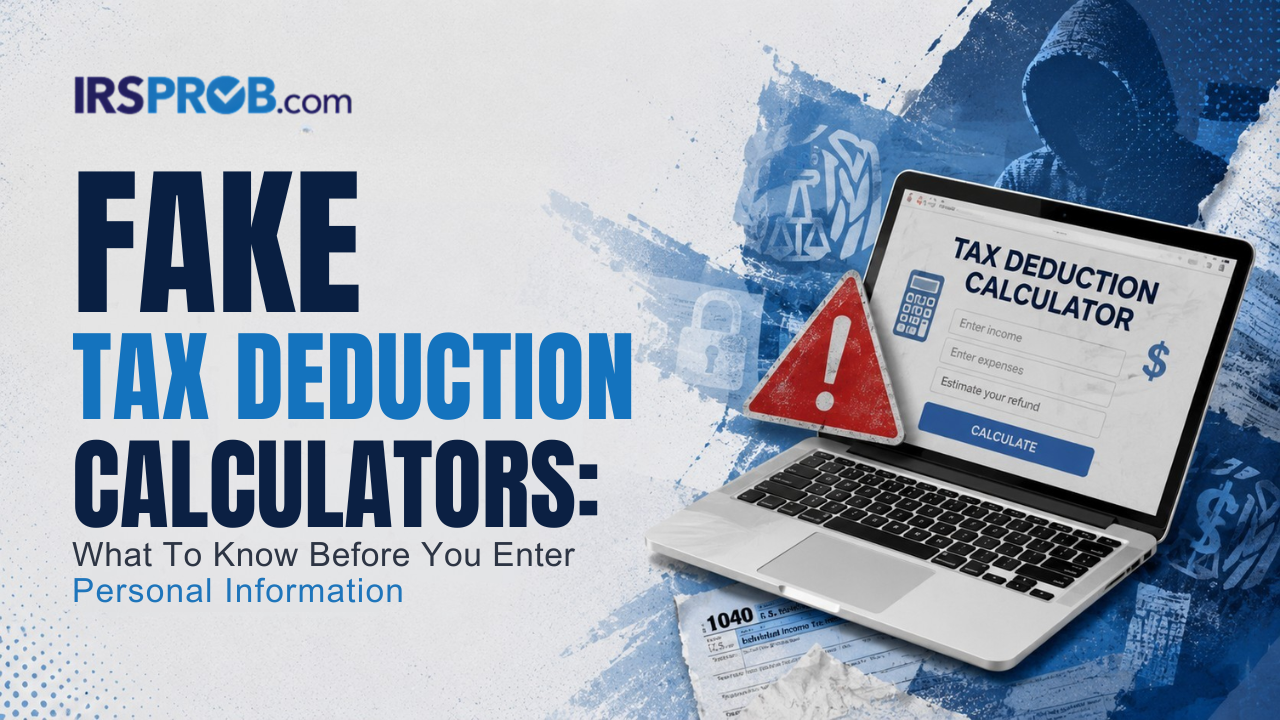
A tax calculator can be helpful.
But not every calculator online deserves your personal information.
The IRS has warned that fake tax deduction calculator tools and online tax tools may exploit confusion around new tax law changes to promise refunds, deductions, or credits that sound too easy.
Before you enter your Social Security number, bank details, income information, or IRS login details, slow down and check who is behind the tool.
A legitimate calculator should help you estimate.
It should not guarantee a large refund or pressure you to enter sensitive information before you understand the source.
If the answer sounds too easy, check the source first.
- Why Fake Tax Deduction Calculators Are Getting Attention
- What a Fake Tax Deduction Calculator May Look Like
- Red Flags Before You Enter Personal Information
- A Calculator Result Is Not the Same as Tax Advice
- Be Careful With New Tax Law Claims
- How To Check Whether a Tax Tool Is More Trustworthy
- What Information You Should Be Careful Sharing
- What To Do If You Already Entered Personal Information
- When To Ask a Tax Professional Instead
- FAQs About Fake Tax Deduction Calculators
Why Fake Tax Deduction Calculators Are Getting Attention
Tax rules can be confusing, especially when new laws, credits, or deductions are being discussed online.
That confusion creates an opening for scammers.
A taxpayer may see an ad, social media post, text, or website that says they qualify for a new deduction or bigger refund. The tool may look simple. It may only ask a few questions at first. Then it may ask for personal, banking, or tax information before the taxpayer knows whether the website is trustworthy.
That is the risk.
The problem is not that every online calculator is bad.
Some tax tools are legitimate. The IRS has official tools on IRS.gov, and many trusted tax software companies and professional firms provide calculators that can be useful.
The problem is trusting a tool too quickly.
A fake tax deduction calculator may be designed to collect information, push a questionable tax claim, or lead taxpayers into filing something that does not match their facts.
You can review the IRS warning on fake tax deduction calculators for more background.
If a tax tool guarantees a large refund or asks for sensitive information too quickly, slow down and verify the source.
What a Fake Tax Deduction Calculator May Look Like
A fake calculator may look polished.
It may use tax language. It may mention the IRS. It may talk about new deductions, new credits, or a limited opportunity to claim money.
But a professional-looking page does not always mean the tool is safe.
A fake tax deduction calculator may:
- Promise a large refund before reviewing real facts
- Claim that “everyone qualifies”
- Use IRS-looking colors, seals, or language
- Ask for your Social Security number too early
- Ask for bank account information
- Ask for IRS Online Account login details
- Pressure you to act now
- Come from a random social media ad, text, email, or sponsored link
- Hide who owns or operates the website
The biggest warning sign is pressure.
A trustworthy tool should not make you feel rushed. It should not make the result sound guaranteed. It should not ask for more information than it needs.
Red Flags Before You Enter Personal Information
Before using any tax calculator, look for red flags.
Be careful if the tool promises a guaranteed refund.
A guaranteed large refund is a warning sign, not proof that the calculator is correct.
Be careful if it says everyone qualifies.
Be careful if it uses phrases like “limited-time IRS benefit,” “hidden refund,” “instant approval,” or “claim before it closes.”
Also be careful if the calculator asks for sensitive information before explaining why it needs it.
That may include:
- Your full Social Security number
- Bank account information
- Routing number
- IRS login details
- Driver’s license number
- Copies of tax forms
- Prior-year tax return details
Some tax tools may need detailed information to estimate properly. But the more sensitive the information, the more carefully you should check the source first.
Also look at the website itself.
- Is there a clear company name?
- Is there real contact information?
- Is there a privacy policy?
- Does the tool explain how the estimate works?
- Does it say the result is only an estimate?
- Can you verify the tax rule on IRS.gov?
If the website hides who is behind it, that is a reason to pause.
A real tax result depends on your facts, records, and current rules. A calculator cannot prove you qualify in a few seconds.
A Calculator Result Is Not the Same as Tax Advice
A calculator can estimate.
It cannot fully review your tax situation.
A real tax answer may depend on your filing status, income, deductions, credits, dependents, business records, documentation, prior tax issues, and the exact rule being claimed.
That is especially true when the calculator talks about a new deduction or credit.
A calculator result should not be treated as proof that you qualify.
It should also not be treated as permission to file a risky claim.
That is where taxpayers can get hurt.
If a taxpayer claims a deduction or credit they do not qualify for, the IRS may later question the return. That can lead to delays, notices, penalties, interest, or the need to fix the return.
The calculator will not be the one answering the IRS notice.
The taxpayer will.
That is why the result should be checked before it is used on a return.
Be Careful With New Tax Law Claims
Scammers often use new tax law language because it sounds timely and official.
They may say there is a new deduction, new credit, special refund, or hidden benefit. They may make it sound like taxpayers need to act quickly before the opportunity disappears.
Sometimes the wording is vague on purpose.
The goal is to get the taxpayer to click, enter information, or believe they qualify before reviewing the real rules.
Watch for claims like:
- “New IRS refund available”
- “Everyone qualifies”
- “Guaranteed tax savings”
- “Fast cash from new tax law”
- “IRS-approved calculator”
- “Claim your hidden deduction”
- “Do this before the IRS closes the program”
New tax law changes do not mean every taxpayer gets a bigger refund.
They also do not mean a random calculator can confirm eligibility in a few seconds.
If a tax benefit is real, there should be a way to verify it through IRS.gov, a qualified tax professional, or reliable tax guidance.
You can also review IRS guidance on tax scams related to new tax law changes.
How To Check Whether a Tax Tool Is More Trustworthy
You do not have to avoid every tax calculator.
You just need to check the source.
Before using a calculator, ask a few simple questions.
- Is it on IRS.gov?
- Is it from a known tax software provider, CPA firm, bank, or financial institution?
- Does it explain what it calculates?
- Does it tell you the result is only an estimate?
- Does it avoid asking for banking details?
- Does it avoid asking for your IRS login?
- Does it explain assumptions, limits, or documentation needs?
- Can you verify the tax rule somewhere reliable?
Official IRS tools should be on IRS.gov. Be careful with lookalike web addresses, misspellings, or sites that use IRS-style language but are not actually government websites.
Also look at the website address.
Scammers may create pages that look official but are not actually IRS.gov. A page can use IRS-style language and still be fake.
If the tool claims to be connected to the IRS, verify that the site is actually IRS.gov before entering information.
A trusted tool should make the process clearer, not pressure you into a decision.
For comparison, the IRS provides official tools such as the Tax Withholding Estimator on IRS.gov.
What Information You Should Be Careful Sharing
Some information should make you pause before you type.
Be careful with your Social Security number, date of birth, bank account details, routing number, IRS Online Account login, employer information, wage information, dependent information, driver’s license details, copies of tax forms, and prior-year tax return information.
That does not mean those details are never needed in tax work.
A real tax professional may need records to prepare or review a return.
A legitimate tax software provider may need detailed information when you are actually preparing a return.
But a random calculator on the internet should not get sensitive information before you know who is collecting it and why.
The more personal the information, the more important it is to verify the source.
Do not enter Social Security numbers, bank details, IRS login information, or verification codes into a site you have not verified.
What To Do If You Already Entered Personal Information
If you already entered information into a calculator and now feel unsure, do not ignore it.
Start by saving what you can.
Take screenshots of the website, emails, texts, ads, or messages. Save the website address. Write down what information you entered.
Then stop using the site until you know more.
If you shared bank information, contact your bank.
If you shared login details, change your password. If you used the same password somewhere else, change it there too.
If you shared an IRS verification code, Online Account login, or tax identity information, act quickly and review IRS identity theft guidance.
If you shared tax information or your Social Security number, watch for IRS notices or account activity you do not recognize.
If the message claimed to be from the IRS, Treasury, or was tax-related, report it through official IRS scam-reporting guidance.
IRS says suspected scam sites and emails can be forwarded to phishing@irs.gov. Taxpayers may also file complaints with TIGTA or the FTC when appropriate.
You can review IRS guidance on how to report fake IRS, Treasury, or tax-related messages.
If you already filed a return based on a questionable calculator or refund claim, talk with a qualified tax professional before filing anything else.
The goal is not to panic.
The goal is to limit damage and avoid making the problem worse.
When To Ask a Tax Professional Instead
Some situations need more than a calculator.
Professional review may be smart if the calculator says you qualify for a large deduction, the rule is new or unclear, self-employment income is involved, business deductions are involved, dependents or credits are complicated, or the tool asks for sensitive information.
It may also be smart to get help if you already filed using questionable advice or received an IRS notice about a deduction, credit, or refund claim.
A tax professional cannot promise a bigger refund.
But they can help review the facts before you claim something risky.
That matters because the IRS looks at the return, the records, and the law. Not just the calculator result.
IRSProb.com helps taxpayers review IRS notices, tax problems, penalty issues, questionable refund claims, and IRS account concerns. If a calculator or online tax claim led to an IRS issue, the next step is to understand what was claimed, what records support it, and what the IRS is asking for.
For related guidance, see IRSProb.com articles on social media tax advice and fast refund promises under new tax rules.
Worried a tax calculator or online refund claim may have caused an IRS problem?
IRSProb.com can help review IRS notices, questionable refund claims, tax reporting concerns, and IRS account issues before you take the next step.
Visit IRSProb.com or call 214-214-3000.
Request a Free Tax ConsultationFAQs About Fake Tax Deduction Calculators
Are all online tax calculators scams?
No.
Some online tax calculators are legitimate and useful. The concern is with calculators that make big promises, ask for sensitive information too early, or hide who is behind the website.
Is an IRS-looking calculator always safe?
No.
Scammers can copy IRS-style language, colors, or design. If a tool claims to be connected to the IRS, verify that the website is actually IRS.gov before entering sensitive information.
Should I enter my Social Security number into a tax calculator?
Be careful.
Many basic calculators do not need your full Social Security number. If a tool asks for sensitive information early, stop and verify the source first.
Can a calculator prove I qualify for a deduction?
No.
A calculator may estimate, but eligibility depends on your facts, records, and current tax rules. A calculator result is not proof that you qualify.
What should I do if I already entered personal information?
Stop using the site, save records of what happened, and monitor your bank, credit, and IRS activity.
If banking information, login details, an IRS verification code, or tax identity information was shared, take action quickly.
Review IRS identity theft and scam-reporting resources, and get help if you think your tax return or IRS account may be affected.