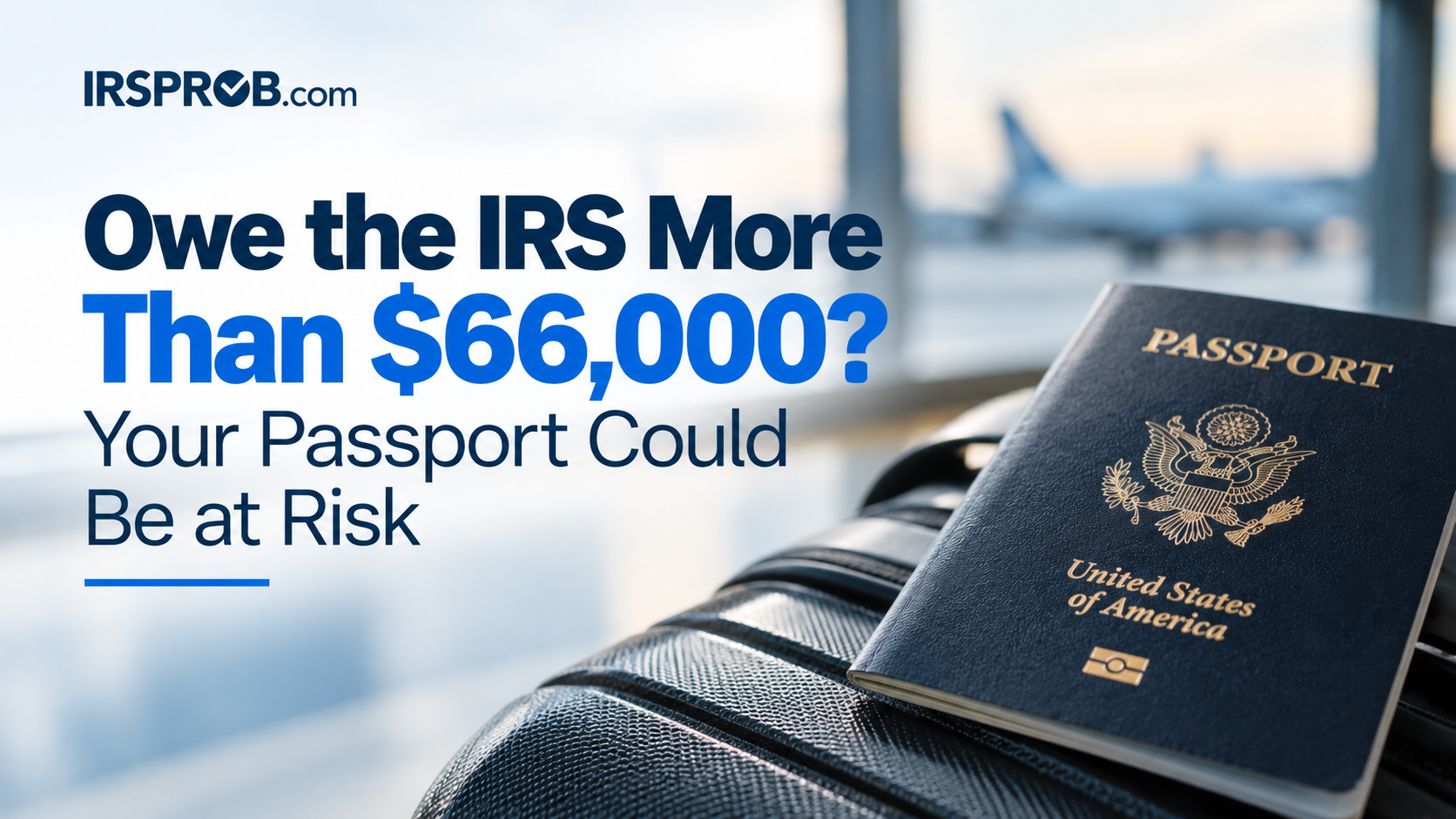
IRS passport tax debt can create a problem many taxpayers do not expect: trouble getting, renewing, or keeping a U.S. passport.
Most people expect IRS debt to affect their bank account, paycheck, or property.
They do not expect it to affect their passport.
But in 2026, certain taxpayers with seriously delinquent federal tax debt of more than $66,000 can have that debt certified to the U.S. Department of State.
That does not mean your passport disappears the moment your balance hits $66,001. The IRS has to meet additional requirements, and some taxpayers fall into exceptions or non-certification categories.
The notice to watch for is CP508C. If you receive it, the IRS has already certified your debt to the State Department.
And there is one rule many people miss: if your debt has already been certified, simply paying it down below $66,000 does not automatically make the passport problem go away.
The number matters. But where your IRS case stands matters even more.
What Happened in the 2026 Spencer Case?
In Spencer, No. 6078-25P (U.S. Tax Ct. Jan. 29, 2026), Lloyd T. Spencer had roughly $1.6 million in trust fund recovery penalty liabilities, plus interest.
The IRS had already taken collection steps, and in March 2025 it issued CP508C and certified the debt to the State Department.
Spencer challenged the certification.
He had previous installment agreements and had proposed an Offer in Compromise, but the agreements were no longer in effect and the offer had already been rejected.
The Tax Court upheld the certification.
You can read more about the 2026 Spencer passport tax case.
An old payment plan or a rejected Offer in Compromise will not protect you from passport certification. What matters is whether a current exception or IRS non-certification category applies when the IRS certifies the debt.
IRS Passport Tax Debt: 5 Things You Need to Know
1. Owing More Than $66,000 Does Not Automatically Cost You Your Passport
For 2026, the threshold is more than $66,000 in qualifying unpaid federal tax debt.
Assessed penalties and interest count toward that amount.
But crossing the threshold is only part of the rule.
The debt generally must be legally enforceable, and the IRS generally must have filed a Notice of Federal Tax Lien with applicable administrative rights exhausted or lapsed, or issued a levy.
So you do not wake up the morning your balance hits $66,001 and suddenly lose your passport.
Qualifying debt can include unpaid income taxes, assessed penalties, interest, trust fund recovery penalties, and certain other federal tax liabilities.
Not every federal debt counts. For example, FBAR penalties are excluded from this passport-certification definition.
Review the IRS rules for seriously delinquent tax debt.
Ask whether your debt actually meets the passport-certification rules and whether any exception or non-certification category applies.
There is also an important rule after certification.
If the IRS has already certified your debt, partial payments that bring the balance below $66,000 do not by themselves require the IRS to reverse the certification.
That can surprise people.
Once certification has happened, you generally need to resolve the certified debt or qualify under an applicable reversal or exclusion rule.
The annual threshold helps determine whether debt can become seriously delinquent. Once the IRS has already certified the debt, a partial payment below that threshold does not by itself require reversal.
2. CP508C Means the IRS Has Already Certified the Debt
CP508C is not a warning that certification might happen later.
It means the IRS has already sent the certification to the State Department.
You can review the IRS explanation of a CP508C notice.
The State Department generally will not issue a new passport to someone with certified seriously delinquent tax debt.
It may also deny a renewal and, in some situations, revoke or limit an existing passport.
But CP508C does not automatically mean your current passport became invalid the day the notice arrived.
If the State Department revokes an existing passport, it generally sends its own notice.
If you apply for or renew a passport while your debt is certified, the State Department generally sends a letter and holds the application open for 90 days from the date of that letter.
That gives you time to resolve the certification or show that it was made in error.
The IRS can also make a separate recommendation that the State Department revoke an existing passport.
Before that type of referral, current IRS procedures provide for Letter 6152.
The tax problem has already reached the passport-certification stage by the time the IRS sends this notice.
3. Some Taxpayers and Tax Debts Are Excluded From Certification
Not everyone who owes more than $66,000 will be certified.
Debt generally is not treated as seriously delinquent when it is being timely paid through an approved IRS installment agreement or an accepted Offer in Compromise.
Other situations can also matter, including certain Department of Justice settlement agreements, certain Collection Due Process hearings involving a levy, and certain innocent spouse requests.
The IRS also says it generally will not certify taxpayers who:
- Are Currently Not Collectible because of hardship
- Have a pending installment agreement request
- Have a pending Offer in Compromise
- Are in bankruptcy
- Are victims of tax-related identity theft
- Are in certain federally declared disaster areas
- Have an accepted adjustment that will fully satisfy the debt
Combat-zone and certain contingency-operation rules can also postpone certification.
This is why timing matters.
Spencer had tried to resolve his tax debt before. But when the IRS certified him, his installment agreements were no longer active and his Offer in Compromise had already been rejected.
An old resolution attempt is not the same as a current exception.
4. You May Not Have to Pay the Entire Balance at Once
If you receive CP508C and owe $80,000, $200,000, or more, your first thought may be:
"I cannot pay this. My passport is gone."
Do not jump straight to that conclusion.
The IRS can reverse certification when the certified debt is fully resolved or when an applicable exception or non-certification category now applies.
Depending on the facts, that can include:
- Timely payments under an approved installment agreement
- An accepted Offer in Compromise
- Currently Not Collectible status based on hardship
- Bankruptcy
- Certain pending installment agreement or OIC requests
- Other qualifying circumstances
The right option depends on your finances and collection history.
Sometimes the issue is not affordability at all.
The certification may be wrong because the debt was paid, became legally unenforceable, qualified for an exclusion, or should already have been reversed.
This is where IRSProb can help review the tax side.
The goal is not to grab the fastest-sounding IRS program because you need a passport.
The goal is to find a legitimate resolution that actually fits your case.
For a broader overview, review IRSProb's IRS tax resolution options.
But the option has to genuinely fit your IRS account and satisfy the applicable passport-certification rules.
And remember: if certification already happened, simply paying enough to get below $66,000 does not automatically reverse it.
Once the IRS is required to reverse certification, it generally notifies the State Department within 30 days.
The taxpayer generally receives CP508R confirming the reversal.
That 30-day period is about IRS notification.
It is not a promise that the State Department will issue or restore a passport within 30 days.
5. Do Not Wait Until the Week of Your International Trip
A tax problem feels very different when you already have a flight booked.
If you know you owe a large amount to the IRS, do not wait until the week before departure to find out whether the debt has been certified.
For taxpayers with an open or pending passport application and international travel planned within the next 45 days, current IRS guidance says to contact the IRS promptly.
There is an expedited process in qualifying cases.
The IRS says it can generally shorten its normal decertification processing time to around 9 to 16 days when the requirements are met.
But it is not automatic.
The taxpayer generally needs an open passport application or renewal request, proof of travel, and required State Department documentation.
So do not assume a plane ticket creates a shortcut.
The better move is to deal with the tax problem before your international travel date becomes another problem.
Can IRSProb Help With an IRS Passport Problem?
If you receive CP508C, the first question is not simply how much you owe.
We want to know why the debt was certified and where your IRS account stands today.
Which tax years are involved?
What collection action has happened?
Is an installment agreement active or pending?
Was an Offer in Compromise submitted or rejected?
Does financial hardship need to be reviewed?
Should the certification already have been reversed?
Those details can change the strategy.
IRSProb can work on the federal tax issue behind the passport certification.
That may include reviewing IRS records and notices, evaluating collection alternatives, communicating with the IRS, and determining whether the certification appears correct.
What IRSProb cannot do is issue a passport or guarantee that the State Department will approve, renew, or restore one.
IRSProb works on the federal tax problem behind the passport-certification issue.
Received CP508C or worried that your IRS debt may affect your passport?
Start by determining whether the debt meets the certification rules, whether an exception applies, and which legitimate IRS resolution options fit your financial situation.
Review IRS Tax Resolution OptionsWhat If You Think the IRS Got the Certification Wrong?
If you believe the certification is wrong, do not ignore CP508C.
Start by contacting the IRS using the information on the notice and find out why the debt was certified.
Federal law also allows judicial review in the U.S. Tax Court or a U.S. District Court.
You can review the statute in IRC §7345.
But the court's role in an IRC §7345 passport-certification case is narrow.
It generally decides whether the certification was erroneous or whether the IRS failed to reverse it when required.
That proceeding does not give the court authority to release an IRS lien or levy or award damages.
It also is not automatically a second chance to reopen every old tax dispute.
That limitation mattered in Spencer.
The court reviewed the passport certification, not every earlier disagreement with the IRS.
Frequently Asked Questions About IRS Passport Tax Debt
Does owing more than $66,000 automatically revoke my passport?
No. The amount is only part of the rule. Additional certification requirements apply, and exclusions or non-certification categories may matter.
If I pay my balance below $66,000, will the IRS reverse my certification?
Not automatically. Once the debt has been certified, partial payments that bring the balance below the annual threshold do not by themselves require reversal.
What does CP508C mean?
It means the IRS has already certified your seriously delinquent federal tax debt to the State Department.
Can I still use my existing passport after CP508C?
Possibly. CP508C itself does not automatically revoke an existing passport. The State Department separately handles revocation and provides notice.
Can an installment agreement help?
Yes, depending on the facts. An approved agreement being paid on time can qualify, and certain pending installment agreement requests can also matter under current IRS rules.
How long does reversal take?
When reversal is required, the IRS generally notifies the State Department within 30 days. The State Department then handles the passport itself.
Final Thoughts
Most people expect IRS debt to create problems with their money.
They do not expect it to create problems with their passport.
But when federal tax debt reaches the seriously delinquent stage and the IRS certifies it to the State Department, that can happen.
If you owe more than $66,000, do not assume your passport is automatically gone.
And if you are already certified, do not assume that simply paying the balance below $66,000 fixes the problem.
Find out why the debt was certified, whether an exception applies, and which legitimate IRS resolution options fit your situation.
The sooner you understand where your IRS case stands, the more time you have to deal with the tax problem before it becomes a travel problem too.