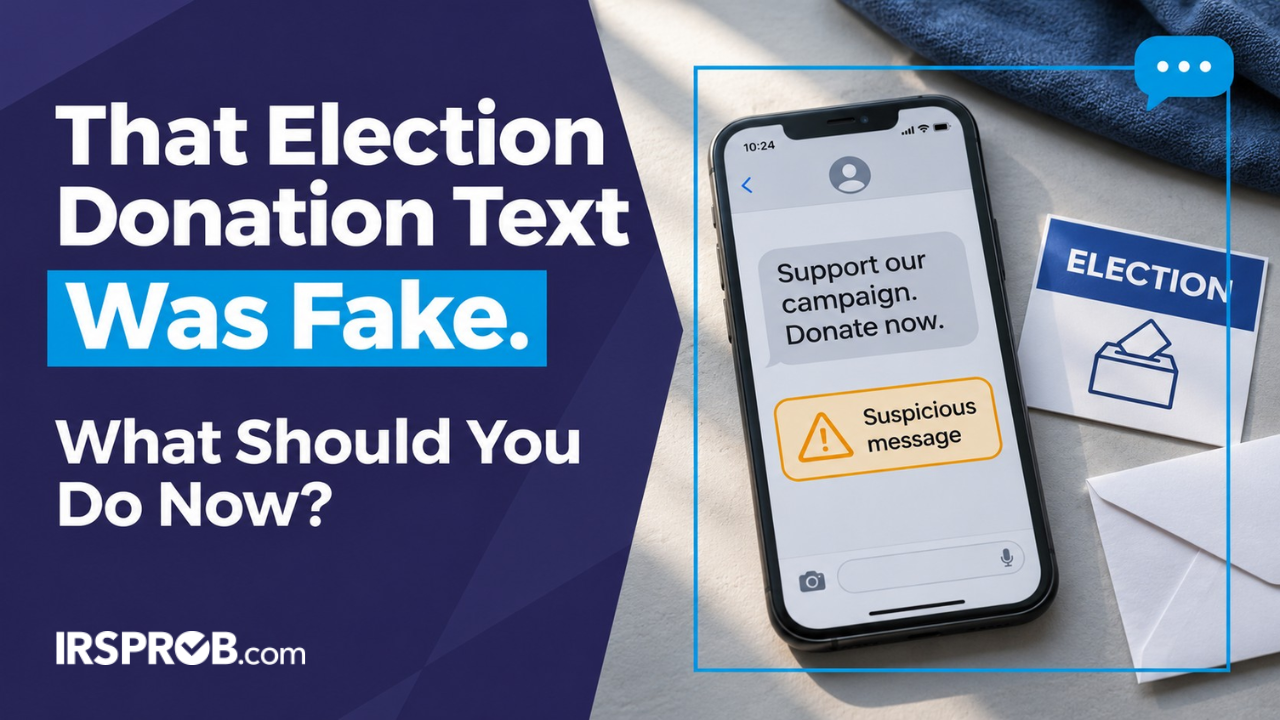
The election donation text looked real. It used a familiar candidate's name and an urgent message. You clicked, gave $50, and went back to your day.
Then something felt off.
The receipt named an organization you did not recognize. The website address did not match the campaign's official site. A few days later, another charge appeared on your card.
This is a realistic example. Legitimate campaigns send fundraising texts, but scammers copy their names, logos, slogans, and photos.
Do not blame yourself. Protect your money, preserve the evidence, and assess what information was exposed.
Election Donation Text Scams Are Real
On October 15, 2026, the FBI warned that scammers could exploit the midterm election through fraud schemes observed during previous elections. The warning covered fake campaign contributions, ScamPACs, political merchandise that never arrives, fake voter-registration pages, and messages designed to steal personal information.
Some use artificial intelligence. Others copy campaign designs and redirect donors.
That does not mean every fundraising text is fake. It means the name on your screen is not enough to establish who is behind the message.
Was It a Fake Campaign Text or a Real Fundraising Message?
Campaigns may use outside fundraising platforms, but these warning signs deserve a closer look:
- The message creates extreme pressure to donate immediately.
- The website address contains misspellings, extra words, or an unfamiliar ending.
- The payment page asks for your Social Security number or online banking password.
- The sender promises that a political donation will earn a financial return.
- The message asks for gift cards, cryptocurrency, or a wire transfer.
- The charge is larger than you approved or repeats without clear permission.
- The receipt does not identify the campaign, committee, or payment processor.
- The sender claims your voter registration will be canceled unless you pay.
What to Do After an Election Donation Text
Step 1: Preserve the Message and Payment Records
Before deleting anything, take screenshots of the text, website, payment page, and receipt. Save the date, amount, and payment method.
Save follow-up emails and the exact name on your statement. If the website disappears, your screenshots may help investigators or your financial provider.
Step 2: Write Down What Information You Shared
If you entered only a card number, the immediate issue may be unauthorized charges. If you also entered a password, date of birth, driver's license number, Social Security number, or bank login, the risk is broader.
List what you shared and every account that used the same password.
Step 3: Contact the Bank, Card Issuer, or Payment Service
Use the number on your card, the provider's official app, or its known website. Do not use information from the suspicious text.
Explain that the campaign page may have been fraudulent. Ask whether the payment can be stopped or disputed and whether the account should be replaced.
Recovery is not guaranteed, but acting quickly may improve your options.
The Federal Trade Commission's guide on what to do if you were scammed gives payment-specific steps for cards, bank transfers, payment apps, gift cards, wires, and cryptocurrency.
Step 4: Stop Unauthorized Recurring Charges and Secure Your Accounts
Tell your card issuer or payment provider that you want unauthorized future charges blocked. Do not rely only on an unsubscribe link from the suspicious organization.
Change any password you entered. If you reused it, change it elsewhere too, starting with email, banking, tax software, and payment apps. Turn on multifactor authentication.
If your information was exposed but you do not know whether it was used, visit IdentityTheft.gov/databreach for protective steps. If identity theft occurred, use IdentityTheft.gov to report it and obtain a recovery plan.
A credit freeze restricts access to your credit report and must be requested from all three nationwide credit bureaus. A fraud alert tells businesses to verify your identity and can be started through one bureau. The FTC explains the differences in its guide to credit freezes and fraud alerts.
Step 5: Verify the Campaign or Political Committee
Type the candidate's or committee's official web address yourself. Compare its donation page, processor, and receipt information with yours.
You can also search the Federal Election Commission's committee database for federal candidates, parties, and political action committees.
Finding a committee is useful, but not a guarantee. The FBI warns that some ScamPACs may appear registered. Confirm that the message actually came from the listed organization.
If the text claims to involve a state or local race, the relevant state election agency may have the appropriate registration records.
Step 6: Report the Election Donation Scam
Report election-related financial scams to the FBI's Internet Crime Complaint Center. Include the sender’s number, website address, payment details, and a description of what happened. IC3 does not accept attachments, so keep screenshots and original records securely in case investigators request them.
You can also report consumer fraud at ReportFraud.ftc.gov. For a suspicious text, you may forward the message to 7726, which spells SPAM, and use your phone's junk-reporting feature.
Report an unauthorized payment to the financial company separately. A government report does not automatically start a bank dispute for you.
Step 7: Protect Your Tax Identity if Sensitive Information Was Exposed
If the page collected your Social Security number or ITIN, consider getting an IRS Identity Protection PIN.
An IRS IP PIN is a six-digit number that helps stop someone from using your SSN or ITIN on a fraudulent federal return. It does not block card charges, loans, or other identity theft.
Review your IRS Online Account for unfamiliar activity. Do not ignore unexpected IRS mail.
How to Verify a Political Campaign or PAC
For a federal committee, use the FEC database to compare its name, identification number, website, filings, and payment receipt. Connect any processor to the committee. Registration does not prove every message using its name is authorized.
Should You Get an IRS IP PIN?
You do not have to wait for a fraudulent return. Taxpayers who can verify their identity may request an IP PIN voluntarily.
An IP PIN can add protection if your SSN or ITIN was exposed. Keep it private. The IRS issues a new number each calendar year for applicable federal returns filed that year.
An IP PIN is not a complete identity-theft plan. Secure accounts, change passwords, and monitor your credit when appropriate.
When Form 14039 May Be Appropriate
Form 14039 is the IRS Identity Theft Affidavit. It addresses specific tax-related misuse, such as a fraudulent federal return, dependent claim, or employment under your SSN or ITIN. Not every dependent-claim dispute is identity theft. The form says not to use it when a dependent’s identity was misused by a parent or guardian in filing taxes.
Clicking a bad link does not automatically mean you should file Form 14039. Even sharing your SSN does not prove a false return was filed.
Warning signs include an e-file rejection saying a return was already filed, an IRS notice about an unfamiliar return, or income from an employer you do not know.
Follow the instructions on any IRS letter. Filing the wrong form can delay the response. If you receive confusing IRS mail, first learn how to review an IRS notice before responding.
Are Political Contributions Tax Deductible?
Generally, no. IRS Publication 529 says contributions to candidates and campaign committees are not deductible. The same applies to admission to a political fundraising dinner or an ad benefiting a candidate.
That remains true even when the candidate or cause is important to you. Political organizations and qualified charitable organizations are not the same thing for federal deduction purposes.
Do not put the payment on Schedule A as a charitable gift just because the receipt uses the word “donation.” The recipient and purpose matter.
Can You Deduct Money Lost to an Election Donation Scam?
A stolen payment is not automatically deductible.
IRS Publication 547 explains that certain financial scam losses may qualify when the conduct is theft under state law, there is no reasonable recovery prospect, and the transaction was entered into for profit.
An ordinary political contribution is usually made for personal or political reasons, not to earn a profit. That makes it very different from an investment scam. A fake campaign page does not turn a personal political payment into an investment merely because the recipient was dishonest.
If the scheme promised a financial return, the analysis may differ. Purpose, state law, recovery rights, tax basis, and other facts matter. See how investment scam losses may be treated for taxes before claiming a loss.
Also account for any refund, chargeback, insurance payment, or reasonable recovery claim. You should not claim a tax loss for money that was returned to you.
Keep a Clean Record of What Happened
Keep the text, screenshots, receipts, statements, reports, and bank correspondence in one folder. Record each call date and dispute reference number.
If a tax issue appears later, the file can show what was exposed and when you responded.
What to Do Next
Start with the problem in front of you.
If money moved, contact the payment provider. If a password was exposed, change it. If your SSN or ITIN was shared, consider an IP PIN and follow an identity-theft recovery plan. Preserve the evidence and file the appropriate reports.
Then handle the tax question separately. A political contribution is generally not deductible, and a scam loss does not automatically create a tax deduction.
The goal is to close the open doors and keep a clear record.
Frequently Asked Questions
Are all election donation texts scams?
No. Legitimate campaigns, parties, and political committees use text messages to raise money. Verify the sender through an official website or government database instead of relying on the link in the message.
What if the charge is from a name I do not recognize?
It may be a payment processor. Ask the official campaign whether it uses that company. If the charge remains unfamiliar, contact your card issuer.
Can I cancel a recurring political donation through my bank?
Contact the legitimate recipient, if one exists, and your financial provider. Explain clearly if the charge was unauthorized.
Should I file Form 14039 because I clicked the link?
Not automatically. Secure your accounts, consider an IP PIN if tax identity information was exposed, and use Form 14039 only when its instructions fit.
Is a political donation a charitable deduction?
Generally, no. Contributions to candidates, campaign committees, and political parties are not federal charitable deductions.
Can a fake donation be deducted as a theft loss?
Usually not when it was an ordinary personal political payment. Certain profit-motivated financial scams can require a different analysis, subject to strict rules.
Where should I report a fake campaign donation page?
Report the fraud to IC3 and the FTC, and report the payment to your financial provider. The real campaign or platform may also need to know.
What if the scammer used a real committee's name?
Contact the committee through independently verified information. A real committee name can be copied onto a fake text or website, so the name alone does not prove the request was authorized.
Need tax consultation? Contact us.
Speak with IRSProb about your tax questions. Call 214-214-3000.
Visit IRSProb.com