You may remember what you originally owed the IRS.
That does not mean the balance is still sitting at that same number.
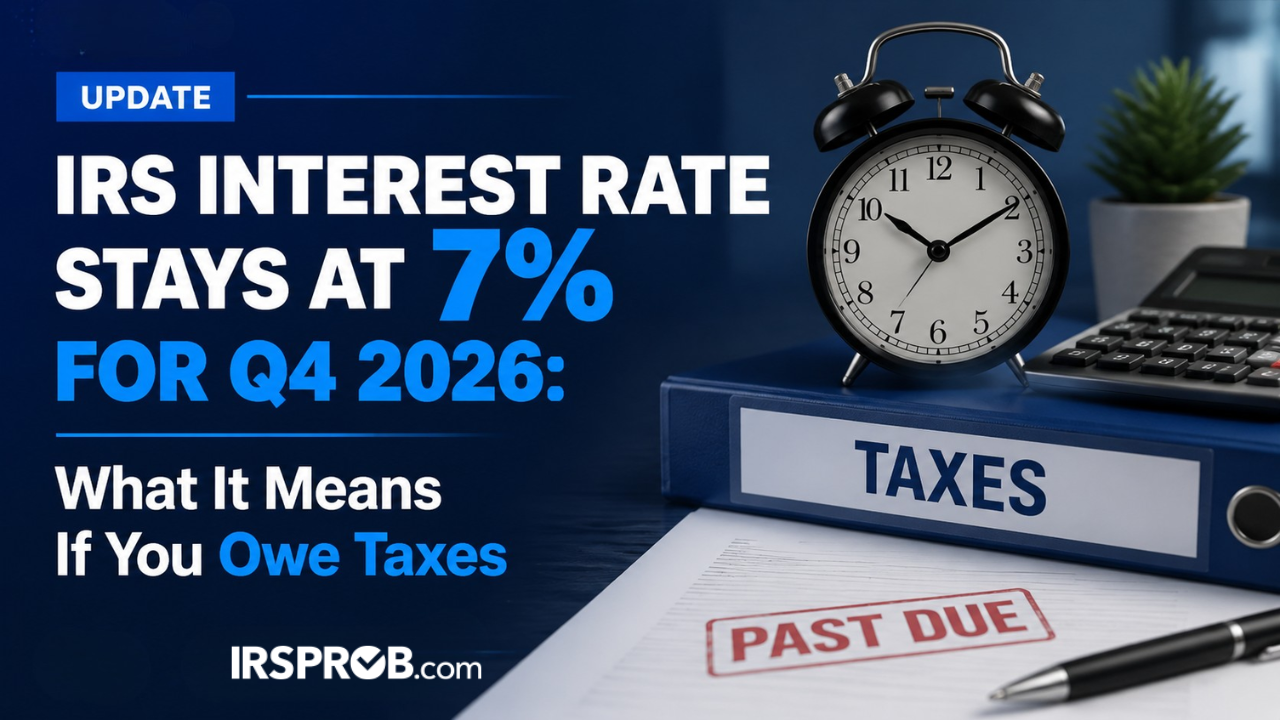
For Q4 2026, the IRS interest rate 2026 for individual underpayments will be 7% per year, compounded daily, beginning October 1.
Seven percent may not sound dramatic in an IRS announcement. But if you already owe taxes, the important part is that an unpaid balance can keep changing.
And if you are already on an IRS payment plan, interest generally does not stop just because you have an agreement in place.
The point is to understand what the 7% rate means and why the amount you owe today may be different from the amount you remember.
This article focuses on the individual underpayment rate. Different IRS interest rates can apply to corporations and other categories.
- What the 7% Q4 Rate Really Means
- Seven Percent Does Not Mean 7% Every Quarter
- What Does Compounded Daily Mean?
- When Does IRS Interest Start?
- IRS Interest and Penalties Are Different
- Does a Payment Plan Stop Interest?
- Does Paying Part of the Balance Help?
- Why Your IRS Balance May Be Higher
- Can IRS Interest Be Removed?
- What If You Cannot Pay in Full?
- What to Do Next
- Frequently Asked Questions
- Final Thoughts
IRS Interest Rate 2026: What the 7% Q4 Rate Really Means
The IRS announced that the underpayment interest rate for individuals will remain 7% per year, compounded daily, for the quarter beginning October 1, 2026.
For this article, think of an underpayment as tax that remained unpaid after it was required to be paid.
The first thing to understand is that 7% is an annual rate.
The second is that IRS interest rates are reviewed quarterly.
So this is the rate for Q4 2026. It does not tell us what the rate will be in 2027, and it does not mean the IRS charges another 7% every three months.
You can review the official IRS Q4 2026 interest-rate announcement directly.
It applies to individual underpayments during Q4 2026 beginning October 1. IRS interest rates are reviewed quarterly and may change in later quarters.
Seven Percent Does Not Mean 7% Every Quarter
It is easy to hear "7% for Q4" and think the IRS is adding 7% during the quarter.
That is not how it works.
The 7% figure is an annual rate. The IRS calculates interest daily while the rate is in effect.
So the rate is not 7% in October, another 7% in November, and another 7% in December.
The actual balance depends on how much remains unpaid, payments, penalties, and whether the IRS changes the rate later.
You can also review the IRS's current quarterly interest rates.
What Does "Compounded Daily" Mean?
You do not need to turn this into a finance lesson.
IRS underpayment interest generally accrues daily on unpaid amounts and is compounded daily.
That means the balance can keep changing while tax remains unpaid.
It also means a simple example like "I owe $10,000, so I will owe exactly $700 more after a year" can be misleading.
Your account may include payments, penalties, credits, adjustments, or more than one tax period. The interest rate can also change from one quarter to the next.
If you want to know what you owe now, check your current IRS account or most recent IRS notice.
Interest, penalties, payments, credits, adjustments, and changes in quarterly interest rates can all affect what the account shows over time.
When Does IRS Interest Start?
IRS underpayment interest generally begins from the applicable due date of the tax and continues until the amount is paid.
This is especially important for taxpayers who filed an extension.
An extension can give you more time to file a return. It generally does not move the payment deadline for purposes of underpayment interest.
So if tax was already due and remained unpaid, the interest generally did not wait until you filed the return.
Filing and paying are connected, but they are not the same thing.
You can review the IRS's current interest guidance for additional information.
IRS Interest and Penalties Are Not the Same Thing
A lot of people look at an IRS balance and call everything above the original amount a penalty.
That can make the account harder to understand.
There are separate pieces.
Tax
This is the underlying federal tax liability.
Interest
Interest generally accrues because an applicable amount remained unpaid after it was due. It normally continues until the balance is paid.
Penalties
Penalties are separate charges that can apply because of specific filing, payment, accuracy, or other compliance problems.
That is why it helps to understand what actually makes up the number on your IRS account.
A $15,000 balance does not necessarily mean $15,000 of original tax. Part of that amount may be interest or penalties added later.
IRSProb has a separate guide explaining IRS penalties and interest and why those amounts should be reviewed separately.
Does an IRS Payment Plan Stop the 7% Interest?
Generally, no.
An IRS installment agreement can give qualifying taxpayers a structured way to pay over time.
What it generally does not do is stop interest on the unpaid balance.
Applicable penalties may also continue.
There is one taxpayer-friendly detail worth knowing.
For an individual who filed the return on time, including extensions, the normal failure-to-pay penalty is generally 0.5% per month or part of a month.
While an approved installment agreement is in effect, that penalty is generally reduced to 0.25% per month or part of a month for a qualifying individual who timely filed.
Interest still continues.
So a payment plan can change part of the cost of carrying the balance, but it does not freeze the account.
That does not make an installment agreement a bad option. If you cannot pay everything at once, a structured agreement may still be useful.
You can review current IRS payment plans or learn more about an IRS installment agreement.
Interest generally continues on the unpaid balance. For certain timely filed individual returns, an approved installment agreement can reduce the failure-to-pay penalty rate while the agreement is in effect.
Does Paying Part of Your IRS Balance Help?
If you cannot pay the entire balance, do not assume the only two choices are "pay it all" or "pay nothing."
Paying part of the balance reduces the amount that remains unpaid.
The IRS generally advises taxpayers who cannot pay in full to pay as much as they can and then review available options for the rest.
The smaller the unpaid balance, the smaller the dollar amount on which future interest is generally calculated.
It simply means reducing the balance can still matter.
Why Your IRS Balance May Be Higher Than You Remember
You may remember owing one amount when you filed your return and then see something larger when you check your account later.
There are several possible reasons.
Interest may have continued to accrue. A penalty may have been added. A payment may not have covered the full amount. More than one tax year may be involved. A credit or adjustment may have changed the balance.
And if the debt has been sitting there across several quarters, more than one IRS interest rate may have applied.
That is why I would not make a decision based on an old number.
Check what the IRS shows today.
If you received a balance-due notice, IRSProb also has a guide explaining the IRS CP14 notice and what it generally means.
Can IRS Interest Be Removed or Reduced?
This is where interest and penalty relief need to stay separate.
IRS interest is generally required by law.
The IRS does not normally remove interest simply because you had reasonable cause for filing or paying late. First-time penalty relief also does not automatically remove interest.
There are limited situations where the IRS may reduce interest caused by an unreasonable IRS error or delay.
Those rules are specific and generally involve certain qualifying managerial or ministerial acts, along with other requirements. The taxpayer or representative generally cannot have significantly contributed to the delay.
So this is not the same as asking the IRS to forgive interest because the balance is difficult to pay.
If the underlying tax or penalty is later reduced, related interest may also be adjusted.
If you believe the interest is wrong, start by understanding why it was charged.
You can review the IRS's interest abatement guidance for the current rules.
Reasonable cause or first-time penalty relief does not generally erase IRS interest. Interest abatement has its own specific requirements.
What If You Cannot Pay the IRS in Full?
This is where the issue becomes practical.
If the balance is more than you can pay today, start with the actual number.
Check the Current Balance
Review your IRS account or most recent notice.
Find out what is owed now.
Do not start with a number from six months ago if interest, penalties, payments, or adjustments have happened since then.
Pay What You Can
If full payment is not realistic, the IRS generally advises taxpayers to pay as much as they can.
Reducing the balance can still matter because interest generally continues on what remains unpaid.
Review IRS Payment Options
Some taxpayers may qualify for more time to pay.
The IRS currently offers qualifying taxpayers short-term payment arrangements of up to 180 days and longer-term installment agreements depending on eligibility and circumstances.
Interest and applicable penalties generally continue until the balance is paid.
Get clear on the balance first. Then look at the payment options that may fit your situation.
If you cannot pay the IRS in full, IRSProb has additional information about possible next steps.
Know When the Problem Is Bigger Than One Balance
Sometimes one unpaid tax bill is straightforward. Other times, it is only one part of a larger problem.
Take a closer look if you are dealing with:
- Several unpaid tax years
- Unfiled returns
- Multiple IRS notices
- Collection activity
- An installment agreement you are struggling to maintain
- A balance you do not understand
Need more time to pay an IRS balance?
A payment plan may help some taxpayers manage a balance over time, but interest generally continues. Review the requirements before deciding which option fits your situation.
Review IRS Installment AgreementsWhat to Do Next If You Already Owe the IRS
If you already have an IRS balance, start with what is true today.
- Check your current balance.
- Identify the tax years involved.
- Understand how much of the balance is original tax, interest, and penalties when possible.
- Check whether you already have a payment arrangement.
- Pay down the balance if you are able.
- Review current IRS payment options if full payment is not realistic.
- Get professional help if several tax years, missing returns, notices, or collection problems are involved.
The goal is not to panic over a 7% headline.
The goal is to know the number you are actually dealing with and understand what is adding to it.
Frequently Asked Questions About the IRS Interest Rate 2026
What is the IRS interest rate for Q4 2026?
For individual underpayments, the IRS interest rate will be 7% per year, compounded daily, for the quarter beginning October 1, 2026.
Other IRS interest categories can have different rates.
Is the IRS 7% interest rate monthly or yearly?
Yearly.
The 7% figure is an annual interest rate, not a 7% monthly or quarterly charge.
Does an IRS payment plan stop interest?
Generally, no.
Interest continues on the unpaid balance while an installment agreement is in effect.
For qualifying individuals who filed on time, the failure-to-pay penalty is generally reduced while an approved installment agreement is in effect.
Does IRS interest continue if I filed an extension?
It can.
An extension to file generally does not extend the tax payment deadline for purposes of underpayment interest.
Can IRS interest be removed?
Only in limited circumstances.
The IRS may reduce certain interest caused by a qualifying unreasonable IRS error or delay when the requirements are met.
Interest generally is not removed simply because someone had reasonable cause or received first-time penalty relief.
Does making a partial payment help?
Yes, in the sense that it reduces the amount that remains unpaid.
Interest generally continues on the remaining balance.
Will the IRS interest rate stay at 7% in 2027?
We do not know yet.
IRS interest rates are determined quarterly. The 7% rate discussed here applies to individual underpayments for Q4 2026 beginning October 1.
Final Thoughts
Seven percent is the headline.
But the more important issue is what remains unpaid.
If you already owe the IRS, your balance can keep changing while you are making payments or deciding what to do next.
That does not mean you need to panic.
It means you need current numbers.
Check what you owe. Understand what part is tax, what part is interest, and what part may be penalties.
Then deal with the actual balance in front of you.