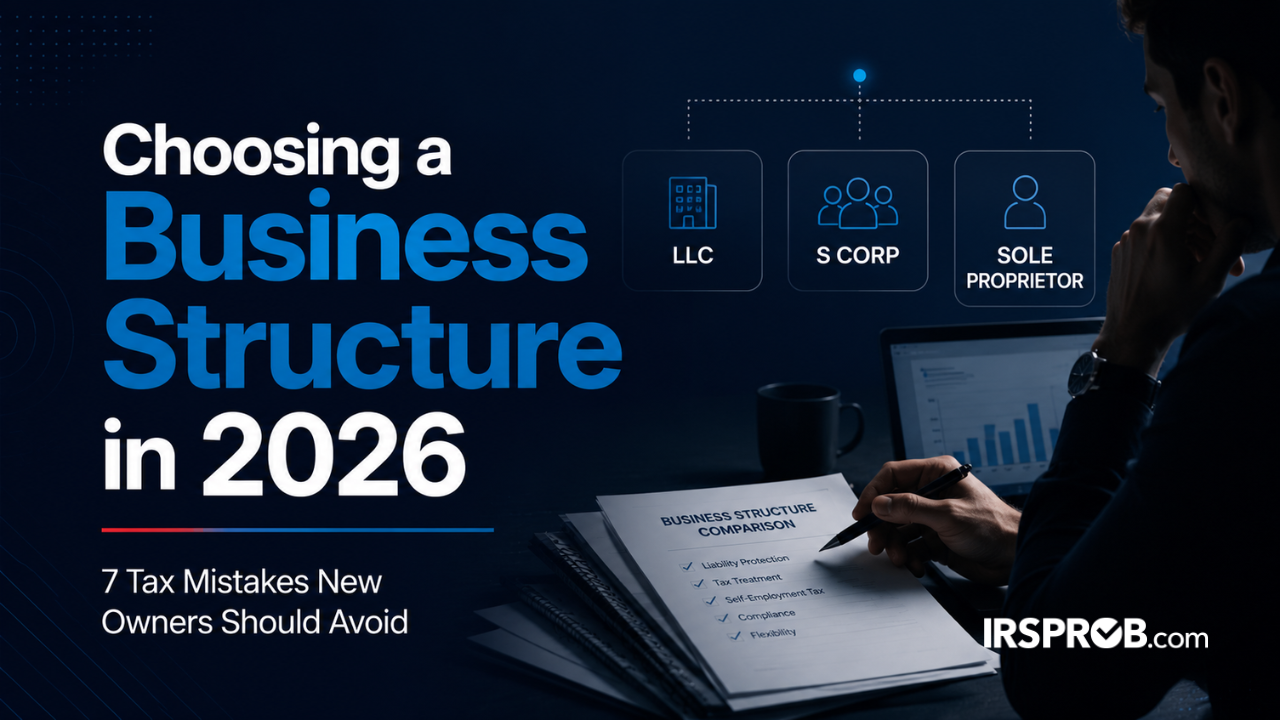
A lot of new business owners start with one question:
“Should I form an LLC?”
That is a fair question. It is just not the whole decision.
An LLC is a legal structure created under state law. It does not automatically tell the IRS how the business will be taxed, whether payroll is required, which return must be filed, or how the owner should take money out.
That is why choosing a business structure in 2026 takes more than filling out an online form.
Most of these rules are not new for 2026, but they are still common places where new owners make expensive mistakes.
The goal is not to choose the structure that sounds most official. The goal is to choose one that fits how the business actually works.
- Legal Structure and Federal Tax Classification Are Not the Same Thing
- Common Business Structures New Owners Compare
- Why Choosing a Business Structure in 2026 Requires More Than an Online Filing
- Mistake 1: Assuming an LLC Automatically Lowers Taxes
- Mistake 2: Ignoring the Default Tax Classification
- Mistake 3: Electing S Corporation Status Too Early
- Mistake 4: Paying an S Corporation Owner Only Through Distributions
- Mistake 5: Starting a Partnership Without Planning the Reporting
- Mistake 6: Choosing a C Corporation Without Planning How Money Comes Out
- Mistake 7: Ignoring State Fees and Annual Requirements
- Other Tax Mistakes After Formation
- What New Owners Should Review Before Choosing a Structure
- What to Review If the Business Already Exists
- When New Business Owners Should Get Help
- FAQs About Choosing a Business Structure in 2026
Legal Structure and Federal Tax Classification Are Not the Same Thing
Your legal structure is created under state law. Your federal tax classification tells the IRS how the business reports income.
Those two things are connected, but they are not always the same.
A single-member LLC is usually treated as part of the owner’s federal income tax return unless it elects corporate treatment. A domestic LLC with two or more owners is generally treated as a partnership unless it chooses another classification.
Some eligible businesses can use Form 8832 to choose a different federal tax classification. An eligible business may use Form 2553 to elect S corporation status.
Forming an LLC with the state does not automatically complete either election.
The legal filing and federal tax election are separate steps. Do not assume the IRS classification changed unless the right election was filed and accepted.
Common Business Structures New Owners Compare
The IRS recognizes several common business structures. Each one comes with different tax returns, costs, and responsibilities.
A sole proprietor usually reports business income and expenses on Schedule C. Net earnings may also be subject to self-employment tax.
A single-member LLC creates a state-law entity, but it is generally treated as part of the owner’s federal return unless corporate treatment is elected.
A domestic LLC with two or more owners is generally treated as a partnership unless it elects corporate treatment. The business may file Form 1065 and issue Schedule K-1 to each owner.
S corporation status is a federal tax election, not simply another name for an LLC. The business generally files Form 1120-S, and many tax items pass through to shareholders. An owner who works in the business may also need reasonable wages through payroll.
Not every business can make the S corporation election. Eligibility rules can involve the type and number of shareholders, one class of stock, and other requirements. The IRS provides more information about S corporation requirements.
A C corporation is generally a separate federal taxpayer. It files Form 1120 and pays tax on its taxable income. Owners may receive wages, dividends, reimbursements, loan repayments, or other payments. Each type of payment has different rules.
Why Choosing a Business Structure in 2026 Requires More Than an Online Filing
Online services make it easy to create a business entity. They do not always explain what happens next.
The formation fee is only the beginning.
Depending on the structure, the business may also need payroll, bookkeeping, a separate tax return, annual state reports, franchise tax filings, business licenses, and professional tax preparation.
Potential tax savings should be compared with the cost of staying compliant. The cheapest structure to form is not always the cheapest one to operate.
Mistake 1: Assuming an LLC Automatically Lowers Taxes
An LLC can be useful. It is not an automatic federal tax-saving tool.
A single-member LLC usually remains part of the owner’s federal return unless it elects corporate treatment. The profit may still be subject to income tax and self-employment tax.
A multi-member LLC is generally treated as a partnership unless another election is made.
The LLC may change the legal setup without changing the basic federal tax result. State fees, franchise taxes, or minimum taxes may also apply.
Before forming an LLC for tax reasons, ask one question:
What will actually change on the federal tax return?
IRSProb’s guide to LLC and S corporation tax differences explains why the two terms do not mean the same thing.
Mistake 2: Ignoring the Default Tax Classification
The number of owners can change how the business is taxed by default.
A one-owner LLC and a two-owner LLC may have very different filing duties even though both are LLCs under state law.
A spouse-owned business also needs careful review. A married couple should not assume a spouse-owned LLC can simply be reported as one sole proprietorship.
Qualified joint venture treatment has specific requirements and generally does not apply when the business is held through a state-law entity such as an LLC. Limited exceptions may exist under community property rules, so the facts should be checked before filing.
Before making an election, confirm which federal return the business will file, whether Schedule K-1 will be issued, whether Form 8832 or Form 2553 is needed, whether the election was filed on time, and whether the IRS accepted it.
Form 2553 generally must be filed no later than two months and 15 days after the beginning of the tax year the election is meant to take effect. Missing the deadline can mean the business is not taxed as an S corporation for that year unless late-election relief applies.
Mistake 3: Electing S Corporation Status Too Early
An S corporation election can make sense when the business has enough steady profit to justify the added payroll, bookkeeping, and filing work.
It also adds responsibility.
The business may need separate books, payroll tax deposits, quarterly payroll returns, year-end wage forms, and a separate S corporation return.
The decision should not be based only on gross sales. A business can collect a lot of revenue and still have modest profit after expenses.
Expected net profit, the owner’s role, payroll costs, state taxes, preparation fees, and cash flow all matter.
Before filing Form 2553, confirm eligibility, timing, payroll readiness, state treatment, and whether the IRS accepts the election.
You can review the IRS Form 2553 instructions for election timing and filing requirements.
Form 2553 does not make income tax disappear, remove every employment-tax duty, or fix weak bookkeeping.
Mistake 4: Paying an S Corporation Owner Only Through Distributions
A shareholder who works in the business may also be an employee.
The IRS generally expects an S corporation to pay reasonable wages to a shareholder-employee for services before using non-wage distributions as the only payment method.
Reasonable compensation is not one fixed amount. It may depend on the work performed, experience, time spent, duties, market pay, and how much revenue comes from the owner’s services.
Payroll also involves more than writing a check. It may require withholding, deposits, quarterly returns, unemployment filings, and Form W-2.
Distributions do not automatically replace wages.
The IRS provides guidance on S corporation compensation. IRSProb’s guide to reasonable compensation for business owners explains why owner pay needs to match the facts.
A shareholder who works in the business may need reasonable wages through payroll before taking only non-wage distributions.
Mistake 5: Starting a Partnership Without Planning the Reporting
Starting a business with another person changes the tax picture.
A partnership generally files Form 1065 and provides Schedule K-1 to the partners. Each partner reports their share of the tax items.
Problems often begin when money starts moving.
Guaranteed payments, draws, capital contributions, reimbursements, profit allocations, and distributions are not the same thing.
Partners generally should not receive Form W-2 wages for regular partner services. Partner payments and allocations need separate review.
Partners may also need estimated tax payments because partnership income can pass through without withholding.
The agreement should address ownership, contributions, duties, voting, profit and loss allocations, payments, distributions, and what happens when someone leaves.
The IRS provides information about partnership tax responsibilities. IRSProb’s partnership tax guide explains why the records should match the agreement.
Mistake 6: Choosing a C Corporation Without Planning How Money Comes Out
A C corporation generally pays its own federal income tax. That is only one part of the picture.
Owners may receive wages, dividends, reimbursements, loan repayments, rent, or other payments. Each one has different tax and documentation rules.
Corporate money should not be treated like a personal checking account.
When owners take money without proper records, the payment may be reclassified or create problems involving wages, dividends, shareholder loans, or other distributions.
A C corporation may fit a business that plans to bring in investors, retain earnings, issue equity, or follow a specific growth strategy.
For a closely held C corporation, review whether retained earnings have a real business purpose and how owner payments will be documented.
The corporate tax rate is only one part of the calculation. How money leaves the corporation matters too.
The IRS provides more information about forming and operating a corporation.
Mistake 7: Ignoring State Fees and Annual Requirements
Federal income tax is only part of the cost.
States may charge formation fees, annual report fees, franchise taxes, minimum taxes, registered-agent fees, or other assessments.
Cities and counties may require licenses, permits, or local filings. Hiring employees can create payroll registration and unemployment-tax duties.
Operating in another state may create additional registration, income-tax, payroll, or sales-tax responsibilities.
Even an unused entity may keep creating fees until it is formally closed.
Changing structures later can also mean updating bank accounts, contracts, payroll systems, tax elections, registrations, and ownership documents.
Look at the full yearly cost, not just the original filing fee.
Other Tax Mistakes After Formation
Choosing the structure is only the beginning.
Owners can still create problems by mixing personal and business money, keeping poor books, recording wages and distributions incorrectly, missing estimated tax payments, missing payroll deposits, treating workers as contractors without reviewing the facts, filing the wrong return, forgetting state filings, or assuming every business loss can be deducted immediately.
A separate bank account and reliable bookkeeping make every structure easier to manage.
IRSProb’s guide to business tax recordkeeping explains why good records matter before an audit or notice arrives.
What New Owners Should Review Before Choosing a Structure
Before filing anything, review ownership, expected profit, startup losses, owner pay, employees, payroll duties, self-employment tax, federal and state filing costs, liability concerns, bookkeeping capacity, investor plans, sale plans, and election deadlines.
The structure should fit the business today while leaving room for realistic growth.
Do not build a complicated system for a business that cannot support it. Do not stay with a poor fit just because changing it feels inconvenient.
What to Review If the Business Already Exists
Start by confirming the legal entity, federal tax classification, EIN information, and returns filed in prior years.
Then review whether Form 8832 or Form 2553 was filed and accepted, which return the business has been filing, how owners have been paid, whether payroll deposits and returns are current, whether state reports and franchise taxes are current, whether ownership has changed, and whether current profit supports the structure’s cost.
A structure that made sense at startup may not fit now.
That does not automatically mean it should be changed. It means the numbers and responsibilities deserve another look.
When New Business Owners Should Get Help
Professional review can be useful when there is more than one owner, a spouse joins the business, an S corporation election is being considered, payroll is starting, or the business operates in several states.
It can also help when the business has losses, outside investors, transferred property, a missed election deadline, late returns, unclear owner payments, or plans to close or convert the entity.
Get advice before filing an election or moving ownership when possible.
Correcting the structure later may cost more than reviewing it first.
Need help reviewing a business tax issue or IRS notice?
IRSProb.com helps business owners review IRS notices, tax balances, payroll issues, late filings, and reporting problems when the next step is not clear.
Visit IRSProb.com or call 214-214-3000.
Request a Free Tax ConsultationFAQs About Choosing a Business Structure in 2026
Does forming an LLC automatically lower taxes?
No. An LLC is created under state law. Its federal tax treatment depends on the number of owners and any elections filed.
Is an LLC the same as an S corporation?
No. An LLC is a legal entity structure. S corporation status is a federal tax election available to eligible businesses.
When should a business consider an S corporation election?
It may be worth reviewing when the business has steady profit and can support payroll, bookkeeping, tax preparation, and other compliance costs. Eligibility, timing, state treatment, and owner compensation also matter.
Which business structure pays the least tax?
There is no one answer. The result depends on profit, owners, compensation, payroll, state rules, distributions, future plans, and ongoing costs.