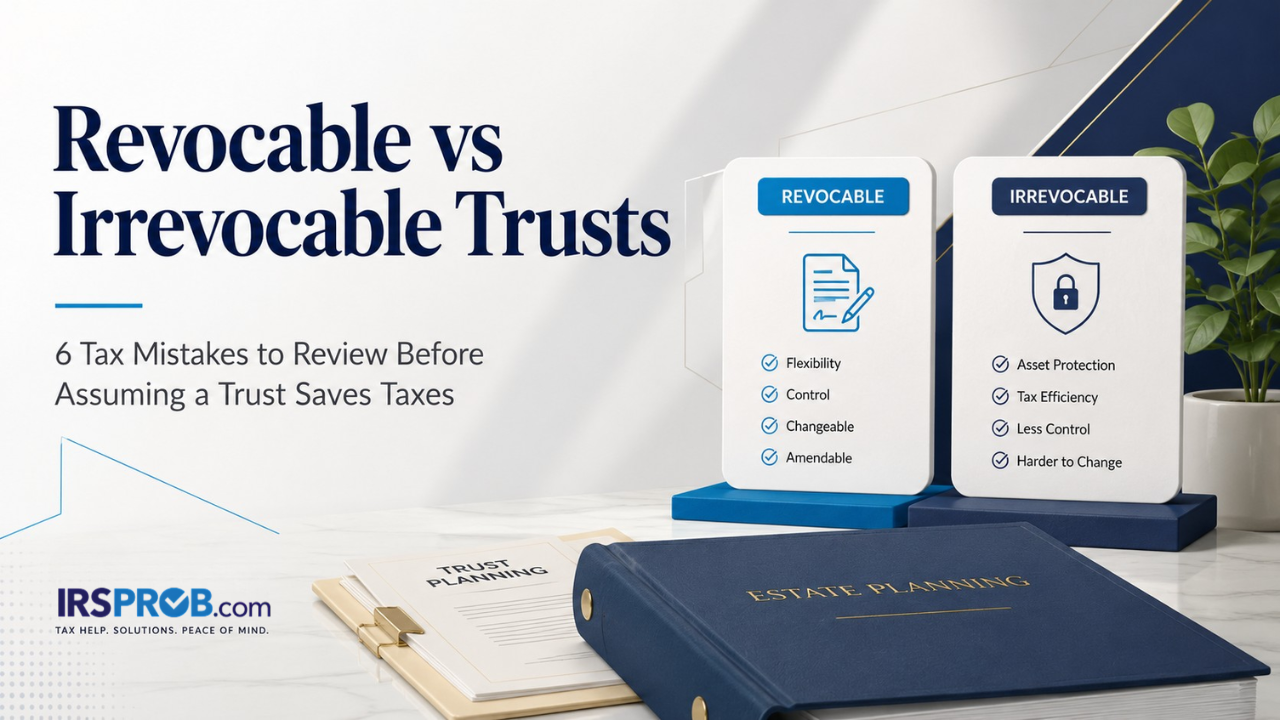
A trust can be a useful estate-planning tool.
It may help manage property, plan for incapacity, or make it easier to pass assets to family.
What it does not do is automatically lower taxes.
The difference between revocable vs irrevocable trusts matters, but the name of the trust does not answer the full tax question.
You still need to know who controls the property, who receives the income, who reports it, whether a gift occurred, whether the assets remain in the taxable estate, and what may happen to the property’s basis later.
That is where people get caught.
A taxpayer may transfer a home, investment account, or business interest into a trust expecting one result and end up with another.
The goal is not to avoid trusts. The goal is to understand what the trust actually changes before property moves into it.
- What a Revocable Trust Is
- What an Irrevocable Trust Is
- Why Revocable vs Irrevocable Trusts Require More Than a Tax-Savings Comparison
- Mistake 1: Assuming a Revocable Trust Lowers Income Taxes
- Mistake 2: Assuming Every Irrevocable Trust Pays Its Own Tax
- Mistake 3: Assuming Giving Up Control Automatically Removes Assets From the Estate
- Mistake 4: Assuming a Trust Transfer Cannot Create Gift-Tax Reporting
- Mistake 5: Assuming the Trust Will Always Pay Less Tax
- Mistake 6: Ignoring Basis and Future Capital Gains
- Asset Protection and Tax Savings Are Different Goals
- What Taxpayers Should Review Before Transferring Assets
- What to Review If the Trust Already Exists
- Red Flags in Trust Tax-Savings Claims
- When Taxpayers Should Get Help
- FAQs About Revocable vs Irrevocable Trusts
What a Revocable Trust Is
A revocable trust is generally created during the grantor’s lifetime. The grantor is the person who creates and funds the trust.
In many revocable living trusts, the grantor keeps the right to change or cancel the trust. The grantor may also serve as trustee, control the property, receive the income, and use the assets.
For federal income-tax purposes, a revocable trust is generally treated as a grantor trust.
IRS guidance on grantor trust treatment explains that when the grantor-trust rules apply, the grantor is generally treated as the owner for federal income-tax purposes. The income is normally taxed to that person.
In plain English, moving a rental property or investment account into a revocable trust usually does not move the taxable income away from the grantor.
The trust may still be helpful.
It can support incapacity planning, property management, privacy, and probate planning for assets properly transferred into it.
Those are real benefits.
They are just not the same as automatic income-tax savings.
It may help with management, incapacity planning, or probate planning, but the grantor usually keeps reporting the income.
What an Irrevocable Trust Is
An irrevocable trust generally cannot be freely changed or revoked by the grantor under its terms.
That does not mean every irrevocable trust is frozen forever.
Depending on the trust and applicable state law, changes may sometimes be possible through court approval, beneficiary consent, a trust protector, or a process known as decanting.
The grantor may also give up meaningful control, access, or ownership rights.
Still, “irrevocable” does not automatically mean “separate taxpayer.”
An irrevocable trust may be treated as a grantor trust, a nongrantor trust, or partly each for federal income-tax purposes.
The result depends on the trust language, powers retained by the grantor, beneficiary rights, and how the trust is actually operated.
A nongrantor trust may need to file Form 1041. Beneficiaries may receive Schedule K-1 when income, deductions, credits, or other tax items are passed out to them.
The filing result depends on the trust’s income, expenses, distributions, and federal filing requirements. The IRS instructions for Form 1041 explain the general reporting framework.
For related estate and fiduciary income tax context, see IRSProb’s guide on handling tax responsibilities after the death of a taxpayer.
Why Revocable vs Irrevocable Trusts Require More Than a Tax-Savings Comparison
Taxpayers often compare the names of the trusts when they should be separating the goals.
Income tax is one issue.
Estate tax is another.
Gift tax, basis, probate, creditor protection, and control are separate questions too.
A trust may help with one goal and do little for another.
For example, a trust may help avoid probate while the grantor continues reporting all of the income. Another trust may move future appreciation outside an estate but create gift-tax reporting and basis concerns.
Before relying on a trust, ask:
- Who controls the property?
- Who can use or benefit from it?
- Who reports the income?
- Was a completed gift made?
- Is the property still part of the grantor’s estate?
- What basis may the beneficiaries receive?
- Which state’s laws and tax rules apply?
The IRS looks at what an arrangement actually does, not just the name printed at the top of the document.
This article focuses mainly on federal tax issues. State trust law, probate law, creditor rules, property law, and state income-tax rules may change the result.
Mistake 1: Assuming a Revocable Trust Lowers Income Taxes
A revocable trust usually does not create a separate tax wall between the grantor and the assets.
When the grantor remains the tax owner, rental income, dividends, interest, and gains generally remain reportable by that person.
The same rule applies to expenses.
Personal expenses do not become tax deductions because a trust pays them.
A family home does not become business property just because its title was changed. Household bills do not become deductible because they are paid from a trust account.
That may sound obvious, but some trust promotions blur that line.
A revocable trust can make administration easier. It may also help family members manage property if the grantor becomes unable to do so.
What it generally does not do is turn the grantor’s personal income into tax-free trust income.
Probate planning and income-tax planning are different jobs.
Mistake 2: Assuming Every Irrevocable Trust Pays Its Own Tax
Some irrevocable trusts are separate nongrantor taxpayers.
Others are still treated as grantor trusts.
A trust may even be partly grantor and partly nongrantor.
When the grantor-trust rules apply, the grantor or another treated owner generally reports the income, deductions, and credits connected to that portion of the trust.
When a nongrantor trust keeps income, the trust may owe tax and file Form 1041.
When income or other tax items are passed to beneficiaries, the beneficiaries may receive Schedule K-1 and report those items on their own returns.
The answer can also depend on the type of distribution.
Income, principal, capital gains, deductions, and trust expenses may not all receive the same treatment.
Do not assume the trustee pays every tax because the trust is irrevocable.
The trust document, tax classification, distributions, and actual administration all matter.
An irrevocable trust may be a grantor trust, a nongrantor trust, or partly both depending on the document and facts.
Mistake 3: Assuming Giving Up Control Automatically Removes Assets From the Estate
Income-tax ownership and estate-tax inclusion are not the same thing.
Property transferred to an irrevocable trust may be outside the grantor’s taxable estate in some situations.
But that result is not automatic.
Estate inclusion may be affected when the grantor keeps the right to use the property, receive income, control certain decisions, change beneficiaries, or exercise other retained powers.
The type of asset can matter too.
A home, life insurance policy, investment account, and business interest may each raise different estate-tax questions.
A trust can also keep property out of probate while that same property remains part of the federal gross estate.
Those rules do not always move together.
The IRS instructions for Form 706 discuss retained use, income rights, powers, and other interests that may affect estate inclusion.
Before assuming an asset is outside the estate, review what the grantor gave up and what the grantor kept.
The answer comes from the document and the facts after the trust is funded.
Mistake 4: Assuming a Trust Transfer Cannot Create Gift-Tax Reporting
Funding an irrevocable trust may be treated as a gift.
The transfer does not have to involve cash.
Real estate, investments, business interests, insurance rights, and other property may all raise gift-tax questions.
Whether the gift is complete can depend on the powers the grantor kept and the rights given to beneficiaries.
Trust transfers may also raise questions involving:
- Generation-skipping transfer tax
- Annual-exclusion treatment
- Property valuation
- Present-interest and future-interest gifts
- Beneficiary withdrawal rights
A gift-tax return may be required even when no current gift-tax payment is due.
That distinction matters.
Filing Form 709 does not automatically mean the taxpayer owes gift tax. The return may still be needed to report the transfer, document value, or address generation-skipping transfer issues.
The IRS instructions for Form 709 explain the federal gift and generation-skipping transfer reporting framework.
IRSProb’s discussion of Form 709 gift-tax reporting also explains why filing a gift-tax return does not automatically mean a current tax payment is required.
For valuable transfers, the estate-planning attorney and CPA should coordinate before the property is retitled.
Fixing the reporting later is usually harder.
Mistake 5: Assuming the Trust Will Always Pay Less Tax
Moving income into a trust does not guarantee a smaller family tax bill.
A grantor trust may leave the income taxable to the grantor.
A nongrantor trust may pay tax on income it keeps, while beneficiaries may report income passed out to them.
Nongrantor trusts can reach high federal income-tax brackets at much lower income levels than individuals. That makes retained income an important planning issue.
Capital gains may also remain taxable to the trust in some situations instead of passing through to beneficiaries.
State tax can add another layer.
The result may depend on where the grantor lives, where the trustee works, where the trust is administered, where the beneficiaries live, and which state’s law governs the trust.
There are also practical costs.
A trust may require a separate return, ongoing accounting, legal work, trustee services, investment management, and recordkeeping.
None of that means the trust is a bad idea.
A trust may still accomplish an important family or estate-planning goal.
The point is to look at the full cost and tax result, not one promised benefit.
Mistake 6: Ignoring Basis and Future Capital Gains
Basis is the tax starting point used to calculate gain or loss when property is sold.
This issue is easy to overlook because the tax may not show up when the trust is created.
It may show up years later when the trustee or beneficiary sells the property.
Property transferred during life often carries the transferor’s existing basis, subject to detailed rules.
Property included in a person’s estate may receive different basis treatment at death.
That can create a tradeoff.
Moving appreciating property outside an estate may support an estate-tax goal, but the beneficiaries may face a larger capital gain later if the asset does not receive the basis adjustment the family expected.
Do not assume beneficiaries will receive a basis adjustment at death.
The trust structure and estate-inclusion rules must support that result.
Basis planning and estate planning should be reviewed together. A move that helps one tax issue may create a different result somewhere else.
The IRS explains the rules for gifted, inherited, and trust property in Publication 551.
Before transferring a home, rental property, business interest, or appreciated investment, document the current basis and ask what basis is expected later.
For more on inherited property and taxable income, see IRSProb’s guide to types of income the IRS does not tax.
Asset Protection and Tax Savings Are Different Goals
A trust may be created to protect a beneficiary, control distributions, manage property, or address creditor concerns.
That does not automatically create tax savings.
Asset protection depends heavily on state law, timing, the grantor’s retained control, beneficiary rights, and the nature of the creditor claim.
Be careful when someone claims a trust can:
- Hide income
- Make personal expenses deductible
- Keep the taxpayer in full control while removing tax ownership
- Eliminate filing requirements
- Guarantee protection from creditors
Those claims deserve a hard look.
The IRS has warned about abusive trust arrangements that disguise ownership, improperly shift income, or claim deductions that are not allowed.
A legitimate trust plan should be explainable by the attorney and CPA reviewing it.
It should not depend on secrecy or on discouraging outside review.
A trust should not be promoted as a way to hide income, deduct personal expenses, or avoid normal reporting rules.
What Taxpayers Should Review Before Transferring Assets
Before signing the trust or retitling property, review:
- The real reason for creating the trust
- Whether it is revocable or irrevocable
- Whether it is expected to be a grantor or nongrantor trust
- Who controls the property
- Who may receive income or principal
- Who reports the income
- Whether Form 1041 or Schedule K-1 may be required
- Whether the transfer is a completed gift
- Whether Form 709 may be required
- Whether GST tax issues may apply
- Whether the property remains in the taxable estate
- The current basis of each asset
- The expected basis later
- State income-tax and trust-residency rules
- Trustee responsibilities
- Ongoing legal, accounting, and administrative costs
Some assets need extra care.
Retirement accounts usually should not be retitled into a living trust during the owner’s lifetime. Beneficiary designations, required distribution rules, and income-tax consequences should be reviewed before naming a trust as beneficiary.
Life insurance, business interests, and mortgaged property may also have separate legal, contractual, or tax consequences.
Do not move the property until you understand who will own it, control it, report it, and eventually receive it.
What to Review If the Trust Already Exists
Start with the actual trust document.
Do not rely only on the title or what someone remembers being discussed years ago.
Confirm whether the trust is revocable or irrevocable today. Identify the powers the grantor kept and the rights given to the beneficiaries.
Then compare the document with what happened in practice:
- Were the intended assets actually transferred?
- Was the income reported by the correct taxpayer?
- Were Form 1041 and Schedule K-1 filed when required?
- Were gift-tax returns filed when needed?
- Did the trustee follow the distribution terms?
- Are state filings current?
- Does the trust still match the family’s goals?
A trust can be legally valid and still be funded, administered, or reported incorrectly.
The document and the real-world activity need to match.
Red Flags in Trust Tax-Savings Claims
Slow down when someone promises that:
- Income becomes tax-free once it enters a trust
- Personal expenses become trust deductions
- The taxpayer keeps full control but no longer owns the income
- Tax returns are optional
- Several layers of trusts automatically eliminate tax
- Asset protection is guaranteed
- An independent CPA or attorney is unnecessary
The IRS provides additional warnings about abusive trust tax-evasion schemes.
A sound tax plan should not depend on hiding ownership, disguising transactions, or avoiding independent review.
When Taxpayers Should Get Help
Professional review is especially important before:
- Transferring a home or rental property
- Moving appreciated investments
- Transferring a business interest
- Funding an irrevocable trust
- Making a large gift
- Filing Form 1041 or Form 709
- Changing beneficiaries or trustees
- Relying on estate exclusion or basis treatment
- Involving a trust in retirement-account planning
- Moving the trust or trustee to another state
- Correcting earlier trust reporting
- Responding to an IRS or state notice
Get help before the transfer when possible.
Once property has moved, control has changed, or a deadline has passed, the available choices may be narrower.
Need help reviewing a tax issue, trust reporting concern, or IRS notice?
IRSProb.com helps taxpayers review tax notices, tax balances, reporting problems, and IRS issues when the next step is not clear.
Visit IRSProb.com or call 214-214-3000.
Request a Free Tax ConsultationFAQs About Revocable vs Irrevocable Trusts
Does a revocable trust reduce income taxes?
Generally, no. A revocable trust is usually treated as a grantor trust, so the grantor normally continues reporting the income.
Does an irrevocable trust always file its own tax return?
No. Some irrevocable trusts are grantor trusts. Others are separate nongrantor trusts. The trust document, retained powers, income, and distributions all matter.
Does transferring property to an irrevocable trust count as a gift?
It may. The result depends on what was transferred, the rights given to beneficiaries, and the powers the grantor retained.
Are irrevocable trust assets automatically outside the taxable estate?
No. Retained rights, use of property, income rights, powers, and other interests may affect estate inclusion.
Does a trust avoid capital-gains tax?
Not automatically. Capital gains may be reported by the grantor, the trust, or the beneficiaries depending on the structure and the transaction.
Does a trust avoid both probate and taxes?
A properly funded trust may help avoid probate for certain assets. That does not automatically reduce income, gift, estate, or capital-gains taxes.