You filed the return.
Then the balance showed up.
That can stop a normal day cold.
If you can’t pay the IRS after filing, the worst move is to ignore it, wait for more notices, or agree to a payment you already know you cannot afford.
A better move is to slow down, look at the balance, and review your options before penalties, interest, notices, or collection pressure make the situation harder to manage.
Filing was still important. But filing and paying are not the same thing.
You may be able to pay part of the balance now, request an IRS payment plan, review penalty relief, look at hardship options, or ask whether an Offer in Compromise is realistic. The right answer depends on your facts, not a sales pitch or a guess.
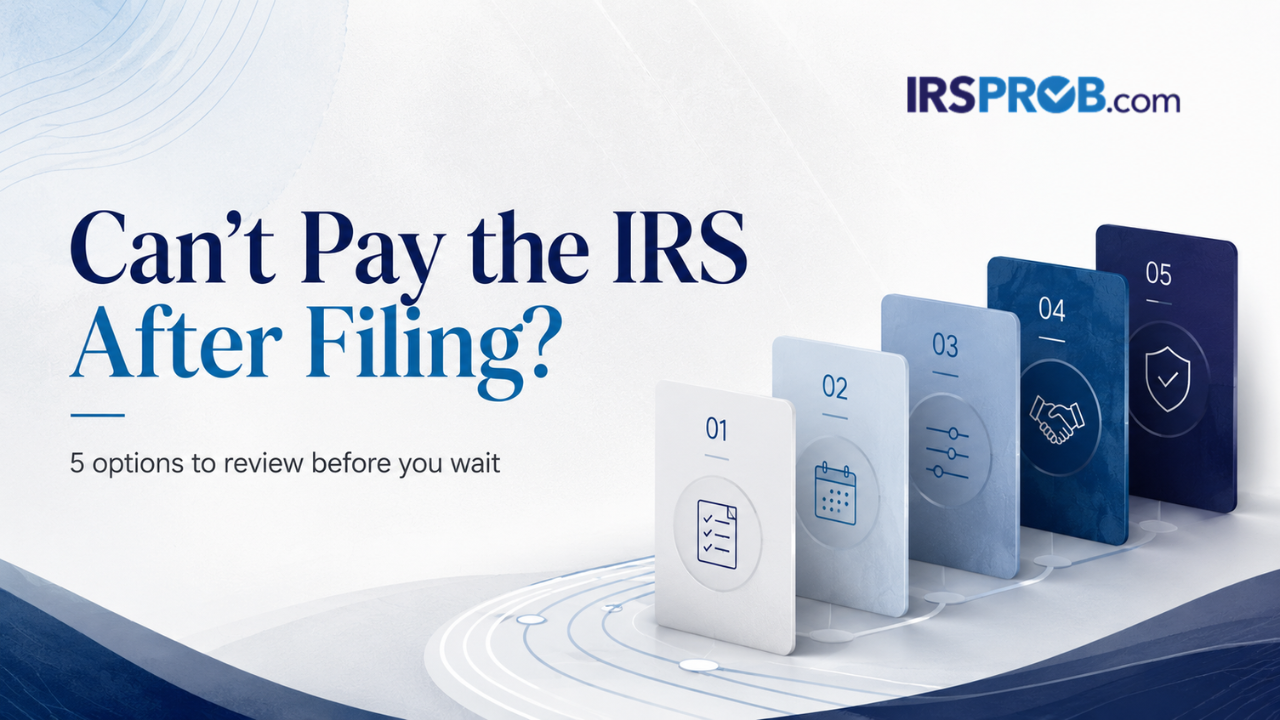
Here are five options to review before you wait too long.
- Can’t pay the IRS after filing: Start With the Balance
- Option 1: Pay What You Can Now
- Option 2: Review an IRS Payment Plan
- Option 3: Check Whether Penalty Relief May Apply
- Option 4: Review Hardship Options if You Truly Cannot Pay
- Option 5: Ask Whether an Offer in Compromise Is Realistic
- What You Should Not Do After Filing With a Balance Due
- When To Get Professional Help
- What To Do Next
- FAQs About Can’t Pay the IRS After Filing
Can’t pay the IRS after filing: Start With the Balance
Before you choose an option, start with the balance itself.
How much does the IRS say you owe? Was the return accepted? Is the balance from the return you just filed, or does it include older years, penalties, interest, or prior unpaid taxes?
That distinction matters.
A taxpayer with one new balance may have different options than someone with several years of unpaid taxes. A self-employed taxpayer may have different issues than a W-2 employee who had too little withheld. A business owner with payroll tax problems may need a more careful review than someone who simply needs time to pay.
Start by gathering:
- A copy of the return you filed
- Any IRS notice you received
- Your IRS online account information, if available
- Records of payments already made
- Your realistic monthly budget
- Any older IRS balances or payment plans
The goal is not to panic. The goal is to understand what stage you are in.
The right option depends on what you owe, what years are involved, what you can pay, and whether older IRS issues are also part of the balance.
Option 1: Pay What You Can Now
If you cannot pay the full amount, paying what you reasonably can may still help.
A partial payment does not erase the rest of the balance. It does not automatically stop penalties or interest. But it may reduce the amount that remains unpaid.
That matters because unpaid balances can grow when tax, penalties, and interest continue to build. The longer the balance sits without a plan, the harder it may be to know what you actually owe.
Do not empty your household cash if that leaves you unable to cover basic needs. Do not promise money you do not have. But if you can safely pay part of the balance, it may be worth reviewing.
“What can I pay now without creating a bigger problem next month?”
That is a better question than guessing, avoiding the balance, or waiting for another notice to make the decision for you.
Option 2: Review an IRS Payment Plan
If you cannot pay the full balance now, an IRS payment plan may be worth reviewing.
The IRS has tax payment options that may include paying in full, a short-term payment plan, or a long-term payment plan, also called an installment agreement. The option available can depend on the taxpayer’s specific tax situation.
IRS online payment plan eligibility can depend on the amount owed, whether required returns are filed, and whether the taxpayer is an individual, sole proprietor, independent contractor, or business taxpayer.
A payment plan can help because it gives the balance some structure. Instead of letting the debt sit with no direction, you may be able to make monthly payments over time.
But a payment plan is not something to enter blindly.
Even with an approved payment plan, penalties and interest may continue until the balance is paid in full.
Before you apply, ask yourself:
- Can I afford the monthly payment?
- Will I be able to stay current on future taxes?
- Are all required returns filed?
- Do I already have another IRS payment agreement?
- Will setup fees, penalties, or interest affect the total cost?
- Could missed payments or new tax balances put the agreement at risk?
This is where people get caught.
They agree to a monthly amount because they want the problem to go away. Then the payment is too high, cash flow gets tight, and the agreement becomes harder to keep.
Taxpayers also need to stay current with future filings and payments. A payment plan for old tax debt does not help much if new tax debt keeps building.
If you are self-employed or a business owner, current-year taxes matter. Before agreeing to a payment plan, make sure you are not creating another balance while trying to fix the old one.
You can learn more from the IRS page on payment plans and installment agreements or review the IRS online payment agreement application.
IRSProb.com also has a guide on IRS payment options and what to review before making a decision.
Option 3: Check Whether Penalty Relief May Apply
Penalty relief may be available in some cases, but it is not automatic.
For failure-to-file or failure-to-pay penalties, the IRS generally looks at whether the taxpayer exercised ordinary care and prudence but still could not file or pay on time. For some other penalties, reasonable cause and good-faith facts may also matter.
That does not mean every penalty will be removed.
Penalty relief can depend on the type of penalty, your filing and payment history, your reason for noncompliance, and the records that support your request.
Lack of funds alone usually is not enough. The IRS will generally want to understand what happened, what you did to try to comply, and whether the facts support relief.
Common situations that may need review include:
- Failure-to-file penalties
- Failure-to-pay penalties
- Penalties tied to circumstances outside the taxpayer’s control
- Penalties where the taxpayer tried to comply but could not
- Penalties connected to a first-time issue
Do not build your plan around penalty relief unless someone has reviewed the facts.
A safer way to think about it is this:
Penalty relief may reduce certain penalties for eligible taxpayers, but it is not a substitute for understanding the full balance and payment options.
You can review IRS guidance on penalty relief and reasonable cause penalty relief.
Option 4: Review Hardship Options if You Truly Cannot Pay
Some taxpayers are not just short on cash. They truly cannot pay the IRS and cover basic living expenses at the same time.
That is a different situation.
The Taxpayer Advocate Service explains that if the IRS agrees you cannot both pay your taxes and your basic living expenses, it may place your account in currently not collectible status.
Currently not collectible status does not erase the debt. It generally means the IRS has determined that collection should be delayed because of the taxpayer’s financial condition.
That sounds comforting, but it does not mean you can wait forever.
Penalties and interest may still continue. The IRS may review your financial situation later. Refunds may still be applied to the tax debt in some situations. In some cases, the IRS may still file a Notice of Federal Tax Lien even when an account is in currently not collectible status.
The underlying balance does not simply disappear because the account is placed in hardship status.
Still, for a taxpayer in genuine financial hardship, this may be an option to review.
Hardship review may matter if:
- Your income barely covers basic living expenses
- You recently lost income
- You have a medical or family financial hardship
- You cannot afford a monthly IRS payment
- A levy would leave you unable to pay necessary expenses
Do not guess your way through it. If paying the IRS would leave you unable to cover basic living costs, that is worth discussing with a qualified tax professional.
IRSProb.com’s guide on the IRS hardship program may help explain when hardship review can matter.
Currently not collectible status may delay collection activity, but penalties and interest may continue, and the IRS may review your finances later.
Option 5: Ask Whether an Offer in Compromise Is Realistic
An Offer in Compromise may allow eligible taxpayers to settle a tax debt for less than the full amount owed.
That is the part most people hear.
The part they miss is that the IRS reviews the taxpayer’s specific facts and circumstances. The IRS considers factors such as ability to pay, income, expenses, and asset equity.
An Offer in Compromise is not just a discount request. It is not available to everyone. It is also not something to assume just because the balance feels too large.
The IRS generally requires OIC applicants to be in filing compliance, to have received a bill for at least one tax debt included in the offer, and to be current with required estimated tax payments. Business owners with employees also have federal tax deposit requirements. Other eligibility rules, including bankruptcy restrictions, may also apply.
An OIC may be worth reviewing if paying the full balance would create financial hardship, or if the taxpayer’s financial picture shows that the IRS may not reasonably collect the full balance.
But if you can pay through a realistic payment plan, or if your assets and income show ability to pay, an Offer in Compromise may not be the right fit.
Before focusing on an OIC, ask:
- Are all required returns filed?
- Have I received a bill for the tax debt included in the offer?
- Are current tax payments being handled properly?
- If I own a business with employees, are required federal tax deposits current?
- Am I in an open bankruptcy proceeding?
- What is my income?
- What are my necessary expenses?
- What assets do I own?
- Can I pay through a monthly agreement?
- Would an offer be realistic based on IRS standards?
I would not let the “settle for less” idea run the show.
It may be an option for some taxpayers. It should not be treated like the first answer for everyone.
You can also read IRSProb.com’s overview of Offer in Compromise help or its guide on how to settle IRS tax debt with an Offer in Compromise.
What You Should Not Do After Filing With a Balance Due
If you filed and now owe more than you can pay, a few moves can make the situation harder.
Do not ignore the balance
Ignoring the balance does not make it go away. It can make it harder to understand later, especially if penalties, interest, notices, or collection activity begin to stack up.
Do not promise a payment you cannot afford
A payment plan should fit your real budget. If you agree to a payment you cannot maintain, you may end up back in trouble.
Do not assume penalties stop on their own
Penalties and interest may continue while a balance remains unpaid. Some penalties may be reviewed for relief, but that depends on the facts.
Do not believe every “settle for less” promise
Some taxpayers may qualify for an Offer in Compromise. Not everyone will qualify. Be careful with anyone who promises a result before reviewing your records.
Do not wait until IRS notices pile up
The earlier you understand the balance and options, the better positioned you may be to choose a reasonable next step.
If the first notice you received is a balance due notice, IRSProb.com’s guide on the IRS CP14 Notice may help explain what to review first.
When To Get Professional Help
Some taxpayers can review IRS payment options on their own.
Others should get help before making a decision.
Professional help may make sense if:
- You owe for more than one tax year
- You have unfiled returns
- You are self-employed and behind on estimated taxes
- You own a business and have payroll tax issues
- You received IRS collection notices
- You are worried about a levy or garnishment
- You defaulted on a prior payment plan
- You are considering penalty relief, hardship status, or an Offer in Compromise
- You do not know whether the IRS balance is correct
A good review should not start with a promise.
It should start with the facts: your returns, notices, income, expenses, assets, and current tax compliance.
IRSProb.com helps taxpayers review IRS balances, notices, and possible tax resolution options in a calm, practical way. The goal is not to guess. The goal is to understand what option may fit the situation.
What To Do Next
If you can’t pay the IRS after filing, do not let the balance sit untouched.
Start with a simple checklist.
- Confirm the balance
- Pay what you reasonably can, if possible
- Review IRS payment plan options
- Remember that penalties and interest may continue while the balance remains unpaid
- Check whether penalty relief may apply
- Consider hardship options if you truly cannot pay
- Ask whether an Offer in Compromise is realistic
- Gather IRS notices and tax records
- Stay current with required future filings and payments
- Speak with a qualified tax professional if you are unsure
The IRS problem may feel heavy, but guessing can make it heavier.
What matters most is what you do next.
Need help reviewing unpaid IRS taxes or payment options?
Visit IRSProb.com or call 214-214-3000 to discuss your situation.
Request a Free Tax ConsultationFAQs About Can’t Pay the IRS After Filing
Can I file my tax return if I cannot pay the IRS?
Yes. In many cases, filing is still important even if you cannot pay the full balance. Filing and paying are separate issues. If you do not file, you may create additional filing-related problems. If you file but cannot pay, you can then review payment or tax relief options.
What happens if I file but cannot pay the IRS in full?
If you file but cannot pay in full, the unpaid balance may continue to accrue interest and some penalties. The IRS may send notices, and taxpayers may be able to request payment options depending on their situation. The key is not to ignore the balance.
Can I get an IRS payment plan after filing?
You may qualify for an IRS payment plan after filing, depending on your tax situation. Payment options may include a short-term payment plan or a long-term installment agreement. The right option depends on what you owe, what you can pay, whether required returns are filed, and whether you can stay current going forward.
Can penalties be removed if I cannot pay?
Some penalties may be removed or reduced if you qualify for penalty relief. For failure-to-file or failure-to-pay penalties, the IRS generally looks at whether the taxpayer exercised ordinary care and prudence but still could not file or pay on time. Penalty relief is not automatic, and lack of funds alone usually is not enough.
What is currently not collectible status?
Currently not collectible status is a hardship status the IRS may use when it agrees that a taxpayer cannot pay tax debt and cover basic living expenses. It does not erase the debt. Penalties and interest may continue, refunds may be applied to the balance, and the IRS may review the taxpayer’s financial situation later.
Is an Offer in Compromise available if I can’t pay the IRS after filing?
An Offer in Compromise may be available for some eligible taxpayers, but it is not available to everyone. The IRS reviews the taxpayer’s ability to pay, income, expenses, asset equity, filing compliance, and other eligibility factors. If you can pay through a realistic payment plan, an Offer in Compromise may not be the right fit.