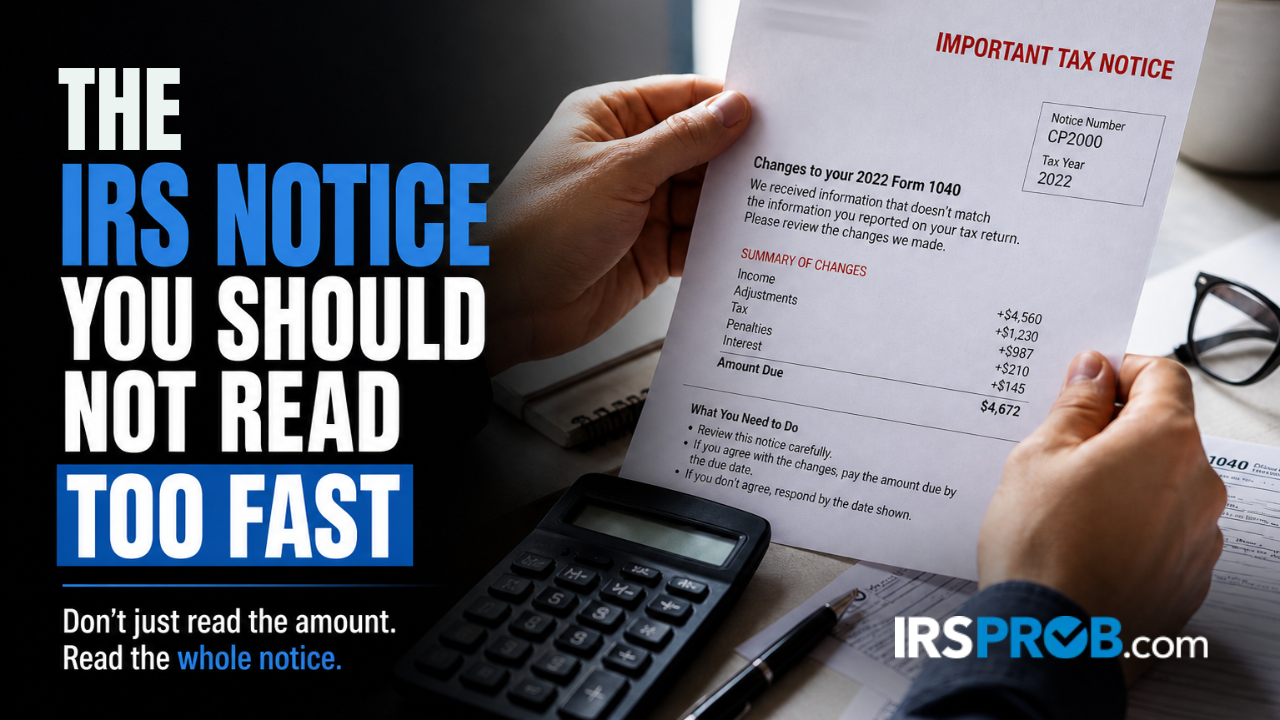
That IRS envelope can stop a normal day cold.
Most people open the letter and look for one thing first: the amount.
I understand why. The number feels like the problem.
But sometimes, the balance is not the most important part of the notice. The deadline, the tax year, the response instructions, or what the IRS is actually asking you to do next may matter even more.
That is where people get caught.
IRS notice mistakes often happen when taxpayers read too fast, panic too early, pay without checking the details, or ignore the notice because it feels overwhelming.
I’m Randy Martin, CPA, and I help good people with IRS problems.
What I want you to understand here is simple: do not just read the balance. Read the whole notice.
The goal is not to panic. The goal is to understand what stage you are in, what deadline applies, and what the IRS is asking you to do next.
- Why IRS Notice Mistakes Happen When You Read Too Fast
- The First Thing Most People Notice Is the Balance
- Not Every IRS Notice Is a Final Bill
- What to Check Before You Respond to an IRS Letter
- Why the IRS Notice Deadline May Matter More Than the Amount
- What Happens If You Agree With the IRS Notice
- What Happens If You Disagree With the IRS Notice
- When an IRS Tax Notice May Need Professional Help
- How IRSProb Helps With IRS Notice Help in Texas
- What to Do Next Before You Respond Too Fast
- FAQs
Why IRS Notice Mistakes Happen When You Read Too Fast
Most people do not read an IRS notice slowly.
They scan it.
They look for the balance. They look for a deadline. They look for words that sound serious. Then they decide whether to panic, pay, ignore it, or set it on the counter for later.
That reaction is human.
But it can also create problems.
An IRS notice may include more than one important detail. It may explain what changed on your account. It may ask for more information. It may propose a change. It may include payment instructions. It may explain appeal or dispute rights.
If you read too fast, you may miss the part that tells you what to do next.
The IRS says notices and letters generally explain the reason for the contact and provide instructions for how to handle the issue. That means the notice itself is often the first roadmap. You can review the IRS page on understanding your IRS notice or letter.
The First Thing Most People Notice Is the Balance
The amount due usually gets the most attention.
That makes sense.
If you see a balance, your mind goes straight to the money. Can I pay this? Is this right? What happens if I cannot pay it now?
The number matters.
But it is not always the whole story.
An IRS letter may explain the tax year involved, what the IRS changed, whether penalties and interest were added, and whether you need to respond.
For example, a notice may show a balance due, but it may also show that the balance was calculated as of a certain date. If time passes, the amount may change because penalties and interest may continue. For a deeper explanation, see our guide on IRS penalties and interest.
Before you react to the number, read the details around it. That is often where the real next step is found.
Not Every IRS Notice Is a Final Bill
One common mistake is assuming every IRS notice means the IRS has made a final decision.
That is not always true.
Some notices explain account changes. Some ask for more records. Some propose changes to a return. Some ask for payment. Some give you instructions if you agree or disagree.
A CP2000 notice is a good example. The IRS says a CP2000 notice explains proposed changes based on information the IRS received from third parties. The IRS also says it is not a bill, although a response may be required. Read more on the IRS page for understanding your CP2000 notice.
That distinction matters.
If a notice is proposing a change, your next step may be different from a notice that is simply asking for payment.
Do not assume.
Read what the letter says.
What to Check Before You Respond to an IRS Letter
Before you respond, pay, or ignore the notice, slow down.
Look for the details that tell you what stage you are in.
Check:
- Notice number or letter number
- Tax year or tax period
- What the IRS says changed
- Amount due, if any
- Penalties and interest
- Response deadline
- Payment deadline
- Address or online instructions
- Whether the IRS is asking for records
- Whether you agree or disagree with what the IRS is saying
This is where the IRS response instructions matter.
Do not send a response just because you feel pressured. Send the right response, to the right place, by the right deadline.
If the notice asks for records, gather the records.
If it asks for payment and you agree, review your payment options.
If it gives instructions for disagreeing, follow those instructions carefully.
Why the IRS Notice Deadline May Matter More Than the Amount
The IRS notice deadline can be one of the most important parts of the letter.
Sometimes the deadline matters more than the balance itself.
Why?
Because missing a deadline can limit your options.
Some notices require a response by a specific date. Some deadlines may affect IRS appeal rights. Certain deficiency notices may involve Tax Court petition rights. Some collection-related notices may give you a limited window to request a hearing or take action.
For example, the IRS says a CP3219N Notice of Deficiency generally gives taxpayers 90 days from the date shown on the notice to file a petition with the Tax Court if they want to challenge the proposed tax, or 150 days if they are outside the United States. Review the IRS page for understanding your CP3219N notice.
If the notice has a date, respect the date.
If appeal rights may apply, our guide on IRS appeals in Texas can help explain the basics.
What Happens If You Agree With the IRS Notice
If you agree with the notice, your next step may be simple.
Take the action the IRS asks you to take.
That might mean making a payment, signing and returning a form, updating information, or keeping the notice for your records.
The IRS says if taxpayers agree with a notice or letter, they should take the requested action and generally do not need to reply unless the IRS specifically asks them to.
But agreeing with the notice does not always mean you can pay in full.
If you received an IRS balance due notice and cannot pay everything right away, do not ignore it. Look at payment options before the balance grows or collection pressure increases.
The goal is not to pretend the notice does not exist.
The goal is to deal with it clearly.
What Happens If You Disagree With the IRS Notice
If you disagree with the notice, do not throw it away.
And do not send an emotional response.
Start with records.
Compare the IRS tax notice with your tax return, payment records, wage statements, 1099s, receipts, bank records, or other documents connected to the issue.
Then follow the instructions in the notice.
If the IRS asks you to respond by mail, keep copies of everything you send. If there is an online response option, save confirmation records. If you mail documents, consider proof of mailing.
The IRS says what you should do depends on your situation, and if a response is requested, you should act by the due date.
Do not guess your way through it.
A clear response with the right records is usually stronger than a long response written out of frustration.
When an IRS Tax Notice May Need Professional Help
Some notices are simple.
Others are not.
You may want help if you do not understand what the IRS changed, the deadline is close, multiple tax years are involved, or the notice includes penalties, interest, lien, levy, or collection language.
You may also want help if the notice involves a proposed adjustment, business taxes, payroll taxes, missing returns, or an amount that does not match your records.
If the notice relates to an audit, see our guide on an IRS audit notice in Texas.
The harder the notice is to understand, the more important it is to slow down before responding.
This is especially true when the notice affects your rights, your deadline, or the next move the IRS may take.
How IRSProb Helps With IRS Notice Help in Texas
IRSProb helps taxpayers read the notice the right way.
That starts with understanding what the IRS is actually saying.
What tax year is involved?
What changed?
Is it a bill, a proposed change, a request for records, or a collection notice?
What deadline applies?
Do you agree or disagree?
Is there a response option, payment option, dispute path, or appeal issue that needs to be reviewed?
If you need IRS notice help or tax help in Texas, the first step is not panic. It is clarity.
Do not guess your way through an IRS notice.
Start here: www.irsprob.com
Call: 214-214-3000
What to Do Next Before You Respond Too Fast
If you received an IRS notice, do not ignore it.
But do not rush through it either.
Read the full letter. Check the tax year. Look at the notice number. Review the balance. Check whether penalties and interest were added. Find the deadline. Read the response instructions. Compare the notice with your records.
Then decide the next step.
Do you agree?
Do you disagree?
Do you need records?
Do you need payment options?
Do you need help before the deadline passes?
The goal is not to panic. The goal is to understand what the IRS is asking you to do next.
That is what helps you respond with a plan instead of reacting out of pressure.
Frequently Asked Questions About IRS Notice Mistakes
What should I do first when I get an IRS notice?
Read the full notice carefully. Do not only look at the balance. Check the tax year, notice number, deadline, response instructions, and what the IRS is asking you to do.
Does every IRS notice mean I owe money?
No. Some IRS notices ask for information, explain account changes, or propose changes. Some notices are bills, but not every notice means you automatically owe the amount shown. Read the full notice and respond by the deadline if a response is required.
What if I disagree with the IRS notice?
If you disagree, follow the instructions in the notice. Gather records, explain what you disagree with, keep copies, and respond by the deadline if a response is required.
What happens if I miss the deadline on an IRS notice?
Missing a deadline can limit your options. Depending on the notice, it may affect response rights, appeal rights, Tax Court rights, or collection options.
Should I pay an IRS notice right away?
If you agree with the notice and can pay, paying may be the right step. But if you do not understand the notice or disagree with the amount, review the details before paying.
When should I get help with an IRS notice?
Get help if the notice is confusing, the deadline is close, the amount is large, multiple years are involved, business taxes are involved, or you disagree but do not know how to respond.