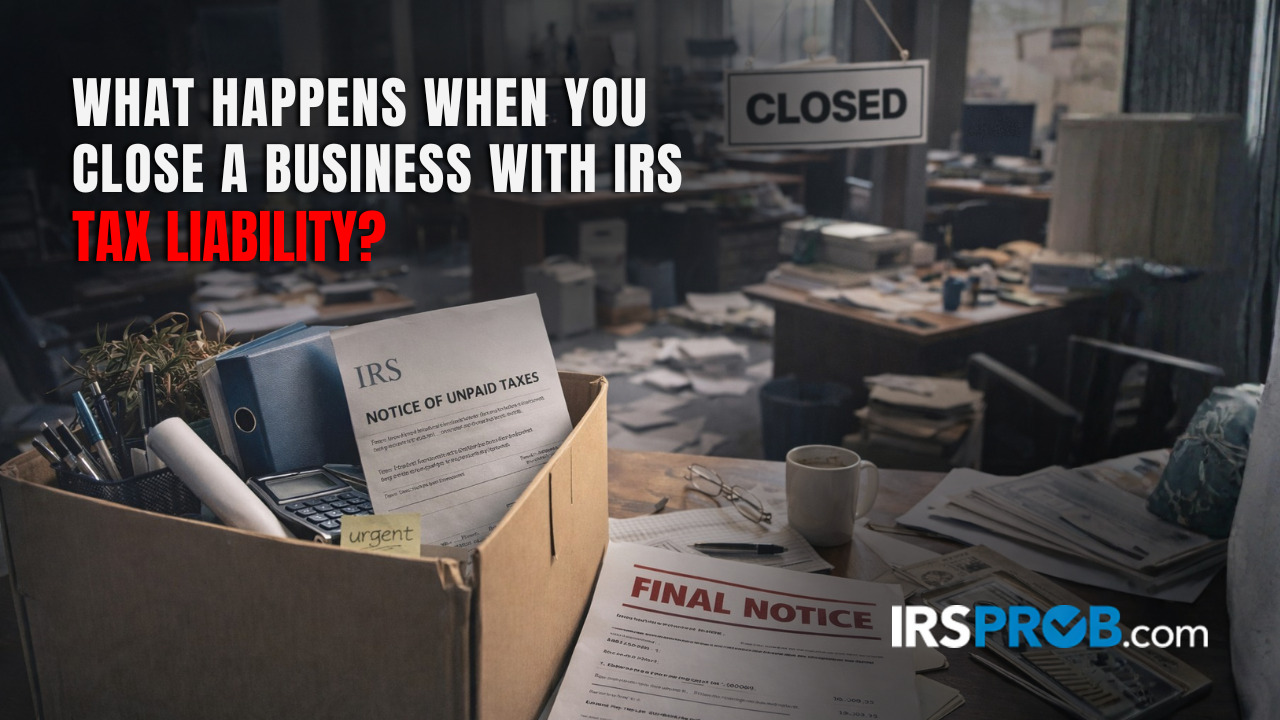
You turned in the keys. Let your last employee go. Filed the dissolution paperwork with the state. The business that consumed five years of your life is officially closed.
But there's one creditor that doesn't care about your closure paperwork.
If you close a business with IRS tax debt, that debt doesn't vanish. The IRS doesn't stamp your file "out of business, case closed" and move on. Instead, they begin a collection process that can follow you personally for up to a decade.
Whether you close your business owing the IRS money because you couldn't keep up anymore, or the state forcibly dissolved your company for nonpayment, what happens next depends entirely on the choices you make right now.
This guide explains exactly what the IRS does when you close with unpaid taxes, who becomes personally liable, and the three legitimate options you have to resolve the debt before it destroys your credit and assets.
If you're dealing with this situation right now, call 214-214-3000 for a free consultation. We've helped hundreds of business owners navigate this exact nightmare.
Understanding What Happens When Facing Close Business With IRS Tax Debt
Here's the hard truth: the IRS doesn't recognize "closed" as a valid reason to stop collecting taxes.
When you dissolve your business with the state, your EIN becomes inactive for new filings. But to the IRS, you still owe the money. The debt remains valid, and the 10-year collection statute keeps ticking.
The debt survives business closure. If your business owed $40,000 in payroll taxes when you closed, you still owe $40,000 the day after. Nothing changes except you no longer have business income to pay it with.
The 10-year collection statute continues. According to IRS Publication 594, the IRS has 10 years from the assessment date to collect. Closing your business doesn't reset this clock. If they assessed the tax in 2022, they can pursue collection until 2032 regardless of when you closed.
Interest and penalties keep accruing. The IRS charges interest (currently around 8% annually as of 2024) plus failure-to-pay penalties of 0.5% per month, up to 25% of the unpaid tax. A $40,000 debt can balloon to $55,000 within two years.
The IRS can still file federal tax liens. Even after dissolution, the IRS can file a Notice of Federal Tax Lien against the business. If you're personally liable, they file liens against your personal property. These become public record, tank your credit score by 100+ points, and make refinancing or buying property nearly impossible.
The IRS can levy accounts and garnish wages. If you have remaining business bank accounts, the IRS can seize them. If you took a new job and you're personally liable, they can garnish up to 25% of your wages under IRC Section 6331.
The bottom line: closing your business doesn't close your IRS problem. It often makes things worse because you no longer have business income to negotiate with.
⚠️ CRITICAL: Closing your business does NOT close your IRS case. The debt remains fully collectible for 10 years from the assessment date, and the IRS has powerful legal tools to collect even after your business no longer exists.
Who Becomes Personally Liable When Closing Business Tax Debt?
This is the question that keeps former business owners awake at night: "Can they come after me personally?"
The answer depends on your business structure and the type of tax you owe.
Business Structure Matters
Sole Proprietorships: You're automatically personally liable for all business debts, including IRS taxes. There's no legal separation between you and your business. If you owed $50,000 when you closed, you personally owe $50,000. The IRS can levy your personal bank accounts, garnish your wages, and file liens against your home.
Partnerships: Partners are personally liable for partnership tax debts. If you were one of three partners, you can be held responsible for the entire debt, not just your one-third share.
LLCs and Corporations: Generally, these provide liability protection. If your LLC owed $50,000 and you followed all corporate formalities, the debt belongs to the LLC, not you personally.
But the IRS has a massive exception.
The Trust Fund Recovery Penalty Destroys LLC Protection
When your business withholds income tax, Social Security, and Medicare from employee paychecks, that money doesn't belong to your business. It belongs to the government. You're holding it "in trust" until you send it to the IRS.
If your business goes under before sending that money, the IRS assesses the Trust Fund Recovery Penalty (TFRP) against individuals within the company.
The TFRP allows the IRS to pierce your LLC or corporate protection and hold you personally responsible for 100% of the unpaid trust fund taxes (the employee withholding portion).
Who gets hit with the TFRP?
- Business owners
- Corporate officers (president, treasurer, CFO)
- Anyone who had authority to pay bills and decide which creditors got paid
- Anyone with check-signing authority or online banking access
The IRS uses Form 4180 to interview people and determine who was "responsible" and "willful" in failing to pay trust fund taxes.
"Responsible" means you had the authority to pay taxes. "Willful" means you knew about the tax obligation and chose to pay other creditors instead.
Real example: A restaurant owner closed her business owing $87,000 in payroll taxes. Her LLC had no assets. The IRS interviewed her, determined she was the responsible party, and assessed a $61,000 Trust Fund Recovery Penalty against her personally. The IRS then garnished her wages from her new job and filed a lien against her home.
💡 KEY POINT: Even if your LLC or corporation shields you from most business debts, the IRS can pierce that protection for payroll taxes and hold you personally responsible through the Trust Fund Recovery Penalty.
The IRS Collection Process After Business Closure IRS Liability
Once your business closes with unpaid taxes, the IRS follows a predictable collection timeline.
Stage 1: Final Demand Notices
The IRS escalates to final demand notices including CP504 (Intent to Levy) or Letter 1058/LT11 (Final Notice of Intent to Levy). These give you 30 days to either pay or request a Collection Due Process hearing.
This is your last warning before enforcement begins.
Stage 2: Federal Tax Lien
If you don't respond within 30 days, the IRS files a Notice of Federal Tax Lien. This becomes public record, shows up on background checks, destroys your credit score, and attaches to all property you currently own or acquire in the future.
Stage 3: Levy Actions
The IRS can levy:
Bank Accounts: They freeze your account for 21 days, then seize the funds.
Wages: They send Form 668-W to your employer, who withholds 25-50% of your paycheck depending on your filing status.
Physical Assets: In extreme cases, they can seize and sell your car or equipment.
The IRS doesn't need a court order to levy. Once the 30-day notice period expires, they have legal authority to take your money.
Stage 4: Trust Fund Recovery Penalty Assessment
If your business owed payroll taxes, the IRS investigates who should be held personally responsible. They conduct interviews, determine who was "responsible" and "willful," and assess the TFRP against those individuals.
⚠️ DEADLINE: You have only 30 days from the Final Notice of Intent to Levy to request a Collection Due Process hearing. Miss this deadline and the IRS can immediately begin levying bank accounts and garnishing wages.
Can You Close a Business With IRS Debt and Walk Away?
Short answer: No. Not if you want to protect your financial future.
Here's what happens if you close a business with IRS debt and ignore the problem:
Your credit gets destroyed. The federal tax lien appears on your credit report and drops your score 100+ points.
You can't start a new business. If you try, the IRS can levy the new business bank accounts and intercept revenue.
Your wages get garnished. Expect 25-50% of your paycheck to disappear if you're personally liable.
Your bank accounts get emptied. One morning you'll discover a zero balance because the IRS levied overnight.
Your passport gets revoked. If you owe more than $62,000, the IRS can ask the State Department to revoke your passport under IRC Section 7345.
The 10-Year Collection Statute
The IRS has 10 years from the assessment date to collect. Closing your business doesn't reset this clock. If they assessed your 2022 payroll taxes in May 2023, they have until May 2033 to collect.
Certain actions extend the statute: filing bankruptcy, submitting an Offer in Compromise, or living outside the U.S. for 6+ months.
💡 REALITY CHECK: Walking away sounds tempting, but the IRS has 10 years and unlimited legal power to make your life financially miserable. Most people can't afford to ignore the problem for a decade.
3 Ways to Resolve Business Tax Debt After Closing
You have options. Here are three legitimate paths to resolution.
Option #1: Offer in Compromise (Settle for Less)
An Offer in Compromise lets you settle your tax debt for a fraction of what you owe.
The IRS calculates your "reasonable collection potential" based on your monthly income, allowable expenses, and asset equity. If your RCP is less than what you owe, they might accept an offer.
Who qualifies:
- You can prove inability to pay the full amount
- All tax returns are filed
- You're current on this year's estimated payments
- You're not in bankruptcy
Real example: A manufacturing company owner closed owing $114,000. We proved his reasonable collection potential was $28,000. The IRS accepted $28,000 paid over 24 months. He saved $86,000.
Option #2: Installment Agreement (Payment Plan)
If you can't settle but can afford monthly payments, an installment agreement gives you up to 72 months to pay.
Streamlined (under $50,000): Set up online in 30 minutes. Propose your payment amount.
Non-Streamlined ($50,000-$250,000): Submit Form 433-F proving what you can afford.
Monthly payment example:
- Debt: $45,000
- Payment period: 72 months
- Monthly payment: $625
- Total paid: ~$52,000 (includes interest)
Setup fees: $31 if you use direct debit, $130 for check/payroll deduction.
Option #3: Currently Not Collectible Status (Temporary Relief)
If you genuinely can't pay anything, request Currently Not Collectible status.
You prove your monthly expenses equal or exceed income. The IRS marks your account uncollectible and suspends collection activity.
The catch: The debt doesn't disappear. Interest and penalties keep accruing. The IRS reviews your status periodically.
When CNC makes sense: You're close to the 10-year statute expiration, facing temporary hardship, or buying time to gather documentation for an OIC.
✅ SUCCESS STORY:
"We closed our medical billing company owing $89,000 in payroll taxes. IRSProb negotiated a $31,000 Offer in Compromise. The IRS accepted it. I saved $58,000 and kept my home."
— Medical Billing Company Owner, Dallas, TX
Critical Mistakes to Avoid
Mistake #1: Not Filing Final Tax Returns
You must file a final business return. If you don't, the IRS has no record your business closed, and the assessment statute never starts. You also can't negotiate any resolution without filing.
Mistake #2: Ignoring IRS Notices
Every notice has a deadline. Miss it and you lose options. Respond to CP504, Form 4180, and lien notices immediately.
Mistake #3: Trying to Hide Assets
The IRS has forensic tools that track asset transfers. If they catch you hiding assets, they'll reject your OIC, pursue collection aggressively, and possibly add fraud penalties.
Mistake #4: Starting a New Business Before Resolving Old Debt
If you're personally liable, the IRS can levy your new business bank accounts and intercept revenue. Resolve old debt before starting fresh.
What to Do Right Now If You Close Business Owe IRS Money
Here's your action plan:
- Gather all IRS notices - Know exactly what you owe and for which tax periods
- Determine personal liability - Were you responsible for payroll tax payments?
- File all missing tax returns - You can't negotiate without tax compliance
- Document your financial situation - Bank statements, pay stubs, monthly expenses
- Get professional representation - Don't try to negotiate alone
How IRSProb Helps Business Owners After Closure
At IRSProb.com, we specialize in getting business owners out from under crushing IRS debt after company closure.
Our Process:
Step 1: Free Consultation - We review your situation, assess personal liability, and explain your options.
Step 2: Stop IRS Collection Immediately - We file power of attorney, handle all IRS communication, and request holds on levy actions.
Step 3: Negotiate Best Resolution - Offer in Compromise, Installment Agreement, or Currently Not Collectible based on your situation.
Step 4: Ongoing Compliance Support - We ensure you stay current and prevent future issues.
Why Choose IRSProb:
- 25+ years experience
- Represented 1,000+ business owners
- 98% success rate on OIC applications
- Certified Tax Resolution Specialists
- Based in Texas, serve nationwide
Closing a business with IRS tax debt doesn't make the debt disappear. The IRS will pursue collection through liens, levies, and personal liability assessments if you ignore the problem.
But you have options. Offer in Compromise, Installment Agreements, and Currently Not Collectible status can all provide relief and prevent the IRS from destroying your financial future.
The worst thing you can do is nothing. Every day you wait, interest and penalties pile up, and the IRS moves closer to enforcement.
Call IRSProb today at 214-214-3000 for a free consultation. We'll review your situation, explain your options, and create a plan to resolve your business tax debt permanently.
Get Expert Help With Business Tax Debt Today
At IRSProb.com, we specialize in resolving IRS tax debt for business owners who have closed their businesses. We've helped hundreds of clients negotiate settlements, stop levies, and protect their personal assets.
📞 Call 214-214-3000 - Free Consultation
🔗 Visit irsprob.com
📧 Schedule online consultation
Don't let IRS debt from a closed business destroy your financial future. Get professional representation today.