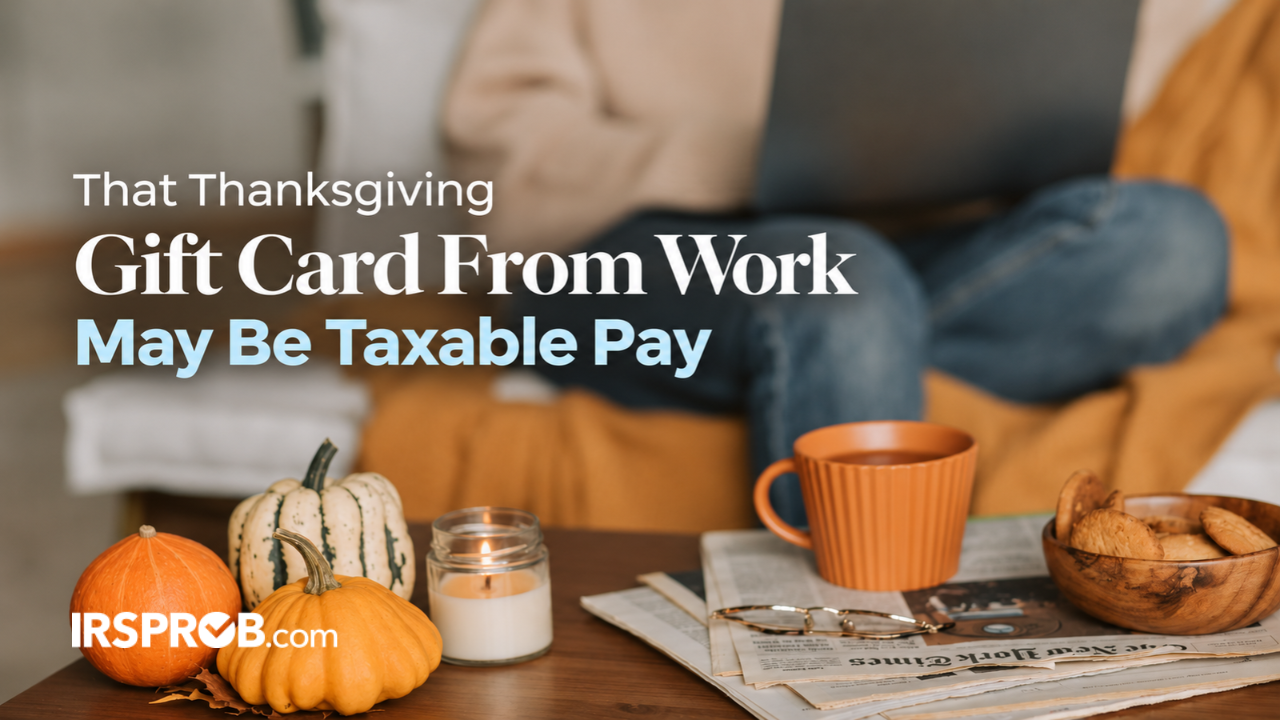
Suppose an employee receives a $100 grocery gift card as a Thanksgiving thank-you from work.
Then the next paycheck arrives. The employee notices an extra $100 in taxable wages and wonders whether payroll took the gift back.
It did not. The employer was reporting the value for tax purposes.
That is where the Thanksgiving gift card tax rules can surprise both employees and business owners. Federal tax rules generally treat cash and cash-equivalent gift cards as taxable compensation, even when the amount is small and the employer calls it a holiday gift.
An actual turkey, ham, or modest food basket may receive different treatment when it is provided occasionally and meets the rules for a de minimis fringe benefit. A grocery gift card usually does not become tax-free just because it can be used to buy the same turkey.
The thought behind the gift still matters. For payroll purposes, however, the form of the gift matters too.
How Thanksgiving Gift Card Tax Rules Work
Most benefits an employer gives in connection with work are taxable unless a specific tax rule excludes them.
This includes more than regular salary. Taxable compensation may include bonuses, prizes, gift cards, and other fringe benefits.
The employer generally reports a taxable benefit based on its fair market value. For an ordinary $100 gift card, that value is usually easy to identify. The employee can spend $100, so the taxable value is generally $100.
The employer’s good intention does not change the result. Calling the card a Thanksgiving gift, appreciation award, or holiday surprise does not make it tax-free.
The IRS explains these rules in Publication 15-B, Employer’s Tax Guide to Fringe Benefits.
Gift Cards Are Generally Treated Like Cash
Cash and cash-equivalent benefits generally cannot be excluded as de minimis fringe benefits, no matter how small they are.
This can include:
- Grocery gift cards
- Restaurant gift cards
- General prepaid cards
- Digital gift cards
- Gift certificates for general merchandise
- Cash bonuses paid by check, direct deposit, or a payment app
A $25 card is not automatically tax-free because the amount seems small. Gift cards are easy to value and account for. That is one reason the de minimis exception generally does not apply.
A certificate redeemable only for a specific low-value item may qualify as a de minimis benefit when it is provided infrequently and accounting for it would be unreasonable or impractical. The result depends on the facts.
Most ordinary grocery, restaurant, retail, and prepaid cards should not be treated as that narrow exception without careful review.
The IRS provides a plain-language explanation of de minimis fringe-benefit rules.
An Actual Turkey May Receive Different Treatment
Publication 15-B lists low-fair-market-value holiday gifts other than cash as possible de minimis benefits.
Depending on the facts, an employer may be able to provide an occasional:
- Turkey
- Ham
- Pie
- Modest food basket
- Flowers or fruit
- Other low-value holiday item
without including its value in the employee’s wages.
The item must be small in value, provided infrequently, and difficult or impractical for the employer to account for. Frequency matters. The employer’s overall pattern of providing similar benefits matters too.
There is no universal dollar amount that makes every noncash gift tax-free. A gift does not automatically qualify merely because it costs less than $100. The facts and circumstances still control.
If a benefit is too valuable or too frequent to qualify, the entire value may become taxable. The rule does not simply tax the amount above an imagined safe limit.
That is why an actual turkey and a grocery gift card that can buy a turkey may receive different treatment. The card is a cash equivalent. The turkey is a specific item of property.
A Thanksgiving Bonus Is Still Compensation
A Thanksgiving bonus is generally taxable wages whether the employer pays it through:
- Regular payroll
- A separate check
- Direct deposit
- Cash
- A payment platform
- A prepaid card
Changing the payment method does not change the basic tax result.
The payment may be subject to federal income-tax withholding, Social Security tax, Medicare tax, and other applicable payroll taxes. State and local rules may also apply.
The employer should not leave the payment out of payroll simply because it was called a gift.
How the Gift May Affect Your Paycheck
Suppose an employee earns $2,000 in regular cash wages for a pay period and also receives a $100 grocery gift card.
Payroll may show $2,100 of taxable wages even though only $2,000 was paid through the paycheck. The extra $100 represents the taxable value of the card.
At the basic employee rates, the additional Social Security and Medicare withholding connected to the $100 would generally be:
- Social Security tax: $100 × 6.2% = $6.20
- Medicare tax: $100 × 1.45% = $1.45
- Combined amount: $7.65
This example assumes the employee is subject to both taxes, remains below the 2026 Social Security wage limit of $184,500, and is not subject to Additional Medicare Tax withholding.
Employers generally begin withholding the additional 0.9% Medicare tax after paying an employee more than $200,000 in wages during the calendar year. The IRS explains these limits in Tax Topic 751.
Federal income-tax withholding may also increase. The exact amount depends on the employee’s Form W-4, pay frequency, other wages, and the employer’s payroll method.
This can make the employee’s net paycheck smaller. Payroll did not take back the gift card. It collected tax connected to its value.
Withholding is not necessarily the employee’s final income-tax cost. The final result is calculated on the federal return using the employee’s full-year income, deductions, payments, and credits.
When an Employer Grosses Up the Gift
An employer may decide to pay extra taxable wages to help cover the employee’s taxes. This is often called a gross-up.
The extra amount is also taxable. Payroll must calculate the additional wages and taxes rather than simply adding $7.65 to the employee’s check.
A gross-up can reduce the effect on the employee’s take-home pay, but it does not make the original gift tax-free.
Will the Gift Appear on Form W-2?
Taxable fringe benefits generally belong in Box 1 of Form W-2. When applicable, they are also included in Boxes 3 and 5 as Social Security and Medicare wages.
The gift card may not appear on a separate line labeled “Thanksgiving gift.” Its value may simply be included in the employee’s total annual wages.
Employees should compare their final pay stub with Form W-2 and ask payroll about unexpected differences.
Employers should review year-end gifts before Forms W-2 are prepared. If taxable gift cards were left out of payroll, the correction may involve payroll adjustments, employment-tax returns, deposits, or Form W-2c, depending on what was already filed.
Do not assume one correction method fits every case. The proper step depends on the year, forms filed, and whether taxes were withheld and deposited.
Review the current Form W-2 and W-3 instructions before making a correction.
Employee Achievement Awards Usually Do Not Cover Gift Cards
Some employers hear about the tax rules for employee achievement awards and assume any employee gift can fit that exception.
That is not how it works.
The exclusion generally applies to qualifying tangible personal property given for length of service or safety achievement. The award must meet several requirements, including meaningful-presentation and nondisguised-pay rules.
Cash, cash equivalents, ordinary gift cards, meals, vacations, and many other benefits generally do not qualify as employee achievement awards.
An ordinary Thanksgiving thank-you is also not automatically a length-of-service or safety award.
What About a Company Thanksgiving Meal or Party?
An occasional Thanksgiving meal or holiday party for employees and their guests may qualify as a de minimis fringe benefit. When it does, employees generally do not include the meal’s value in wages.
The employer’s business deduction is a separate question.
Food and beverage expenses tied to employee recreation, such as a holiday party, may be 100% deductible when the event is primarily for employees who are not officers, owners with a 10% or greater interest, or other highly compensated employees.
The result can change when an event mainly benefits owners, executives, clients, or a small favored group. Ordinary client business meals are generally subject to separate rules and may be limited to a 50% deduction when the requirements are met.
Do not treat every office meal as a holiday party. Starting after 2025, employer meal deductions changed for certain food provided through employer eating facilities or for the employer’s convenience. The purpose, attendees, and setting matter.
See IRS Publication 463 and current Publication 15-B before claiming the expense.
Can the Business Deduct Thanksgiving Gifts?
A business may generally deduct reasonable compensation paid to employees when the ordinary business-expense rules are met. That can include taxable gift cards and bonuses properly reported through payroll.
The employer should keep:
- Purchase receipts
- A list of recipients
- Dates and values
- The business purpose
- Payroll records
- Records showing whether the gift was cash, a card, or property
The business deduction and the employee’s wage treatment are connected, but they are not identical questions.
An employer should not assume a cost is deductible merely because it spent money. It also should not skip payroll reporting just because it plans to deduct the expense.
What Employees Should Do
If you received a Thanksgiving gift from work:
- Keep the email, card, or notice describing the gift.
- Review your next pay stub.
- Ask payroll whether the value was included in taxable wages.
- Compare your final pay stub with Form W-2.
- Ask for an explanation before assuming payroll made an error.
A smaller net check does not necessarily mean the company took the gift away. It may reflect tax withholding on the benefit.
What Employers Should Do
Before distributing holiday gifts:
- Separate cash and gift cards from low-value noncash items.
- Identify employees, owners, and independent contractors separately.
- Give payroll the value and recipient list promptly.
- Decide whether the company will gross up taxable gifts.
- Review state and local payroll rules.
- Keep receipts and distribution records.
- Review the year-end Forms W-2 before filing.
If the cards were already distributed without payroll reporting, contact the payroll provider before year-end. Early correction is usually easier than waiting until forms have been filed.
Need help with a payroll tax problem?
Request a Tax ConsultationWhat About Independent Contractors?
An independent contractor does not receive Form W-2 for contractor compensation. A holiday payment related to the contractor’s services is generally business income, even if the payer calls it a gift.
Information-reporting requirements may depend on the payment method, annual amount, and other facts. The contractor may have taxable income even when no Form 1099 is issued.
Worker classification must come first. A business should not label an employee as a contractor merely to avoid payroll reporting.
Read our guide to holiday workers and contractor classification.
Frequently Asked Questions
Is a $25 Thanksgiving gift card taxable?
Generally, yes. A cash-equivalent gift card does not become a tax-free de minimis benefit merely because its value is small.
Is a grocery gift card different from an actual turkey?
Yes. The grocery card is generally a cash equivalent. An occasional actual turkey with a low fair market value may qualify as a de minimis benefit, depending on the facts.
Does the employee pay tax on the full value?
The fair market value is generally included in taxable wages. The actual income-tax cost depends on the employee’s full return.
Can the employer pay the employee’s tax?
The employer may gross up the gift by paying additional taxable wages. The gross-up is also taxable and must be calculated through payroll.
Is a company Thanksgiving meal taxable to employees?
An occasional employee meal or party may qualify as a de minimis benefit.
Regular meals require a separate review. Whether employees can exclude a meal’s value and whether the employer can deduct its cost are separate questions.
Will the gift card appear separately on Form W-2?
Not necessarily. It may be included in total wages rather than shown as a separate Thanksgiving item.
What if the employer forgot to report the cards?
The employer should contact its payroll professional. The correction depends on whether payroll returns and Forms W-2 have already been filed.
The Bottom Line
A Thanksgiving gift card can still be thoughtful even when it must be treated as taxable pay.
The important distinction is not whether the employer calls something a gift. It is whether the benefit is cash, a cash equivalent, or an occasional low-value item that may qualify for an exclusion.
Employees should review their pay stubs without assuming the gift was taken back. Employers should involve payroll before handing out cards, not after Forms W-2 are prepared.
What matters most is handling the gift correctly while keeping the gesture simple and appreciated.
Disclaimer
This article is for informational purposes only and does not constitute legal or tax advice. Every tax situation is unique. Fringe-benefit, payroll, deduction, and reporting rules can depend on the type of gift, recipient, timing, employer structure, and state law. Consult a licensed CPA or tax attorney before taking action.