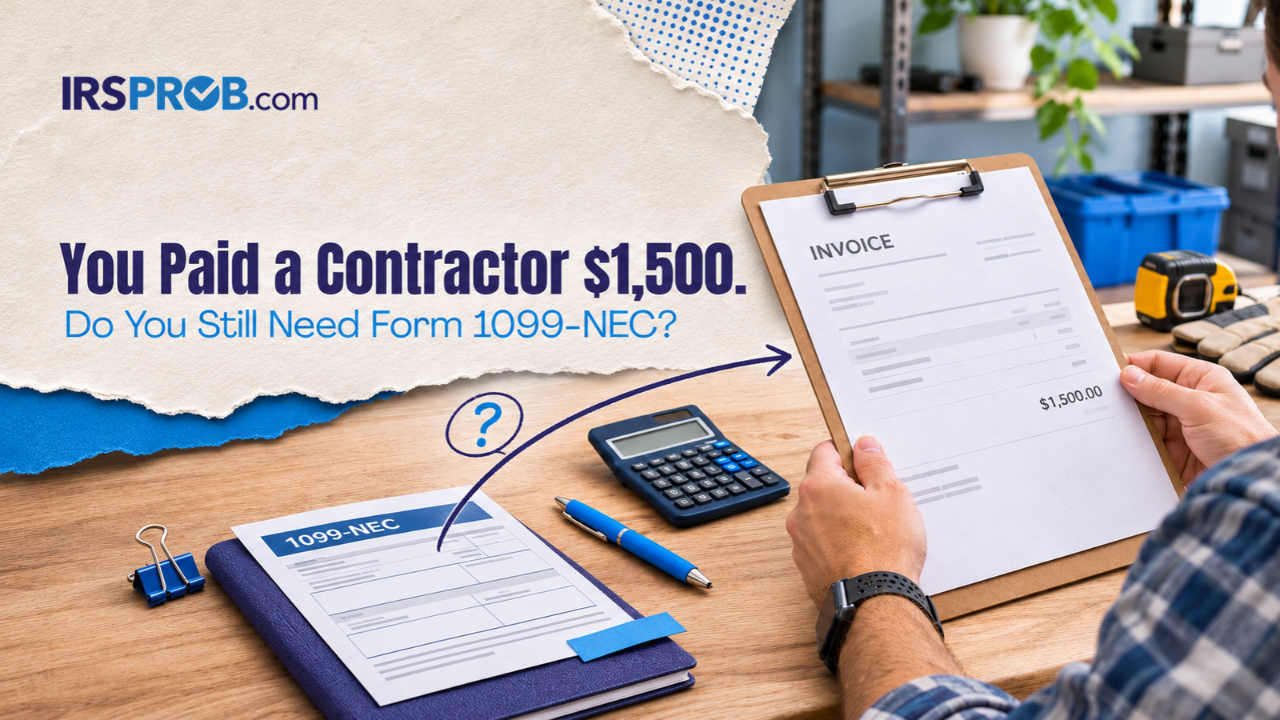
The 2026 Form 1099-NEC threshold is $2,000 for many contractor payments. That is a big change from the old $600 rule, but it is also easy to misunderstand.
Consider this simple example.
It is November, and a small-business owner is cleaning up the books before year-end. The business paid a freelance designer $1,500 during 2026. The owner remembers the old $600 rule and assumes a Form 1099-NEC will be required.
The designer has a different thought. If no form arrives, maybe the $1,500 does not have to go on the tax return.
Both people are focused on the form. That is where people get caught.
The new threshold may mean the business does not have to issue Form 1099-NEC. It does not make the income tax-free, erase the payment from the books, or prove the worker was properly treated as a contractor.
The form rule changed. The money did not disappear.
Here is what business owners and contractors need to know before filing season.
The 2026 Form 1099-NEC Threshold Is $2,000
For payments made before 2026, the general Form 1099-NEC threshold was $600.
For qualifying payments made during 2026, the general threshold is $2,000. That is more than triple the old amount.
The year of payment matters. If a business is preparing a form for money paid in 2025, it must use the 2025 rule. It cannot use the new $2,000 threshold for an earlier year.
The IRS Form 1099-NEC instructions should always be checked before filing. There are exceptions, and an old checklist may give the wrong answer.
What Payments Count Toward the $2,000 Threshold?
A business generally files Form 1099-NEC when it pays at least $2,000 during 2026 for services performed by someone who is not an employee.
The payment may include commissions, prizes, awards for services, and certain parts or materials connected with the work.
The payment also generally must be connected to the payer’s trade or business.
For example, repairing a company office may count. Repairing the owner’s personal home generally does not.
That distinction matters. The amount alone does not decide the answer.
Add the Whole Year Together
The $2,000 limit applies to the total paid to the same person during the calendar year. It does not apply separately to each invoice.
Suppose a business pays one contractor:
- $500 in March
- $700 in June
- $800 in November
No single payment is more than $800, but the yearly total is $2,000. The business generally reaches the 2026 reporting threshold.
Businesses should total qualifying payments to each contractor for the full year.
What Happens in the $1,500 Example?
Let us return to the freelance designer.
Assume the following facts:
- The designer was properly treated as an independent contractor.
- The business paid the designer $1,500 by check.
- The business made no other payments to the designer during 2026.
- No federal tax was withheld under the backup-withholding rules.
- No special reporting exception applies.
Under those facts, the business generally would not need to issue Form 1099-NEC. The yearly payment is below $2,000.
The designer still reports the $1,500 as income.
If the designer runs a business, the payment may be reported on Schedule C. Allowed and properly documented business expenses may also be deductible.
The $2,000 threshold controls the payer’s form-filing duty. It is not a tax-free allowance for the contractor.
No Form Does Not Mean No Income
Taxable income does not depend on whether a Form 1099-NEC arrives in the mail. A contractor must report taxable income using the actual business records.
Those records may include:
- Invoices
- Bank deposits
- Cash receipts
- Bookkeeping reports
- Payment-app statements
- Forms 1099-NEC
- Forms 1099-K
The goal is to report the real total once.
Do not simply add every tax form to every bank deposit. The same payment may appear in both places. That can cause income to be counted twice.
The business also keeps the payment in its books. A payment does not vanish from the general ledger just because it is below the Form 1099-NEC filing threshold.
Should the Business Still Collect Form W-9?
Yes. That is still a good business habit.
Form W-9 gives the business the contractor’s legal name, taxpayer identification number, federal tax classification, and certain certifications.
A business may expect to pay someone only $1,000, then approve more work later. By December, the total could be over $2,000. If the business waits until January to ask for Form W-9, the contractor may be hard to reach.
Ask for the form before the first payment or near the start of the job. Store it safely because it contains private information.
Form W-9 does not turn a worker into an independent contractor. It only provides tax information. Worker status depends on how the relationship works in real life.
Backup Withholding Can Change the Answer
For covered contractor payments in 2026, the payment threshold tied to backup withholding also increased to $2,000. Missing or incorrect taxpayer information can trigger withholding when the applicable rules are met.
If backup withholding actually occurred, Form 1099-NEC is generally required regardless of the payment amount. A business that withheld federal income tax under these rules generally must report it on Form 945 and remit it under the applicable payment and deposit rules.
If a contractor will not provide Form W-9, do not guess. Check the IRS backup-withholding guidance before making more payments.
How You Paid the Contractor Matters
The payment method can change the reporting duty.
Cash, Checks, ACH, and Direct Transfers
Cash, checks, and many direct bank transfers are generally included when the business applies the Form 1099-NEC rules.
Payments made through an app need a closer look. The app’s name does not settle the issue. The important question is how the payment was processed.
Credit Cards and Payment Networks
Credit-card payments and qualifying third-party-network payments are generally handled by the payment-settlement company under the Form 1099-K rules. The business payer usually does not include those same payments on Form 1099-NEC.
Suppose a business pays a contractor $1,200 by check and $1,000 by credit card. The check total is below the $2,000 Form 1099-NEC threshold. The card company handles its own Form 1099-K rules.
The business should not automatically add the two amounts together and issue Form 1099-NEC for $2,200.
Do Not Report the Same Payment Twice
Duplicate reporting can create a headache for the contractor.
Suppose a business includes a credit-card payment on Form 1099-NEC. The card processor also includes it on Form 1099-K. The IRS may then see two forms for one payment.
The contractor may then need strong records to show that the income was reported only once.
It can also lead to an IRS mismatch notice. IRSProb’s guide to a CP2000 information-return mismatch explains why taxpayers should compare the notice with their records before agreeing to a proposed change.
Businesses should separate checks, bank transfers, card payments, and payment-network transactions before preparing tax forms.
Corporations and Attorneys Need a Closer Look
Payments to corporations are often exempt from Form 1099-NEC, but not always.
Legal fees are an important exception. For 2026, qualifying attorney’s fees generally reach the Form 1099-NEC threshold at $2,000, even when the law firm is incorporated. Certain gross proceeds paid to attorneys remain reportable on Form 1099-MISC at $600.
Medical payments, rent, royalties, and other types of payments may also belong on Form 1099-MISC instead of Form 1099-NEC.
Do not make the decision only because a vendor’s name includes “LLC” or “Inc.” Review Form W-9, the type of payment, and the current IRS instructions.
The Form Does Not Decide Whether Someone Is an Employee
The new threshold did not change the employee-versus-contractor rules.
A worker does not become an independent contractor because the business paid less than $2,000. The worker also does not become a contractor just because the business collected Form W-9 or issued Form 1099-NEC.
The IRS looks at the real working relationship. That includes who controls the work, how the worker is paid, who provides tools, and the kind of relationship the parties created.
Someone who should have been treated as an employee may need Form W-2 and payroll-tax reporting, even if the total pay was below $2,000.
IRSProb explains this issue in its guide to holiday workers and independent-contractor classification.
Can the Business Deduct a Payment Without Form 1099-NEC?
Possibly. The business deduction and the form-filing rule are not the same test.
A contractor payment may be deductible when it is an ordinary and necessary expense and the business can prove the amount, payee, and purpose.
Being below the Form 1099-NEC threshold does not automatically block the deduction. Issuing the form also does not automatically prove the payment is deductible.
Keep the contract, invoice, proof of payment, completed Form W-9, and a clear note showing what work was done for the business.
What Should a Contractor Do if No Form Arrives?
Use your own records. Do not wait for a tax form to tell you how much you earned.
Reconcile your invoices with the payments you received. Count each payment only once. If you use the cash method, you generally report income when you actually or constructively receive it. Different timing rules can apply under the accrual method.
Then compare your income records with any Forms 1099-NEC and 1099-K you receive. A self-employed person may need to report the income on Schedule C and calculate self-employment tax on Schedule SE.
Allowable business expenses may still be deducted when they meet the tax rules and are properly supported.
If a client says, “You are under the threshold, so you do not need to report it,” do not rely on that advice. The client’s form-filing duty does not control your income-tax return.
What if Form 1099-NEC Is Wrong?
Start with your records.
Compare the form with your invoices, payment dates, refunds, and payment methods. If the amount is wrong, contact the payer quickly and ask for a corrected form. Explain the problem in writing and keep a copy.
Do not report a wrong amount just to match the form. Do not ignore the form either. Report the correct tax result and keep the records that support it.
If the same payment appears on both Form 1099-NEC and Form 1099-K, ask whether one of the forms needs to be corrected before you file.
The Threshold Can Change After 2026
The $2,000 threshold applies to qualifying payments made during 2026. For later years, the amount is subject to inflation adjustment.
Do not assume $2,000 will be the right number every year. Check the current IRS information-return filing guide for the year in question.
A Simple Year-End Checklist
Before January, a business should:
- Make a list of everyone paid for services.
- Separate employees from independent contractors.
- Ask for any missing Forms W-9.
- Total qualifying payments by person for the full year.
- Separate checks and direct payments from card and payment-network transactions.
- Review any backup withholding.
- Look closely at payments to attorneys and corporations.
- Check names and taxpayer identification numbers.
- Find out whether electronic filing is required.
- Use the correct form and instructions for 2026 payments.
For 2026 payments, the general deadline to file Form 1099-NEC with the IRS and give the recipient a copy is February 1, 2027. January 31 falls on a Sunday, so the deadline moves to the next business day.
Businesses can use the IRS Information Returns Intake System to file electronically. If you plan to use the IRIS Taxpayer Portal, arrange access early because you need an IRIS Transmitter Control Code.
Frequently Asked Questions
Did the Form 1099-NEC Threshold Double?
No. It went from $600 to $2,000 for qualifying 2026 payments. That is more than triple the old amount.
Is $1,999 of Contractor Income Tax-Free?
No. The threshold concerns the business’s duty to file a form. The contractor still reports taxable income.
Do Smaller Payments Count Together?
Yes. Qualifying payments to the same person are generally added together for the calendar year.
Do Personal Payments Require Form 1099-NEC?
Generally, no. Form 1099-NEC usually covers payments made in a trade or business.
Should I Collect Form W-9 Below $2,000?
Generally, collecting Form W-9 early is a good practice for U.S. contractors, even when expected payments are below $2,000. Payments may increase, and the information may be needed if backup-withholding questions arise.
Do Credit-Card Payments Go on Form 1099-NEC?
Generally, no. Qualifying card payments are normally handled by the payment-settlement company under the Form 1099-K rules.
Does Form 1099-NEC Prove Contractor Status?
No. Worker status depends on the real relationship, not the tax form the business chooses.
What to Do Next
Business owners should review contractor payments before the year ends. That leaves time to collect missing Forms W-9, separate payment methods, and fix bookkeeping mistakes.
Contractors should compare invoices, deposits, and payment-app records. Do not wait for a tax form to decide what income belongs on the return.
The goal is not to file every possible form. The goal is to file the right forms, report the right income, and keep records that explain the numbers.
If the payment method, worker status, or reporting rule is unclear, ask a CPA or tax attorney to review the facts before filing season gets busy.
Need tax consultation? Contact us.
Visit IRSProbDisclaimer
This article is for general information only. It is not legal or tax advice. Tax results depend on the facts, payment method, worker relationship, and current law. Talk with a licensed CPA or tax attorney before taking action.