Consider this hypothetical example. Maria had finally built a retirement habit. Every payday, a small amount went into her 401(k).
When she filed her tax return, she sometimes qualified for the Saver's Credit. Then she heard that the credit was ending after 2026.
Her first thought was, “There goes another tax break.” That is not the whole story.
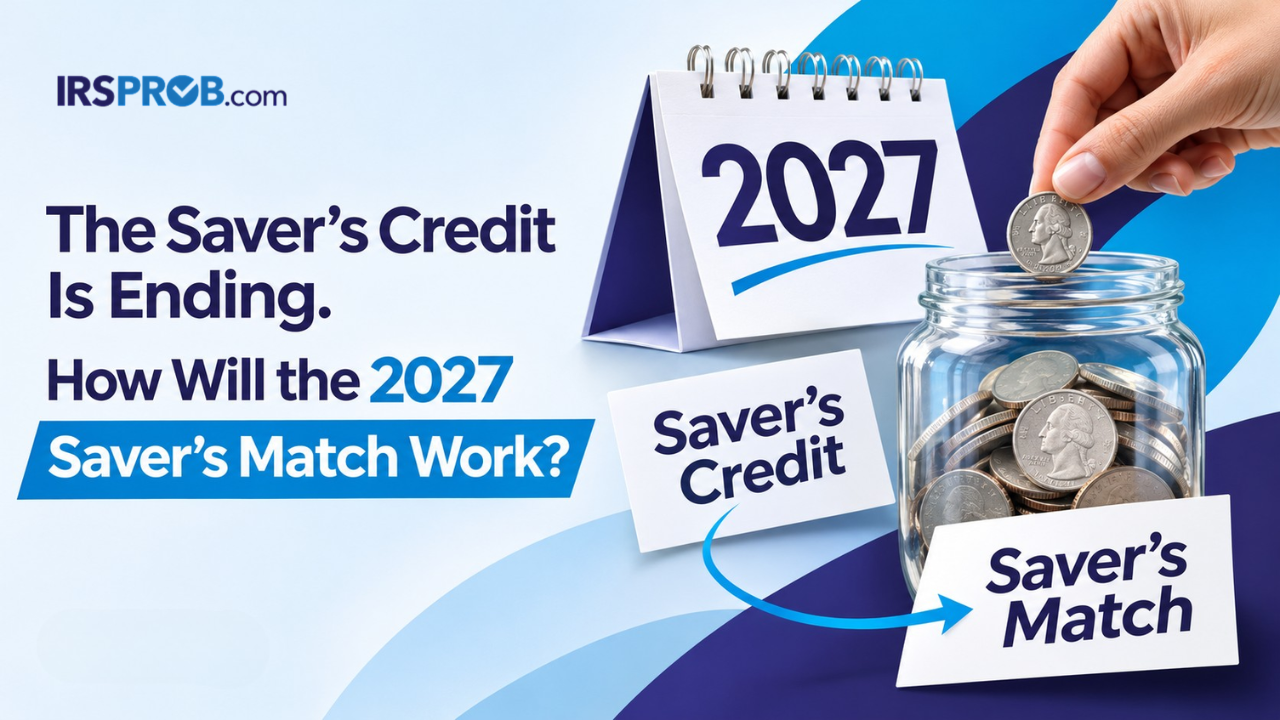
The 2027 Saver's Match will replace the Saver's Credit for most qualifying retirement contributions. Instead of only reducing your tax bill, the new program can place federal matching money into a retirement account.
But the words “50% match” can be misleading without the details. A $2,000 contribution does not guarantee a $1,000 match. Your income, filing status, recent retirement withdrawals, and other eligibility rules can change the result.
Here is what retirement savers should know.
The Saver's Credit Still Applies to Qualifying 2026 Contributions
Do not write off the current credit too early.
The existing Saver's Credit still applies to qualifying contributions made for 2026. As a nonrefundable credit, it can reduce federal income tax but generally cannot exceed the tax you owe.
The credit rate can be 50%, 20%, or 10% of up to $2,000 of eligible contributions for each qualifying person. Several eligibility rules apply.
For contributions made to retirement plans and IRAs, the new match generally replaces that credit beginning with the 2027 tax year. Contributions to an ABLE account are a special exception. They may continue to qualify for the Saver's Credit because the Saver's Match does not apply to ABLE accounts.
What Is the 2027 Saver's Match?
The IRS Saver's Match program is aimed at workers with low or moderate income who save for retirement.
For 2027, an eligible person may receive a federal match of up to 50% of the first $2,000 of qualifying retirement contributions. That makes the maximum match $1,000 per person.
A married couple filing jointly could potentially receive up to $2,000 if both spouses contribute enough and each qualifies.
Most matches will not be paid to your checking account. They generally will go to a qualifying retirement account that you designate and that accepts the payment.
The Saver's Credit and Saver's Match Are Not the Same
| Rule | Saver's Credit through 2026 | Saver's Match starting in 2027 |
|---|---|---|
| Basic benefit | Nonrefundable tax credit | Federal retirement contribution |
| Maximum base contribution | $2,000 per eligible person | $2,000 per eligible person |
| Maximum benefit | Up to $1,000 per eligible person | Up to $1,000 per eligible person |
| Where benefit goes | Reduces federal income tax | Usually deposited into a qualifying retirement account |
| When claimed | On the federal tax return | On Form 8880-A with the federal tax return |
| Income effect | Uses credit rates and limits | Uses a 50% rate that gradually phases down |
How Much Could Your Saver's Match Be?
The simple calculation is:
Qualifying contributions, limited to $2,000 × your match percentage
First, relevant retirement distributions reduce your qualifying contributions. The $2,000 cap is then applied to the remaining amount.
Suppose Maria contributes $2,000 to her 401(k) in 2027. She qualifies for the full 50% rate and has no retirement withdrawals that reduce her contribution amount.
Her potential match is:
$2,000 × 50% = $1,000
Now change one fact. Maria contributes the same $2,000, but her income places her inside the phaseout range. Her income may reduce her match rate, depending on the phaseout calculation and rounding.
The IRS gives another useful example. A single filer contributes $1,500 to a traditional IRA and has 2027 modified adjusted gross income of $30,000. After the calculated percentage-point reduction is rounded down, the match rate is 19%, producing a $285 match.
Who May Qualify for the 2027 Saver's Match?
You generally must:
- Make a qualifying retirement contribution
- Be at least age 18 by the end of the tax year
- Not be a student under the federal definition
- Not be claimed as someone else's dependent
- Be a U.S. resident for tax purposes, subject to special rules
- Fall within the applicable income range
A student for this purpose generally includes someone enrolled full time during at least five calendar months of the year.
The 2027 income ranges are:
| Filing status | Full 50% match | Partial match | No match |
|---|---|---|---|
| Married filing jointly or qualifying surviving spouse | Up to $41,000 | $41,001 to $70,999 | $71,000 or more |
| Head of household | Up to $30,750 | $30,751 to $53,249 | $53,250 or more |
| Single or married filing separately | Up to $20,500 | $20,501 to $35,499 | $35,500 or more |
These limits use modified adjusted gross income, or MAGI, not simply the number shown as wages on your W-2.
For this program, MAGI starts with adjusted gross income and adds back certain amounts. Those additions include pretax retirement deferrals, deductible traditional IRA contributions, and certain excluded foreign income.
In plain English, increasing a pretax 401(k) contribution may lower income shown elsewhere on your return, but it does not necessarily lower MAGI used for the Saver's Match.
Which Retirement Contributions Count?
Qualifying contributions can include contributions to a traditional or Roth IRA and deferrals to plans such as a 401(k), 403(b), governmental 457(b), SIMPLE IRA, SIMPLE 401(k), or qualifying SEP arrangement.
Employer matches, rollovers, and trustee-to-trustee transfers generally are not your new qualifying contribution.
Workplace contributions generally must be made during the calendar year. An IRA contribution may generally be made by the regular filing deadline and designated for the prior year.
If you change jobs and use two workplace plans, keep a combined record. The same habit helps prevent excess 401(k) contributions and supports the match calculation.
Recent Withdrawals Can Reduce the Match
This rule may surprise more people than the income limit.
Certain retirement distributions can reduce the contributions used to calculate your match. For a 2027 claim, the testing period generally includes 2025, 2026, and 2027, plus the period in 2028 before the due date of your 2027 return, including extensions.
Distributions to a spouse can also matter in some joint-return situations.
Consider this example. You contribute $2,000 to a 401(k) in 2027. You took a $900 IRA withdrawal in 2026 and another $500 withdrawal in 2027. Neither amount was rolled over.
The amount used for the match may be only:
$2,000 − $900 − $500 = $600
At a 50% rate, the potential match would be $300, not $1,000.
Not every movement of retirement money causes this reduction. Proper rollovers, trustee-to-trustee transfers, and certain corrective distributions may be excluded. If you are moving retirement money, a direct transfer can also help you avoid a missed 60-day rollover deadline.
Where Will the Match Be Deposited?
You will need a qualifying account that accepts the payment. An eligible 401(k), 403(b), governmental 457(b), or traditional IRA may receive it if the plan or provider participates.
The receiving process is still being developed. IRS Notice 2026-48 discusses possible methods for identifying accounts and moving payments through temporary conduit IRAs.
The federal match cannot be deposited directly into a Roth IRA or designated Roth plan account. Treasury is considering a traditional-IRA conduit followed by a Roth conversion. That conversion could create taxable income. Do not assume a match moved into a Roth IRA will be tax-free.
Check future forms and final instructions before relying on an advertisement or social-media post.
There is one small-payment exception. If your calculated match is more than zero but less than $100, you may elect to receive it as a refundable tax credit instead of a retirement-account contribution.
When Will the First Match Arrive?
The first matches are based on qualifying 2027 contributions. You will claim the benefit by filing the new Form 8880-A with your 2027 federal return in 2028.
The payment will be made after the return is filed and the claim is processed. There is no single guaranteed deposit date in the current guidance.
Did You Receive IRS Notice CP321J?
The IRS has sent CP321J notices to some people who claimed the Saver's Credit for 2025 or whose income appeared to be within the new program's range.
The notice does not guarantee eligibility, and it does not require an amended return. Keep it with your tax records.
Do You Need to Do Anything in 2026?
The IRS says no action is required in 2026 solely because the program is coming.
You can still prepare:
- Keep proof of 2025 and 2026 retirement withdrawals
- Save year-end payroll and IRA contribution records
- Check whether your current plan expects to accept the match
- Review the fees and investment choices in any IRA you may use
- Avoid opening or moving an account only because a promoter promises “free money”
Good retirement tax planning considers account fees, investment risk, cash needs, and early-withdrawal rules too.
What to Do Next
First, save at a level your budget can support. Do not create high-interest debt to chase a possible match.
Second, estimate your 2027 MAGI instead of relying only on wages or taxable income. Include the add-backs that apply to this program.
Third, review retirement distributions from 2025 forward. A prior withdrawal may reduce the contribution amount used for your match.
Fourth, confirm that the account you plan to designate will accept Saver's Match payments. If it will not, ask about another eligible account before filing.
Finally, use the final Form 8880-A and instructions available for the 2027 return. The IRS has announced the framework, but some payment procedures are still being developed.
Frequently Asked Questions
Is the Saver's Credit gone in 2026?
No. It can still apply to qualifying 2026 contributions. The Saver's Match generally replaces it for retirement contributions beginning in 2027.
Does a $2,000 contribution guarantee a $1,000 match?
No. The full amount depends on eligibility, MAGI, filing status, and retirement distributions during the testing period.
Can both spouses receive a match?
Yes, if each spouse makes qualifying contributions and separately meets the individual requirements. The maximum is generally $1,000 per eligible spouse.
Can I receive the match if I owe no federal income tax?
Yes. Unlike the old nonrefundable credit, the match can be available even when you have little or no income-tax liability.
Will the match go into my bank account?
Usually not. It generally goes to a qualifying retirement account. A calculated amount below $100 may be elected as a refundable credit.
Do Roth IRA contributions count?
They can count when calculating the match. The process for directing the federal payment toward a Roth IRA is more complicated and may involve a taxable conversion.
Do rollovers count as new savings?
No. Moving existing retirement money through a rollover or transfer generally is not a new qualifying contribution.
Can an old withdrawal reduce my 2027 match?
Yes. Certain distributions during 2025 through 2027 and the period in 2028 before your 2027 return's filing deadline, including extensions, may reduce it.
Must I file a tax return to receive the match?
Yes. You will generally claim it on Form 8880-A with your 2027 federal return filed in 2028.
Are all payment rules final?
No. The law and main framework are in place, but the IRS and Treasury are still developing parts of the account-registration and payment process.
Need tax consultation? Contact us.
Speak with IRSProb about your retirement tax questions. Call 214-214-3000.
Visit IRSProb.comGuidance reviewed November 4, 2026.