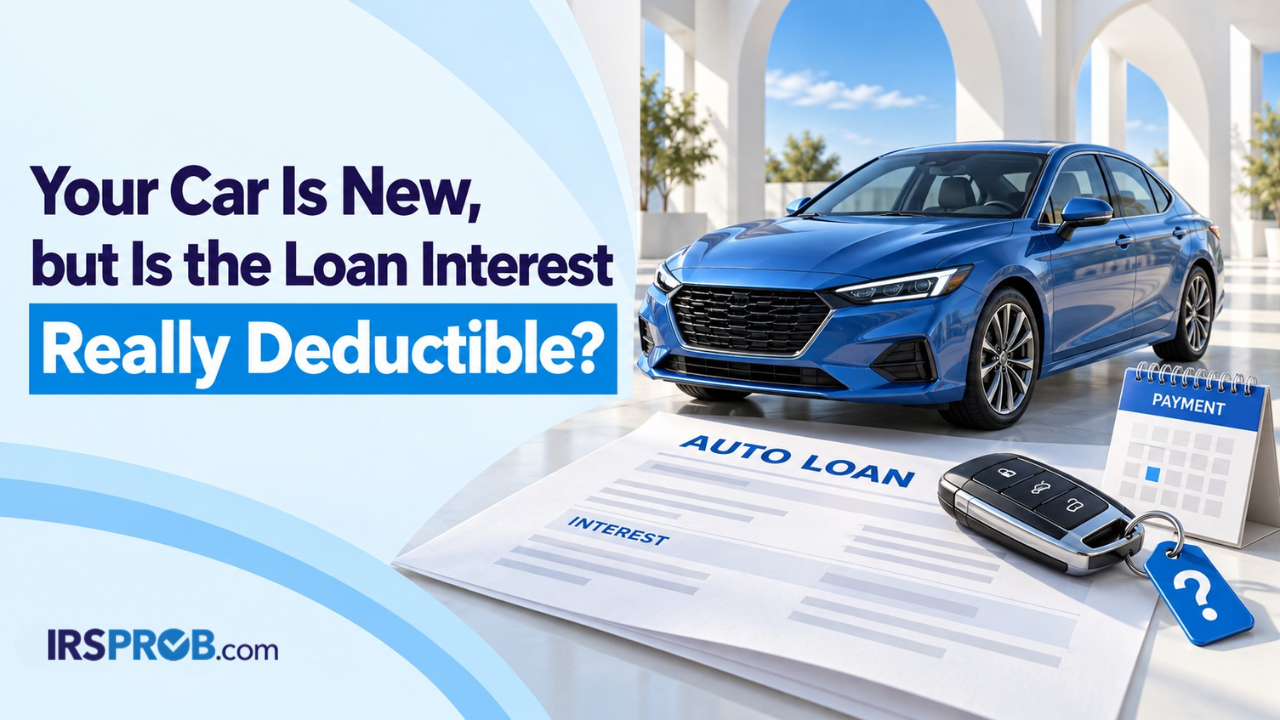
Consider this hypothetical example. The new car was in the driveway. The loan was signed, and the salesperson had mentioned a new tax break for auto-loan interest.
The buyer assumed the car loan interest deduction would cover the interest paid during the year. Maybe it would make the payment easier to justify.
Then tax time arrived.
The buyer still had to confirm final assembly, the loan terms, personal use, interest paid, and whether income reduced the deduction.
A dealer cannot guarantee the tax deduction.
Before claiming it, separate the sales pitch from the tax rules. The vehicle, loan, and taxpayer must qualify. The deduction covers eligible interest actually paid, not the full payment.
How the Car Loan Interest Deduction Works
For tax years 2025 through 2028, eligible taxpayers may deduct up to $10,000 of qualified passenger-vehicle loan interest on a federal return.
Treasury and the IRS published final regulations on September 8, 2026, with an effective date of November 9, 2026. The deduction provisions apply to qualifying tax years beginning after 2024 and before 2029.
It generally applies to interest on a qualifying loan used to buy a qualifying new vehicle for personal use. The loan must arise after December 31, 2024.
The deduction is available whether you itemize or take the standard deduction. It is generally claimed on Schedule 1-A with Form 1040.
A Deduction Is Not a Dollar-for-Dollar Credit
A deduction reduces taxable income. It does not reduce your tax bill dollar for dollar.
If you deduct $4,000 of interest, the IRS does not send you $4,000. The tax effect depends on your income and the rest of your return.
Do not treat the deduction as free money. Interest is still money leaving your bank account.
The Vehicle Must Meet the Original-Use Test
Used vehicles generally do not qualify. However, dealer test drives do not automatically disqualify a demonstrator held primarily for sale. A dealer service vehicle held for business operations may be different. The financing documents must also treat the purchased vehicle as new.
Ask the dealer to confirm how the vehicle was held and whether you are its original user. Keep the purchase agreement and title records.
Which Vehicles May Qualify?
The rules cover more than ordinary sedans. A qualified passenger vehicle may include a:
- Car
- Minivan
- Van
- Sport utility vehicle
- Pickup truck
- Motorcycle
The 14,000-Pound Weight Limit
The vehicle generally must have a gross vehicle weight rating below 14,000 pounds. This is the manufacturer’s rating, not the amount the vehicle happened to weigh on purchase day.
You can often find the rating on the driver-side door label or in the manufacturer’s records.
The Vehicle Must Be Made for Public Roads
The vehicle must generally be manufactured primarily for use on public streets, roads, and highways.
Golf carts, racing vehicles, and equipment made mainly for off-road use may not qualify.
Final Assembly Must Occur in the United States
This requirement surprises many buyers.
An American brand is not enough, and a foreign brand is not automatically disqualified. What matters is final assembly.
Two vehicles with the same badge may be assembled in different countries. Do not rely only on the brand name.
How to Check Final Assembly Using the VIN
Use the vehicle identification number, or VIN, to verify the assembly plant and country. The National Highway Traffic Safety Administration VIN decoder can help.
Keep a copy of the result with your tax records. Include the vehicle’s VIN on your return for every year you claim the deduction.
The Auto Loan Must Pass Its Own Tests
A qualifying vehicle does not rescue a loan that fails the rules.
The Loan Must Be Secured by the Vehicle
The debt generally must be secured by a first lien on the vehicle. In plain English, the vehicle backs the loan.
Interest on a personal loan, credit card, home-equity loan, or loan secured by different property generally does not become qualified vehicle-loan interest just because the money was used to buy a car.
The Loan Must Finance the Vehicle Purchase
The loan must be incurred to purchase the qualifying vehicle. Amounts financed as part of the purchase may include certain closely related costs, such as sales tax, vehicle fees, warranties, service plans, or qualifying accessories.
Money borrowed for unrelated purchases does not qualify merely because it appears in the same financial arrangement.
Interest attributable to negative equity from a trade-in does not qualify merely because that debt is rolled into the new vehicle loan.
Loans From Related People Need Special Care
Interest on debt owed to a related person generally does not qualify. A family loan may also lack the required lien and purchase records.
If a parent, child, family business, or other related party financed the purchase, obtain professional advice before claiming the deduction.
Lease Payments and Cash Purchases Do Not Qualify
A lease is not a vehicle-purchase loan. The finance charge built into a lease payment is not qualified car-loan interest under this deduction.
A cash buyer has no loan interest to deduct. The rule applies only to qualifying interest paid on qualifying debt.
How Much Interest Can You Deduct?
The maximum deduction is $10,000 per federal return, not per car and not per spouse. Filing jointly does not double the limit.
The limit applies to interest, not principal. Use the lender’s year-end information and your payment records.
A Simple Interest Example
Assume Taylor pays $7,200 during the year on a qualifying auto loan. The lender’s records show that $4,100 was interest and $3,100 reduced principal.
Taylor starts with $4,100, not $7,200. If Taylor passes the vehicle, loan, personal-use, and income tests, the potential deduction is $4,100 before any income phaseout.
Income Can Reduce or Eliminate the Deduction
The deduction begins to phase out when modified adjusted gross income exceeds $100,000, or $200,000 for married couples filing jointly.
The reduction is $200 for every $1,000, or fraction of $1,000, over the applicable threshold.
How the Phaseout Works
Suppose a single taxpayer has $6,000 of otherwise qualified interest and modified adjusted gross income of $112,400.
The taxpayer is $12,400 over the threshold. Because a fraction of $1,000 counts as another $1,000, the calculation uses 13 increments.
Thirteen times $200 equals a $2,600 reduction. The potential $6,000 deduction becomes $3,400.
The maximum $10,000 deduction is fully phased out at $150,000 of modified adjusted gross income, or $250,000 on a joint return. A smaller starting deduction can disappear at a lower income.
You Do Not Have to Itemize
An eligible taxpayer may generally claim the deduction while taking the standard deduction.
Enter the vehicle, loan, interest, VIN, and income information carefully, then review Schedule 1-A before filing.
What If the Vehicle Has Both Personal and Business Use?
Mixed use can become technical.
The rules generally ask whether the vehicle was expected to have more than 50 percent personal use when the debt arose.
A self-employed taxpayer may have another possible deduction for business interest or vehicle expenses. The same interest cannot be deducted twice.
If the vehicle qualifies under both personal and business rules, the taxpayer may need to choose a reporting method or make an allowed allocation. Review the facts with a tax professional. For background, see this guide to personal and business vehicle deductions.
What Happens After Refinancing?
Interest on a refinanced qualifying vehicle loan may continue to qualify, but generally only to the extent the new debt replaces the outstanding qualifying purchase balance.
Keep the purchase contract, payoff statement, and refinancing agreement to trace the qualifying balance.
Cash-Out Refinancing Can Change the Result
If the refinancing gives you extra cash, interest related to that additional amount generally is not qualified vehicle-loan interest.
For example, refinancing a $24,000 qualifying balance into a $30,000 loan does not automatically make interest on the entire $30,000 eligible. The extra $6,000 needs separate treatment.
What Records Should You Keep?
Build the file while the transaction is fresh. Keep:
- The purchase agreement and financing contract
- The vehicle title or registration
- The VIN and final-assembly verification
- The manufacturer’s gross vehicle weight rating
- Proof that the vehicle was new and original use began with you
- Lender statements showing interest paid
- Proof of payments
- Refinancing and payoff records
- Records supporting personal and business use
- Any corrected lender statement
- The return and Schedule 1-A claiming the deduction
For 2026, a lender generally must issue Form 1098-VLI when it receives at least $600 of reportable interest. That threshold is not a minimum deduction requirement. Keep payment records even if you do not receive the form.
The lender’s statement may not prove every eligibility requirement. For more ideas, review these vehicle deduction recordkeeping tips.
Situations That Need a Closer Look
Married Taxpayers and Co-Borrowers
The person claiming the deduction should be able to show an ownership interest, responsibility for the debt, and payment of the interest. Married filing separately does not automatically disqualify you. The $100,000 income-phaseout threshold applies to a separate return. Review who incurred the debt and paid the interest.
Vehicles Purchased for Dependents
If a parent finances a vehicle titled to a child, the person who owns the vehicle, owes the debt, and pays the interest may not be the same. Do not assume the parent automatically receives the deduction.
Vehicles Titled to a Business
A vehicle titled to a corporation, partnership, or other separate entity may not fit the individual personal-use deduction, even when an owner drives it. Business deductions follow different rules.
Someone Else Paid the Interest
Being named on a loan does not necessarily let you deduct interest another person paid. Trace who was legally liable and who made the payments.
Review your tax withholding for 2026.
Read IRSProb’s related guide to qualified vehicle loan interest and withholding.
Review Tax WithholdingFrequently Asked Questions
Does every new car qualify?
No. The vehicle, final-assembly location, weight, intended road use, loan, personal use, interest, and taxpayer’s income must all satisfy the rules.
Can I deduct interest on a used car?
Generally, no. Original use must begin with the taxpayer claiming the deduction.
Does an American brand automatically qualify?
No. Final assembly of that specific vehicle must occur in the United States. Check the VIN.
Can I deduct my full monthly payment?
No. Principal is not interest. Only eligible interest paid may enter the deduction calculation.
Must I itemize deductions?
No. Eligible taxpayers may generally claim the deduction even when taking the standard deduction.
Can I deduct lease interest?
No. Lease payments are not interest on a qualifying vehicle-purchase loan.
Does refinancing destroy the deduction?
Not automatically. Interest on the qualifying refinanced balance may remain eligible. Cash-out and unrelated debt generally do not.
What if I use the car in my business?
Personal and business rules can overlap. You cannot deduct the same interest twice, so compare the available treatments carefully.
What if I bought the car late in the year?
You may deduct only eligible interest actually paid during that tax year, subject to all other requirements.
What to Do Next
Start with the documents, not the dealership promise.
Confirm the vehicle was new, check final assembly through the VIN, review the weight rating, read the loan agreement, and identify the interest actually paid. Then calculate whether the income phaseout applies.
The IRS provides an overview of the qualified passenger vehicle loan interest rules and filing details in the Form 1040 instructions. Use the instructions for the year being filed.
The car may be new. The deduction is not automatic.