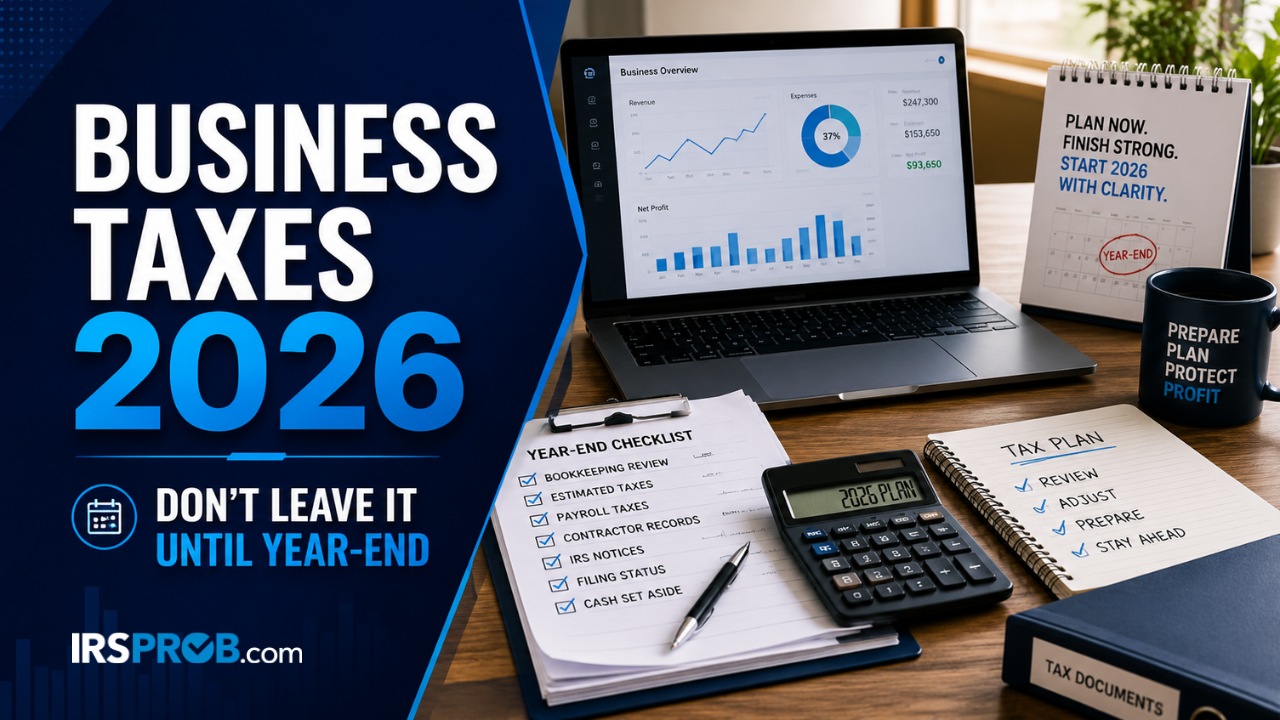
By the time December shows up, some business tax problems have already been building for months.
They do not always show up loudly.
Sometimes it is a set of books that has not been cleaned up. Sometimes it is estimated tax payments that no longer match the current income, profit, deductions, credits, and tax picture. Sometimes it is payroll records, contractor paperwork, or an IRS notice that kept getting pushed behind customer work.
That is why business taxes 2026 should not be treated like a year-end scramble.
For small business owners, the better move is to look at the basics while there is still room to adjust. Not everything can be fixed in one afternoon, but you can usually get a clearer picture before tax season is already at the door.
- Why business taxes 2026 Need Attention Before Year-End
- Bookkeeping Should Not Be Months Behind
- Estimated Tax Payments May Need a Mid-Year Review
- Payroll Taxes Need Regular Attention
- Contractor Records and 1099s Should Not Wait Until January
- IRS Notices Should Be Reviewed Before They Become a Bigger Problem
- Old Filing Gaps Do Not Fix Themselves
- Cash Set Aside for Taxes Should Match the Business You Actually Have
- What Small Business Owners Should Review Now
- What to Do Next
- Frequently Asked Questions
Why business taxes 2026 Need Attention Before Year-End
Small business taxes usually do not go wrong all at once.
They drift.
One month of bookkeeping gets skipped. A quarterly estimate gets based on old numbers. A contractor starts work before a W-9 is collected. Payroll tax records are handled, but nobody reviews whether the filings and deposits match. An IRS notice gets opened, then set aside until things slow down.
The problem is that things do not always slow down.
By year-end, those small delays can turn into a stack of questions that should have been answered earlier.
- What has been filed?
- What has been paid?
- What is missing?
- What does the IRS still show as open?
That is where a mid-year or pre-year-end review can help. The goal is not to make the business perfect. The goal is to know what needs attention before the calendar runs out.
The IRS Small Business and Self-Employed Tax Center is also a useful official starting point for business tax responsibilities.
Bookkeeping, estimates, payroll records, contractor paperwork, and IRS notices are easier to review before year-end pressure builds.
Bookkeeping Should Not Be Months Behind
Bookkeeping is not just paperwork for the tax preparer.
It is how the owner sees what is really happening.
When the books are months behind, it becomes harder to know the real profit, current cash position, deductible expenses, and how much should be set aside for taxes.
That creates guessing.
And guessing is where many small business owners get caught.
Before year-end, it helps to check the basics:
- Bank accounts reconciled
- Credit card transactions categorized
- Loans and owner draws recorded correctly
- Income matched to deposits
- Major expenses supported with records
- Payroll reports matched to the books
This is not about fancy reporting.
It is about having numbers clean enough to make decisions from facts instead of memory.
Estimated Tax Payments May Need a Mid-Year Review
Estimated tax payments are easy to put on autopilot.
A business owner may keep using last year’s numbers because it feels simple. But if 2026 looks different from 2025, that old estimate may not tell the full story.
Maybe sales are higher. Maybe profit is lower because costs increased. Maybe the owner hired staff. Maybe a new service line changed the numbers. Maybe owner draws were larger than expected.
The estimate should be reviewed against the current income, profit, deductions, credits, and tax picture, not just last year’s habit.
The IRS explains that estimated taxes are based on expected income, deductions, credits, and tax for the year.
A review before year-end gives the owner time to see whether enough has been paid in, whether the business may be short, and whether adjustments should be discussed with a qualified tax professional.
Do not wait until the return is being prepared to find out the estimate was off.
If income, profit, expenses, payroll, or owner draws changed, estimated tax payments may need another look before year-end.
Payroll Taxes Need Regular Attention
Payroll is one area small business owners should not treat casually.
Once a business has employees, payroll deposits, filings, records, and deadlines need regular attention. Payroll taxes are not ordinary operating bills.
Taxes withheld from employees are trust fund taxes. They should not be treated like general business cash.
Payroll records should show what was withheld, what was deposited, what was filed, and which period each item belongs to.
If the business has grown, payroll may have changed quickly. New employees, higher wages, bonuses, turnover, and payroll provider changes can all create recordkeeping issues if nobody is reviewing the details.
Before year-end, check whether payroll reports match the books and whether deposits and filings are current. The IRS provides information on employment tax due dates, including regular filing and payment responsibilities.
If payroll tax issues are already part of the problem, IRSProb.com’s page on trust fund recovery penalties may help explain why these cases can involve different risks than ordinary business tax balances.
Do not leave payroll cleanup until the last week of December.
Employee withholding should not be treated like normal operating cash. Payroll tax issues can become harder to clean up if filings, deposits, and records are not reviewed.
Contractor Records and 1099s Should Not Wait Until January
Contractor paperwork feels small until it suddenly is not.
A vendor gets paid. A subcontractor starts work. A consultant sends an invoice. Everyone is busy, so the W-9 gets skipped.
Then January arrives, and the business is chasing names, addresses, taxpayer identification numbers, and payment totals.
That is not a good system.
If your business pays contractors, review those records before year-end. Make sure you have W-9s where needed. Review who was paid, how much was paid, and whether the records match the books.
The IRS explains that after determining a worker is an independent contractor, the business should have the contractor complete Form W-9 and keep it in the business’s files. You can review the IRS page on forms and associated taxes for independent contractors.
The cleaner habit is to request Form W-9 before paying a contractor, so the name and taxpayer identification number are on file before 1099 preparation.
This is much easier to handle while the relationship is active and the records are fresh.
IRS Notices Should Be Reviewed Before They Become a Bigger Problem
An IRS notice should not sit unopened on a desk.
Some notices are simple. Some are more serious. Some require action. Some do not. But the owner needs to know what the notice says before deciding what to do next.
Look for the tax year, form, amount, deadline, and reason for the notice.
Then compare it with your own records.
Do not assume the notice is wrong. Do not assume it is right either. Start with the facts.
If the notice tells you to call, have the notice and related return available before you call.
If the business has multiple notices, put them in date order and separate them by tax year or tax period. That simple step can make the situation easier to understand.
The goal is to know what the IRS is asking for before the issue moves into a later stage.
If an unresolved balance has moved toward collection language, IRSProb.com’s page on federal IRS tax liens and levies may help explain why collection notices should be reviewed carefully.
Old Filing Gaps Do Not Fix Themselves
A missing return does not disappear because the business is busy.
If the business skipped a prior return, missed a payroll filing, or never fully cleaned up an old filing issue, year-end is a good time to see what is still open.
The IRS generally expects required past-due returns to be filed, even when the taxpayer cannot pay the full amount right away. The IRS has information about filing past due tax returns.
That does not mean every situation is simple. The right next step can depend on the type of return, entity, tax period, records available, and whether payroll taxes are involved.
But waiting usually does not make the filing gap clearer.
Before year-end, list what has been filed and what may still be missing. Then review what records are needed to move forward.
If old returns are part of the issue, IRSProb.com also has a guide on unfiled tax returns in Texas.
Cash Set Aside for Taxes Should Match the Business You Actually Have
A tax savings habit that worked two years ago may not fit the business anymore.
If sales changed, profit changed, payroll changed, or the business structure changed, the amount being set aside for taxes may need another look.
The bank balance can be misleading.
Some of that cash may already belong to payroll, vendors, rent, loans, sales tax, income tax, or estimated payments.
Small business owners should not treat every dollar in the account as spendable.
Before year-end, review what is available, what is already committed, and what may need to be set aside for taxes. That one habit can prevent a lot of last-minute pressure.
Some cash may already be committed to payroll, vendors, loans, estimated payments, or tax obligations.
What Small Business Owners Should Review Now
Start with the records.
Pull together:
- Current bookkeeping reports
- Bank and credit card statements
- Payroll reports
- Estimated tax payment records
- IRS notices
- Contractor W-9s
- 1099 payment records
- Prior-year returns
- Missing filing information
- Current cash flow numbers
Then ask the practical questions.
- Are the books current enough to make decisions?
- Have estimated payments been reviewed this year?
- Are payroll filings and deposits current?
- Do contractor records look complete?
- Are there any IRS notices that need attention?
- Are any old returns still missing?
- Can the business stay current going forward?
That last question matters.
A plan that does not fit the current cash flow may not hold for long.
If unresolved balances, penalties, or interest are already part of the problem, IRSProb.com’s guide on IRS penalties and interest may help explain why waiting can make an existing tax issue harder to manage.
What to Do Next
Do not wait until year-end to find out the tax side of the business is behind.
Start with the records. Open the notices. Review estimated payments. Check payroll. Confirm contractor paperwork. Look for filing gaps. Then decide what needs attention first.
If your business has IRS notices, old filing gaps, payroll tax concerns, or tax balances that need review, IRSProb.com can help you understand the situation and discuss possible next steps.
If a payment option is needed, the IRS provides an Online Payment Agreement Application, but business owners should still review the full picture before choosing an option.
Need help reviewing business taxes 2026 before year-end?
For small business owners dealing with IRS notices, filing gaps, payroll tax concerns, or tax balances, IRSProb.com can help you slow down and review what needs attention first.
Visit IRSProb.com or call 214-214-3000.
Request a Free Tax ConsultationFrequently Asked Questions
What should small business owners review before year-end?
Review bookkeeping, payroll records, estimated tax payments, contractor W-9s, 1099 payment records, IRS notices, old filing gaps, and current cash flow.
Should estimated tax payments be reviewed during the year?
Yes. Estimated tax payments may need review if income, profit, deductions, credits, expenses, owner draws, payroll, or the business structure changed during the year.
Do I need W-9s from contractors before issuing 1099s?
In many cases, businesses should request Form W-9 from independent contractors before payment or before preparing required information returns.
What should I do if my business received an IRS notice?
Open it and read it carefully. Look for the tax year, form, amount, deadline, and reason for the notice. Then compare it with your own records before responding.
Can I fix old business tax filings before year-end?
In some cases, yes. The best next step depends on the type of return, tax period, records available, and whether the business can stay current going forward.