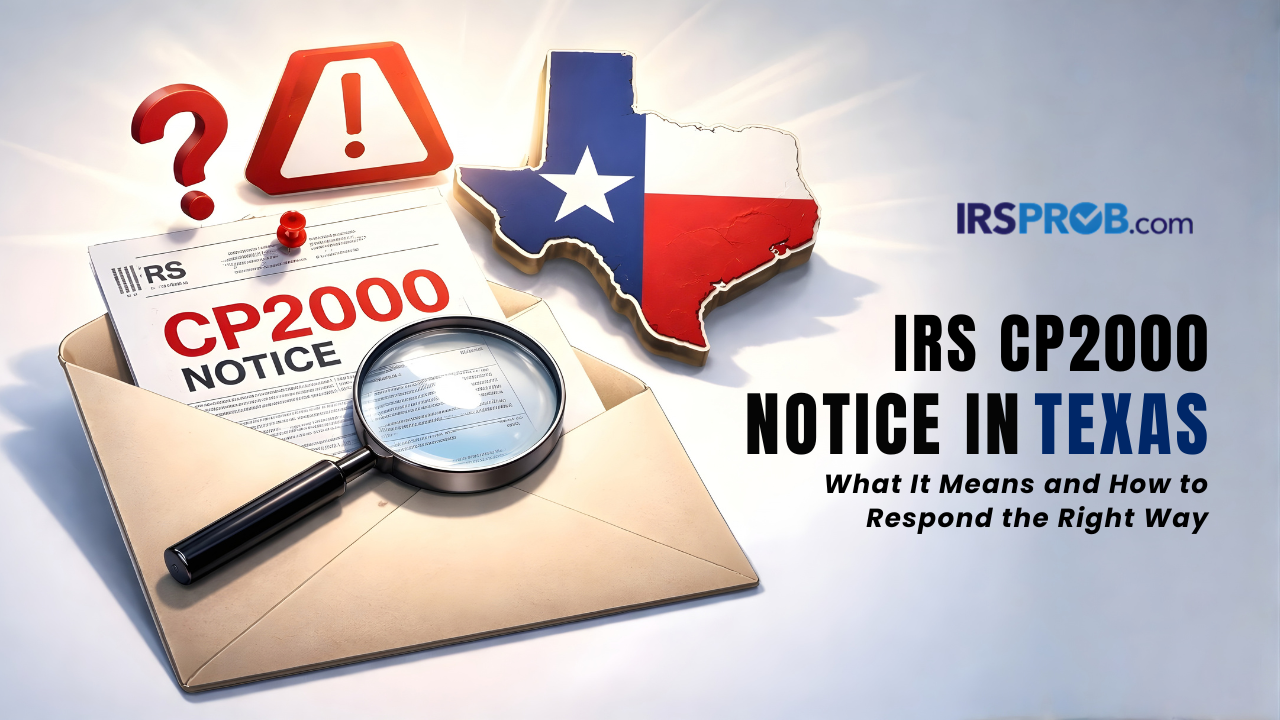
Receiving an IRS CP2000 notice can make any Texas taxpayer uneasy. It often arrives without warning, uses formal language, and makes it feel like something serious has already been decided. In most cases, though, the IRS is saying that information reported by a third party — such as an employer, bank, broker, or payer — does not match what was listed on your tax return. According to the IRS page on understanding your CP2000 series notice, the notice explains proposed changes to your return and the information used to determine them.
The same IRS guidance also makes an important point: a CP2000 is not a bill, but your response may be required.
What an IRS CP2000 Notice Actually Means
If you have been searching what is a CP2000 notice, the clearest answer is this: it is the IRS's proposal to adjust your income, payments, credits, or deductions because the information on file does not match what you reported. The IRS explains in Topic no. 652, Notice of underreported income that a tax examiner reviews the return against information reported by employers, banks, businesses, and other payers on forms such as W-2s, 1098s, and 1099s. If a discrepancy exists, the IRS may issue a CP2000.
This is why the phrase CP2000 not a bill matters so much. The IRS uses that exact concept in its own guidance. That means you still have a chance to review the proposed changes, compare them to your records, and respond before the matter moves forward. It also means a CP2000 usually does not mean you are being audited. The IRS says that clearly in its CP2000 explanation page, and that clarification matters because many taxpayers panic the moment the notice arrives.
You can also think of this as an IRS income mismatch notice. The agency is not automatically accusing you of fraud. It is saying that what was reported to the IRS by outside sources does not line up with your return and needs to be resolved. That is serious, but it is still a stage where facts and documentation matter.
A CP2000 is a proposed adjustment, not a final bill and not an audit. You have the right to review it, respond to it, and correct it if the IRS has incomplete information.
Why Texans Receive a CP2000
Most CP2000 notices happen because income was omitted, reported differently, or reported without enough detail. Common examples include forgotten 1099 income, retirement distributions, brokerage sales without basis information, or payment amounts that do not match what was filed. The IRS states that the difference may increase your tax, decrease it, or sometimes not change it at all.
For taxpayers in Texas, the process is the same statewide. Whether you are in Dallas, Houston, Austin, San Antonio, Fort Worth, or a smaller Texas community, the key issue is not location. It is whether you review the notice carefully and respond the right way. A good first step is to read a focused Texas CP2000 guide and then explore more IRS CP2000 notice Texas resources if you want more local context.
What to Do as Soon as the Notice Arrives
Start by reading the entire notice carefully. The IRS says the notice explains the proposed changes and the information used to determine them. Compare those details against your filed return and the forms you actually received. Do not rely on memory. Pull the return, the W-2s, the 1099s, the brokerage records, and anything else tied to the issue. The IRS video transcript for IRS Letter CP2000 proposed changes to your tax return gives the same first instruction: read the notice carefully and compare it to your return.
Next, pay attention to the CP2000 response deadline. The IRS says you should reply by the date shown on your notice, and its public guidance notes that replying within 30 days helps resolve the issue more quickly. If the notice includes a response form, complete it and sign it. If it does not, follow the instructions given in that specific letter.
Then gather your support. That may include corrected tax forms, proof of basis, payer correspondence, or other records that support your explanation. If your notice allows secure upload, the IRS says the Document Upload Tool is a secure, fast way to send scans, photos, or digital copies of documents in response to an IRS notice or letter.
The CP2000 response deadline is printed on the notice. Missing it without contacting the IRS first can limit your options and lead to a bill being issued automatically.
How to Respond if You Agree
If you agree with the proposed changes, the IRS says you should sign and return the response by the due date using the method shown on the notice. If you filed jointly, both spouses generally need to sign. The IRS also states that if you agree and do not have other income, credits, or expenses to report, you generally do not need to amend your return for that issue. That is one reason many taxpayers search how to respond to IRS CP2000 and get confused — the response is made through the notice itself, not automatically by filing an amended return.
If the proposed change creates a balance you cannot pay in full, do not let the issue sit. Interest may continue until the amount is paid. For many taxpayers, it makes sense to review installment agreement options and also read broader help for people behind on taxes so the notice is handled as part of the bigger tax picture, not just as a one-time letter.
How to Respond if You Disagree
If you disagree with some or all of the proposed changes, respond anyway. The IRS says you should indicate that you do not agree, explain why, and include photocopies of supporting records rather than originals. The IRS CP2000 video transcript also explains that if you fax your response, you should include identifying information on each page.
This is where documentation matters most. If the issue involves stock sales, you may need basis records. If it involves duplicate reporting, you may need corrected statements or correspondence from the payer. If your response clears up the issue, the IRS generally sends a letter confirming the matter is resolved. If your explanation only resolves part of the discrepancy, the IRS may send a revised CP2000 with an updated calculation.
If you do not respond or the issue remains unresolved, the IRS may later send a CP3219A. On the IRS page for understanding your CP3219A notice, the agency explains that this notice describes the proposed change, tells you what to do if you agree or disagree, and explains how you can challenge the decision in U.S. Tax Court. That is a more serious stage, which is why a timely and organized CP2000 response matters.
Do not file an amended return just because you received a CP2000. The IRS wants you to respond to the notice itself. Filing an amended return prematurely can complicate the process.
Before Filing Checklist
Before sending your response, slow down and check the basics:
- Read every page of the notice carefully.
- Compare the IRS figures against your return and your source documents.
- Decide whether you fully agree, partially agree, or disagree.
- Gather copies of the records that support your position.
- Verify the mailing address, fax number, or upload option listed on the notice.
- Keep a full copy of everything you send.
- If you need more time, call the number on the notice before the deadline passes.
The IRS also recommends keeping complete records and making sure your returns match the information documents you receive before filing. If you want more context around other IRS letters and what they mean, the IRS notices section is a helpful companion resource.
Common Mistakes
The biggest mistake is ignoring the notice. The IRS says your response may be required, and if you do not reply, the matter can move forward into additional notices and a bill. Waiting rarely improves the outcome.
Another common mistake is assuming the IRS is always right. Sometimes the IRS file is incomplete. A missing cost basis, corrected information return, or reporting duplication can change the result. That is why records matter.
The opposite mistake is assuming the IRS is always wrong. Many CP2000 notices do reflect a real mismatch. If income was left off the return, delaying the response can mean more interest and fewer easy fixes later.
Another mistake is filing an amended return too quickly. IRS guidance says not to amend the return just because you received a CP2000. The IRS wants you to answer the notice itself, unless there is a separate reason to amend for other items not covered by the notice.
When to Get Professional Help
Some CP2000 cases are manageable on your own. Others are not. You should think seriously about professional help if the proposed change is large, the issue involves investments or business income, the records are incomplete, multiple years are involved, or the notice is only one part of a broader tax problem. The IRS states on its CP2000 guidance that you may authorize someone to represent you in dealing with the notice.
You can start with a free tax consultation if you want a professional review. If paying the balance is the real issue, you may also want to understand whether an offer in compromise solution or a payment plan is more realistic for your situation.
If you need help reviewing an IRS CP2000 notice anywhere in Texas, call 214-214-3000 or visit IRSProb.com. The right response now can save a lot of money, time, and stress later.
Call 214-214-3000FAQ
1) Is a CP2000 the same as an audit?
Usually no. The IRS says a CP2000 generally means there is a discrepancy between what was reported on the return and what third parties reported to the IRS, and it does not necessarily mean you are being audited. The IRS explains this directly on its CP2000 notice page.
2) Do I need to amend my return after getting a CP2000?
Not usually. The IRS says that if you agree with the notice and do not have other income, credits, or expenses to report, you generally do not need to amend your return for that issue.
3) What if I cannot respond by the deadline?
The IRS says to call the number on the notice and ask for more time if needed. That is much better than missing the due date without communicating.
4) What happens if I do not respond?
The IRS says it may send additional notices, and if the matter remains unresolved it may move to a CP3219A statutory notice of deficiency.
5) Can I submit my reply online?
In many cases, yes. The IRS says the Document Upload Tool can be used to securely upload documents in response to an IRS notice or letter when that option is available in your case.
Final Thought
An IRS CP2000 notice is serious, but it is also workable. The smartest response is not panic and not delay. It is a calm review of the notice, a comparison against your records, and a clean reply backed by documentation. For Texas taxpayers in Dallas, Houston, Austin, San Antonio, Fort Worth, and beyond, that approach creates the best chance of resolving the issue before it turns into something more expensive and disruptive.