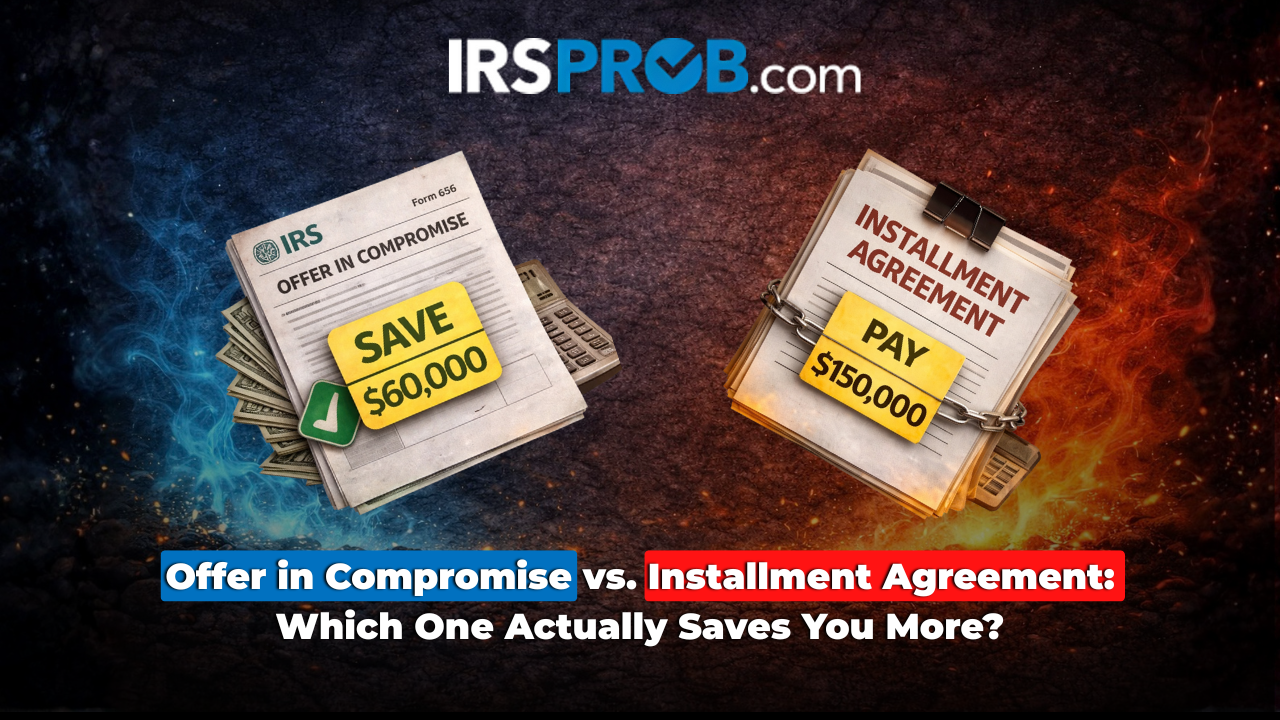
You owe the IRS $80,000. The late-night commercials promise you can "settle for pennies on the dollar" with an Offer in Compromise . Your accountant suggests a payment plan. Your brother-in-law says to just ignore it.
Here's what nobody's telling you: the choice between an Offer in Compromise vs installment agreement isn't about which sounds better. It's about which one you actually qualify for and which one costs you less money when you run the real numbers.
The IRS rejects 60% of Offer in Compromise applications. That's not to scare you. It's to prepare you. Because if you spend six months chasing an OIC that never had a chance, you're six months deeper in penalties while collection actions are stacking up.
An installment agreement is boring. It doesn't sound sexy. But it has a 90% approval rate and stops the IRS from emptying your bank account tomorrow.
So which one actually works for your situation? Let's figure it out.
What is an Offer in Compromise (OIC)?
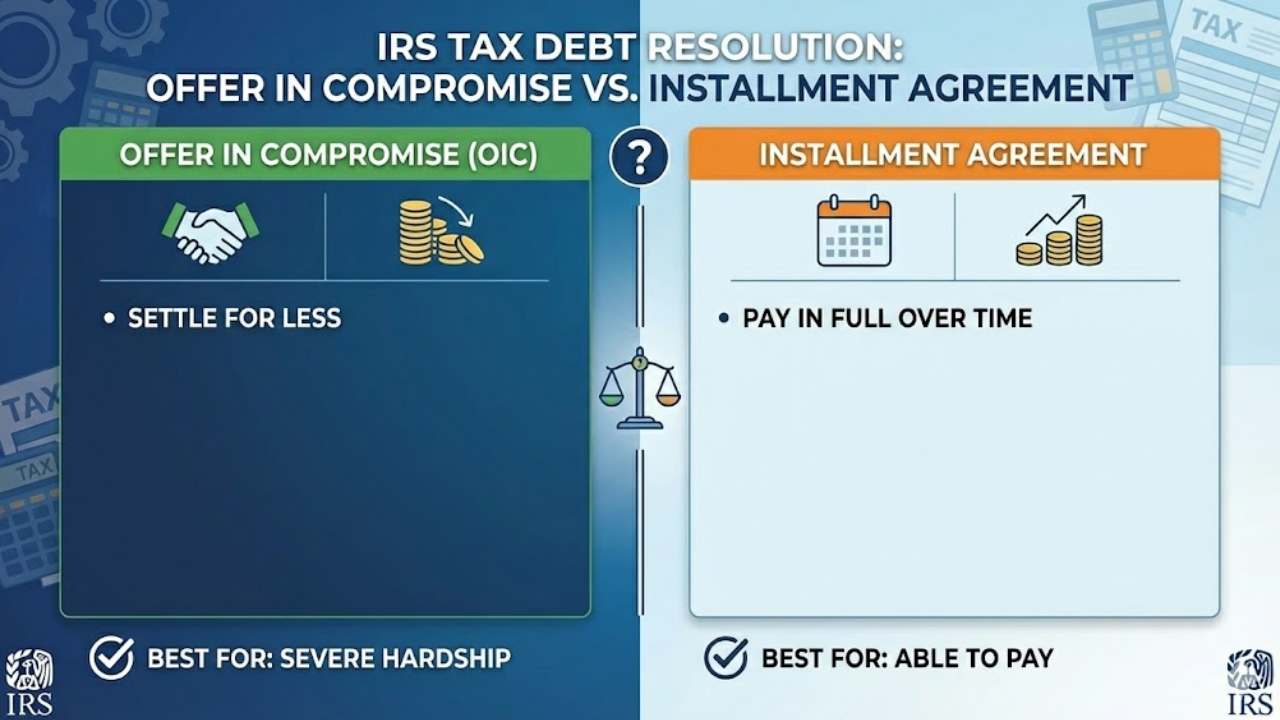
An Offer in Compromise is an IRS program that lets you settle your tax debt for less than the full amount you owe. Sometimes significantly less.
Here's how it works. The IRS looks at your income, your necessary living expenses (using their standards, not yours), your assets, and your future earning potential. They calculate something called your "reasonable collection potential." That's the most they think they can squeeze out of you over the next 10 years.
If that number is less than what you owe, they might accept a settlement.
Travis runs a small construction company in Houston. He owes $95,000 in payroll taxes after three rough years. His business is barely breaking even. After selling his truck and liquidating everything he could, he has about $18,000 in equity. His reasonable collection potential came out to $22,000. The IRS accepted his Offer in Compromise for $22,000.
He saved $73,000. But here's the catch: Travis genuinely couldn't pay more without losing his house. The IRS verified every number. It took 11 months to get approved.
That's an Offer in Compromise. It works when you legitimately cannot pay the full amount. But the IRS doesn't take your word for it. They audit your entire financial life.
The three types of OIC are doubt as to collectibility (most common), doubt as to liability (you legitimately don't owe the tax), and effective tax administration (paying would create extreme hardship). Most people who qualify fall under doubt as to collectibility.
You can learn more about whether you qualify for an Offer in Compromise and see real qualification requirements. The IRS also provides detailed information on their official OIC page.
What is an IRS Installment Agreement?
An installment agreement is a payment plan. You pay your tax debt over time, usually up to 72 months. You pay the full amount plus interest and penalties that keep accruing until it's paid off.
It's not exciting. But it's reliable.
Elena owns a marketing agency in Dallas. She owes $45,000 in back taxes. Her business is profitable now. She can afford $750 a month. She applied online for a streamlined installment agreement, got approved in 20 minutes, and started making payments.
Over 72 months, she'll pay about $54,000 total when you factor in interest. That's $9,000 more than she originally owed. But she got immediate relief from IRS collection actions, avoided a tax lien, and kept her business running.
There are three main types of installment agreements:
Streamlined agreements (debt under $50,000) get approved automatically if you're current on tax filings. You propose your payment amount. The IRS typically approves it as long as you pay off the debt within 72 months.
Non-streamlined agreements (debt over $50,000) require financial disclosure. The IRS calculates what you can afford based on their expense standards. They tell you what your payment will be.
Partial payment installment agreements are a hybrid. You make monthly payments for the life of the collection statute (usually 10 years), but you'll never pay the full amount. When the statute expires, the remaining balance is forgiven.
You can explore installment agreement options or review the IRS payment plan guidelines for official details.
Offer in Compromise vs. Installment Agreement: The Key Differences
Let's cut through the confusion. Understanding the difference between an offer in compromise vs installment agreementcomes down to six factors.
Total Amount You'll Actually Pay
With an OIC, you might pay $18,000 to settle an $80,000 debt. With an installment agreement, you'll pay the full $80,000 plus interest and penalties over six years. When evaluating offer in compromise vs installment agreement costs, OIC saves more money if you qualify and get approved.
Qualification Requirements
OIC requires proving financial hardship using IRS expense standards. They'll question your rent amount, car payment, and grocery bill. They'll look at what you could earn if you sold assets or got a different job. It's invasive and difficult.
Installment agreements require that you're current on tax filings and not in active bankruptcy. That's basically it. If your debt is under $50,000, you're almost guaranteed approval.
Timeline to Resolution
An OIC takes 6 to 12 months for the IRS to review. During that time, collection actions pause. But if they reject it, you've lost a year and penalties have piled up.
An installment agreement gets approved immediately (streamlined) or within 30 days (non-streamlined). You start making payments right away.
Impact on Your Credit
The IRS doesn't report OICs to credit bureaus. Neither program directly affects your credit score. But the IRS may file a tax lien for larger debts, which destroys your credit regardless of which program you choose.
Collection Actions
Once you're in an approved installment agreement, the IRS stops all collection actions. No levies, no garnishments. You're protected as long as you make payments and file future returns on time.
With an OIC, collections pause during the review period. But if they reject your offer, collections restart immediately and aggressively.
IRS Approval Rate
Here's the big one. The IRS rejects a majority of OIC applications, with acceptance rates typically around 30-40%, meaning that 60-70% are not accepted. This is according to analysis of IRS statistics by third-party sources like QMK Consulting. Most rejections happen because people either overstate their financial hardship or make calculation errors.
Installment agreements with the IRS are commonly approved, and for taxpayers owing $10,000 or less who have timely filed and meet the requirements, approval may be guaranteed according to IRS payment plan guidance from TurboTax's summary of IRS payment plan options. As long as you're current on your tax filings and propose a reasonable payment plan, you are likely to receive approval.
Here's what this looks like side by side:
| Factor | Offer in Compromise | Installment Agreement |
|---|---|---|
| Total paid | $15K-$30K (example) | Full debt + interest |
| Qualification difficulty | Very difficult | Easy |
| Timeline to approval | 6-12 months | Immediate to 30 days |
| Approval rate | 40% | 90%+ according to IRS guidelines on installment agreements |
| Savings | Massive (if approved) | None (pay full amount) |
| Collection protection | During review only | Throughout payment plan |
When comparing OIC vs payment plan options, understand that OIC is high-risk, high-reward. Installment agreements are low-risk, guaranteed relief.
When to Choose an Offer in Compromise
Choose an OIC when you genuinely, legitimately cannot pay your tax debt even over six years.
Marcus is 68 years old, retired, living on $1,800 a month in Social Security. He owes $52,000 from a business that failed five years ago. He has no assets, no retirement accounts, and no ability to earn more income. His monthly expenses (rent, food, utilities, medication) eat up almost all his income.
The IRS calculated his reasonable collection potential at $8,000. They accepted his Offer in Compromise for $8,000, which he paid using money borrowed from family. His $52,000 debt disappeared.
This is when OIC works:
Your income barely covers IRS-approved living expenses. Not your actual expenses. The IRS has National Collection Financial Standards that dictate what they consider "reasonable" for food, housing, transportation, and other necessities. If your income exceeds these standards by a meaningful amount, you won't qualify.
You have little to no equity in assets. The IRS will make you liquidate everything before accepting an OIC. That rental property? Sell it or borrow against it. That second car? Gone. Your retirement accounts? They'll expect you to tap those too in many cases.
You're retired, disabled, or on fixed income. If your earning potential is limited due to age or health, and you're living on a fixed income that genuinely doesn't cover the debt, OIC becomes viable.
You're facing catastrophic circumstances. Terminal illness, permanent disability, situations where paying the tax would leave you unable to provide basic necessities. These fall under "effective tax administration" OICs.
If you're profitable, growing your business, or have stable income that could support monthly payments, the IRS will reject your OIC. They'll tell you to set up an installment agreement instead.
The IRS Fresh Start program expanded OIC eligibility slightly, but the core requirement remains: you have to prove you can't pay.
When to Choose an Installment Agreement
Choose an installment agreement when you have steady income and can afford monthly payments.
Angela owns a hair salon in Austin. She owes $38,000 in payroll taxes after she miscalculated her deposits for two years. Her salon is profitable now. She brings home about $5,500 a month after business expenses. Her rent, utilities, and personal expenses run about $3,800 a month.
She has disposable income. An OIC wouldn't work. She doesn't have financial hardship by IRS standards.
She set up a streamlined installment agreement online for $650 a month. Approval took 15 minutes. Over 72 months, she'll pay about $46,800 total with interest. It costs her $8,800 more than she originally owed, but the alternative was wage garnishment and bank levies.
This is when installment agreements work:
You have stable, predictable income. If you're employed with regular paychecks or you own a business with consistent cash flow, you can budget for monthly payments.
Your debt is under $50,000. Streamlined agreements make this ridiculously easy. Apply online, get approved immediately, start making payments. No financial disclosure required.
You want immediate relief from collection actions. The IRS will stop sending threatening letters, stop levying your accounts, and stop garnishing your wages the moment your installment agreement is approved.
You don't want the IRS digging through your finances. Unlike OIC, streamlined installment agreements don't require you to submit bank statements, profit and loss statements, or asset lists. You just make payments.
You're okay paying the full amount over time. Yes, it costs more with interest. But it's reliable, predictable, and you're guaranteed approval if you follow the rules.
Most people comparing offer in compromise vs installment agreement options discover they don't qualify for OIC. That's not a failure. That means you have income and assets. The installment agreement is your path to resolution.
You can review detailed installment agreement information to see which type fits your situation.
Can You Switch Between Options?
Yes. But understand the strategy.
If you apply for an OIC and the IRS rejects it, you can immediately request an installment agreement. The IRS will often propose one in their rejection letter.
You cannot have both simultaneously. It's one or the other.
Here's the smart play: if you genuinely might qualify for an OIC, try that first. The worst that happens is they reject it, and you fall back to an installment agreement. Collections are paused during the OIC review period, so you're buying time.
But if you know you don't qualify for an OIC, don't waste six months chasing it. Go straight to the installment agreement and get relief now.
Some tax resolution firms will push you toward OIC because it sounds better and they can charge more. Be skeptical. If you have steady income and assets, you're probably not an OIC candidate.
The Biggest Mistake People Make
The biggest mistake is choosing based on what sounds better instead of what you actually qualify for.
Javier owns a successful plumbing company in San Antonio. He owes $125,000 in back taxes. He saw a commercial about settling for "pennies on the dollar" and hired a company that charged him $8,000 to prepare an OIC application.
The IRS rejected it in four months. Why? Because Javier's business was grossing $650,000 a year. He had $180,000 in business assets and $75,000 in equity in his home. He drove a $60,000 truck. By IRS standards, he could afford to pay.
He wasted $8,000 in fees and four months of time. The penalties and interest during those four months added another $6,000 to his debt. He ended up with an installment agreement anyway, which is what he should have done from day one.
When deciding between offer in compromise vs installment agreement, run the math first. Don't run toward the option that sounds better. Run toward the option that actually works.
Other common mistakes:
Waiting too long to act. The 10-year collection statute doesn't pause just because you're thinking about it. Every month you wait, penalties and interest pile up. If you're close to the end of the collection statute, even a partial payment installment agreement might be smarter than OIC.
Applying for OIC without professional help. The forms are complex. Form 656 and Form 433-A require detailed financial disclosure. One mistake and you're rejected. The 60% rejection rate becomes 80%+ for DIY applications.
Defaulting on your installment agreement. Miss one payment, file one return late, and the IRS defaults your agreement. Getting reinstated is harder than setting it up the first time. Protect your installment agreement like your business depends on it, because it does.
Not addressing penalties. Before you commit to any payment plan, see if you qualify for penalty abatement. If penalties make up 30% to 40% of your debt, removing them first makes either option cheaper.
Which One Saves You More Money: The Real Answer
Let's be direct. An Offer in Compromise saves you more money if you qualify and get approved. You could pay $15,000 to settle an $80,000 debt. That's $65,000 in savings.
But you have a 40% chance of approval. And if you don't genuinely qualify, your chance drops to near zero.
An installment agreement costs you more. You pay the full debt plus interest. But you have a 90% chance of approval and you get immediate relief.
So which saves you more money? The one that actually gets approved and stops the bleeding.
Here's the decision tree:
Question 1: Can you afford to pay the full debt over 72 months?
If yes, you're setting up an installment agreement. You don't qualify for OIC.
If no, move to Question 2.
Question 2: Do you have disposable income after IRS-allowed expenses?
If no, you might qualify for OIC. Get professional help to evaluate.
If yes, you're probably looking at a partial payment installment agreement or Currently Not Collectible status.
Question 3: Is your debt over $50,000?
If yes, you need professional representation regardless of which path you choose. The IRS will scrutinize everything.
If no, you can likely handle a streamlined installment agreement yourself.
The question isn't which program is better. The question is which program you qualify for and which one gets you out of this mess with the least damage.
Get Professional Help Deciding Between OIC and Installment Agreements
At IRSProb.com, we evaluate your financial situation and tell you which option actually works. Not which one sounds better. Which one the IRS will approve. If you're looking to understand the different tax relief options, we have a detailed guide on that.
We've negotiated thousands of IRS settlements. We know exactly what the IRS looks for in OIC applications. We also know when pushing for a partial payment installment agreement might be a better option. And in some cases, Currently Not Collectible status is the smartest choice. If you want to learn more about these options, this post breaks down everything you need to know about installment agreements.
Here's what we do:
We analyze your income, expenses, and assets using the same formulas the IRS uses. We calculate your reasonable collection potential before submitting anything. If an OIC isn't the right choice, we let you know. And if an installment agreement is your best path, we'll make sure it's set up correctly the first time. Check out this article for more on how we handle installment agreements.
We handle all IRS communication so you don't have to. No more talking to revenue officers or getting buried in paperwork. We negotiate on your behalf, guiding you through every step. For tips on dealing with the IRS, click here.
We've helped clients settle over $50 million in tax debt. Our clients have left reviews sharing their experiences working with us on complex IRS negotiations. Explore some of our success stories here.
Don't guess which option saves you more. Let us analyze your numbers and show you the exact outcome for each program. Get more details on how each program can affect your situation.
📞 Call 214-214-3000 for a free consultation.
We'll tell you which program you qualify for, what it will cost, and how long it takes. For more about what to expect during the IRS debt settlement process, click here.
Stop losing sleep over IRS debt. Get a clear plan from someone who's done this thousands of times.
The IRS isn't going away. But the stress can. Let's figure this out together.